Technical Guide to Buying a Genuine Jade Beads Necklace
Master the technical details of buying a jade beads necklace. Learn about Type A, B, C treatments, bead grading, silk knotting, and authentication.

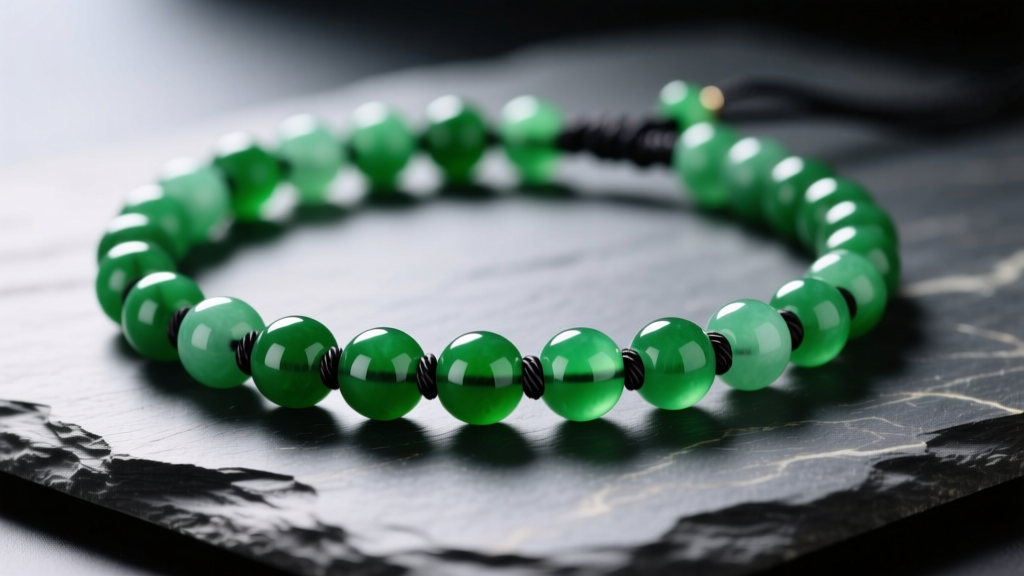
Acquiring a high-quality jade beads necklace is one of the most complex pursuits in the gemological market. Unlike faceted diamonds, which are graded on a universally standardized scale, jade evaluation requires a deep understanding of mineralogy, chemical treatments, and structural craftsmanship. For collectors and enthusiasts in 2026, distinguishing between a generational heirloom and a chemically altered imitation is paramount. This expert deep dive explores the technical specifications, grading metrics, and structural nuances you must evaluate before investing in a jade bead strand.
The Mineralogy of Jade: Nephrite vs. Jadeite Beads
The term 'jade' is a commercial umbrella that covers two distinct silicate minerals: nephrite and jadeite. While both are used in carving, a premium jade beads necklace is almost exclusively crafted from jadeite (sodium aluminum silicate). Nephrite (calcium magnesium iron silicate) possesses a greasy or oily luster and lacks the vitreous, glass-like brilliance required for high-end spherical bead cutting.
From a gemological standpoint, jadeite has a higher refractive index (approximately 1.66) compared to nephrite (1.61), and a higher specific gravity (3.30 to 3.38). When evaluating a strand, the interlocking crystalline structure of jadeite allows light to penetrate and scatter, creating the highly prized internal glow known in the trade as 'water head' (shui tou). Nephrite beads will appear uniformly opaque and flat under direct lighting. According to the Gemological Institute of America (GIA), confirming the base mineral as jadeite is the absolute first step in the authentication process.
The ABCs of Jade Treatments: A Critical Buyer's Framework
The most significant value determinant in a jade beads necklace is its treatment status. The market categorizes jade into Types A, B, C, and B+C. Understanding the chemical reality of these treatments is crucial, as they dictate both the financial value and the long-term structural integrity of the beads.
| Treatment Type | Chemical Process | Structural Impact | Market Value |
|---|---|---|---|
| Type A | Untreated; polished with natural beeswax or plum wax. | Preserves natural crystalline structure. Heirloom durability. | Premium ($5,000 - $100,000+) |
| Type B | Acid-bleached to remove impurities, then vacuum-impregnated with polymer resin. | Destroys natural structure. Resin yellows and degrades over 5-10 years. | Low ($50 - $300) |
| Type C | Dyed with organic or inorganic chemical dyes to enhance green/lavender hues. | Dye fades under UV exposure and concentrates in micro-fractures. | Very Low ($20 - $150) |
| Type B+C | Acid-bleached, dyed, and polymer-filled. | Completely artificial appearance. Brittle and prone to cracking. | Costume Jewelry ($10 - $50) |
Type B and B+C beads are structurally compromised. The hydrochloric acid used in bleaching dissolves the natural mineral matrix, leaving a porous sponge that must be filled with epoxy resin. Over time, this resin oxidizes, turning the once-vibrant beads a sickly yellow, and making them highly susceptible to shattering upon impact. Always demand a spectroscope or FTIR (Fourier Transform Infrared) spectroscopy report from a certified lab to confirm the absence of polymer resins.
Technical Sizing, Tolerances, and Drill Hole Quality
Creating a perfectly matched jade beads necklace requires immense rough material, making bead diameter a primary driver of exponential pricing. Standard necklace beads range from 4mm to 14mm. However, the raw numbers tell only half the story; tolerance is where true quality is revealed.
Diameter Matching and Caliper Tolerances
In a master-crafted strand, the variance between the largest and smallest bead should not exceed 0.2mm. If a necklace is advertised as 10mm, but caliper measurements reveal beads ranging from 9.4mm to 10.6mm, the strand is considered poorly matched, reducing its collectible value by up to 40%. Spherical symmetry is equally critical; out-of-round beads (oval or barrel shapes) indicate lower-tier cutting and will cause the necklace to drape awkwardly on the clavicle.
The Mechanics of Double-Drilling
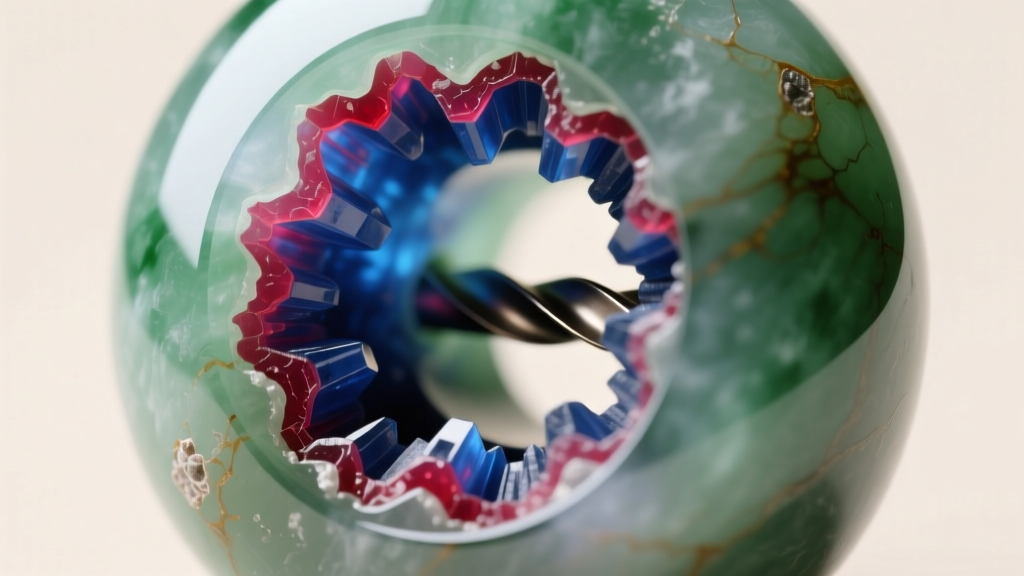
Examine the drill holes of the beads using a 10x jeweler's loupe. High-quality jade beads are double-drilled—meaning the lapidary drills halfway through the bead from one side, then flips it and drills from the exact opposite pole to meet in the center. Single-pass drilling inevitably causes 'blowout' or chipping at the exit point. This microscopic chipping creates a sharp, jagged edge inside the hole that will slowly saw through the stringing silk over time, leading to catastrophic strand failure.
Evaluating Color, Tone, and Translucency
Color in jadeite is evaluated not just by hue, but by tone, saturation, and distribution. For a jade beads necklace, the color must be consistent across dozens of individual stones, a feat that requires cutting from a single, massive, homogeneous boulder.
- Imperial Green: The pinnacle of jadeite. A vivid, highly saturated, medium-dark emerald green with high translucency. Beads of this caliber frequently auction for six figures.
- Apple Green: A lighter, slightly yellowish-green. Highly desirable and more accessible, offering a bright, youthful aesthetic.
- Icy / Glassy: Colorless or near-colorless beads prized for their extreme translucency. The value here lies entirely in the 'water head' and the absence of internal inclusions or 'cotton'.
According to specialists at Mason-Kay, translucency is often more critical than color. A strand of pale but highly translucent 'glutinous' jadeite will command a higher price and age more beautifully than a strand of dark, opaque, emerald-green beads that look like flat plastic.
Stringing Architecture: Silk Knotting vs. Wire
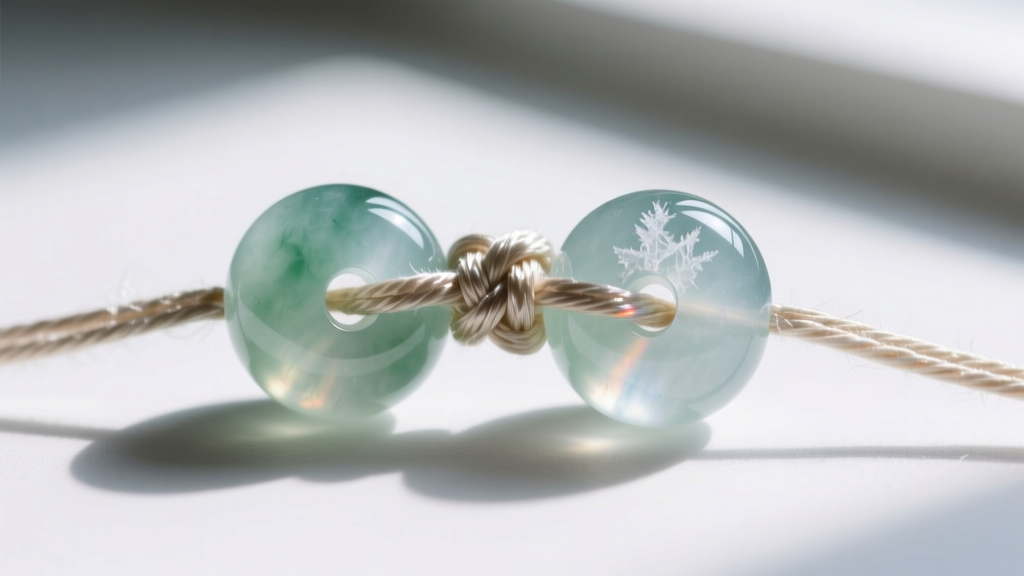
The structural assembly of your jade beads necklace dictates its lifespan. Never purchase a high-value jade strand strung on beading wire or unknotted synthetic cord. The industry standard for heirloom jade is hand-knotted silk.
There must be a micro-macrame knot between every single bead. This serves two vital engineering purposes:
- Friction Prevention: Jadeite is exceptionally hard (6.5 to 7 on the Mohs scale). If beads touch each other without a silk buffer, the constant friction of wear will slowly grind down the edges of the drill holes, creating irreversible damage and a gritty, uneven drape.
- Loss Mitigation: If the silk degrades and snaps, the knots ensure you lose only a single bead rather than watching fifty precious stones scatter across a hard floor.
Inspect the knots closely. They should be tight, uniform, and sit flush against the bead without gaping. The silk color should complement the jade; traditionalists use black or dark brown silk to enhance the green contrast, while icy jade is often strung on white or transparent nylon-silk blends.
Market Pricing and Authentication Checklist
Pricing a jade beads necklace is highly volatile and dependent on auction trends, but baseline metrics exist for Type A jadeite. As of current market valuations, a well-matched 8mm strand of medium-green, semi-translucent Type A jadeite will typically range from $12,000 to $35,000. Conversely, a visually similar Type B+C strand will retail for under $100 in tourist markets.
Before finalizing a purchase, run through this technical checklist:
- Request a Lab Report: Accept only reports from tier-one laboratories (GIA, SSEF, or Gübelin) explicitly stating 'Natural Jadeite' with 'No indications of impregnation or dyeing'.
- Perform the Chelsa Filter Test: While not definitive on its own, a Chelsea filter can help detect the chromium-based dyes used in Type C jade, which will glow pinkish-red under the filter.
- Check the Temperature: Genuine Type A jadeite has high thermal inertia. It should feel noticeably cold to the touch and take several seconds to warm up against your skin, whereas polymer-filled Type B beads will feel room temperature almost immediately.
- Examine Under UV Light: Long-wave UV light will often reveal a chalky blue or green fluorescence in the polymer resins used in Type B jade, while natural Type A jade typically shows no reaction or a very weak, inert response.
Conclusion: Investing in Heirloom Quality
A genuine jade beads necklace is a masterclass in geological rarity and human craftsmanship. By looking past the superficial green hues and interrogating the mineralogy, treatment history, drill-hole geometry, and stringing architecture, you transition from a casual shopper to an informed collector. Prioritize Type A certification, demand strict diameter tolerances, and ensure traditional silk knotting to secure a piece that will not only retain its structural integrity but appreciate in value for generations to come.


