How to Tell if Chrome Heart is Real Necklace: Expert Auth Guide
Master how to tell if Chrome Heart is real necklace jewelry. Our expert guide covers hallmarks, silver weight, chain links, and fakes.

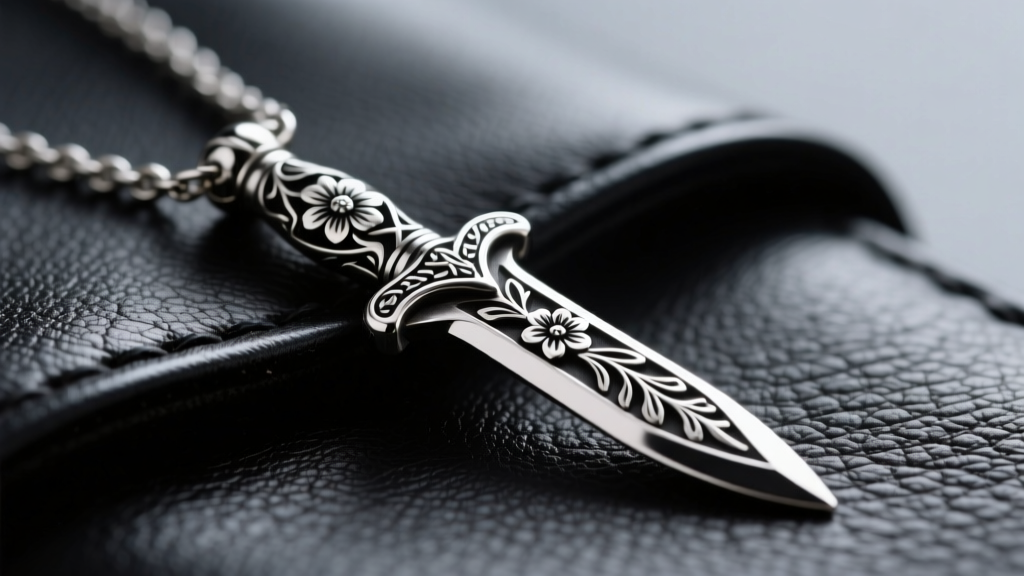
The secondary market for luxury gothic jewelry has exploded, and with it, a flood of highly sophisticated counterfeits. Chrome Hearts, founded by Richard Stark in 1988, remains one of the most coveted and frequently faked silver brands in the world. When learning how to tell if chrome heart is real necklace hardware, you must look far beyond the surface aesthetic. Counterfeiters have mastered the general silhouette of the iconic daggers, crosses, and paperchains, but they consistently fail at the microscopic details of metallurgy, hand-finishing, and hallmark typography.
This comprehensive authentication guide breaks down the exact material grades, weight specifications, and structural anomalies you need to inspect to verify the authenticity of a Chrome Hearts necklace.
The Hallmark Hierarchy: Decoding the Stamps
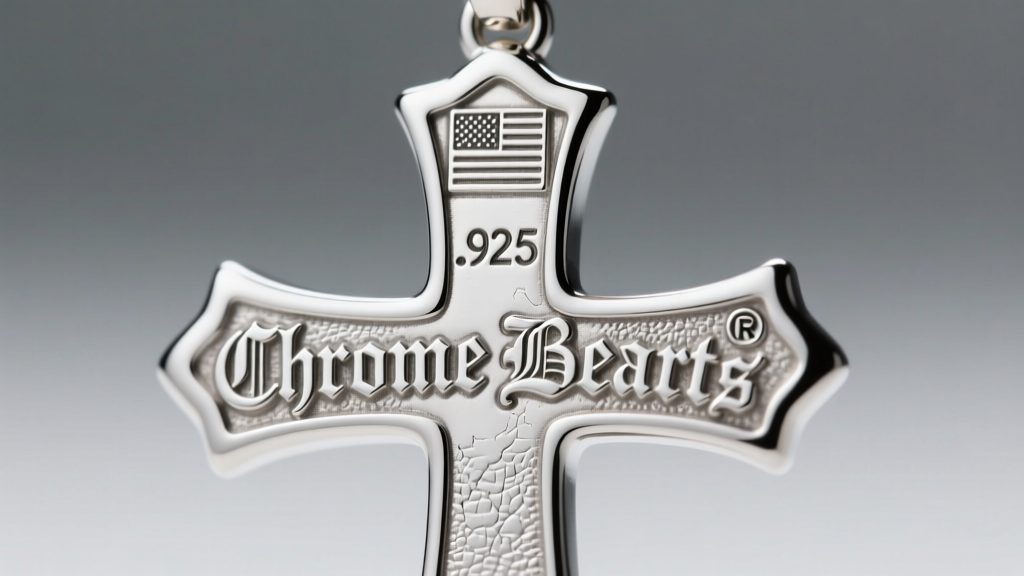
The most immediate way to authenticate a piece is by examining the hallmarks. Genuine Chrome Hearts jewelry is stamped with a specific hierarchy of marks, usually located on the back of the pendant or the clasp of the chain. You should look for four distinct elements: the brand name, the registered trademark symbol, the country of origin, and the silver purity.
Typography and the Registered Trademark
Counterfeiters often use standard sans-serif fonts that mimic the Chrome Hearts logo but fail under magnification. On a genuine piece, the letters in "CHROME HEARTS" are sharply struck with uniform depth. The most glaring tell is the registered trademark symbol (®). On authentic pieces, the 'R' inside the circle is crisp, and its diagonal leg does not touch the outer boundary of the circle. Fakes frequently feature a blurry 'R', an oval-shaped circle, or an 'R' that bleeds into the outer ring due to poor casting molds.
The .925 and USA Stamps
Chrome Hearts uses premium .925 sterling silver. The ".925" stamp should be deeply recessed with clean edges. The "USA" stamp is equally important; while some vintage or specialized collaboration pieces may vary, standard production necklaces will bear the USA mark. According to authentication experts at LegitGrails, the spacing between the USA letters and the surrounding hallmarks is a frequent failure point for fakes, which often crowd the stamps together.
Weight, Dimensions, and Material Density
Sterling silver is a dense, heavy precious metal. Counterfeit rings and pendants are often made from brass, stainless steel, or zinc alloys that are merely plated in silver. Because these base metals have different densities, the weight of the pendant is a massive indicator of authenticity.
Below is a reference table for the approximate weights of genuine Chrome Hearts necklace pendants. Note that minor variations (±2 grams) can occur due to the hand-finished nature of the lost-wax casting process, but significant deviations are an immediate red flag.
| Pendant Style | Approximate Genuine Weight | Common Counterfeit Weight | Material Discrepancy |
|---|---|---|---|
| Small Dagger | 14g - 17g | 8g - 11g | Hollow casting or aluminum alloy |
| Large Dagger | 40g - 45g | 22g - 28g | Zinc alloy with silver plating |
| Plus Cross (Medium) | 22g - 26g | 15g - 18g | Brass core, poor density |
| Fleur de Lis Cross | 30g - 35g | 18g - 22g | Stainless steel base |
Pro Tip: Use a digital jeweler's scale accurate to 0.1 grams. If a Large Dagger feels unusually light or lacks the "cold touch" characteristic of high-purity silver, it is almost certainly a fake.
Analyzing the Chain: Link Soldering and Clasps
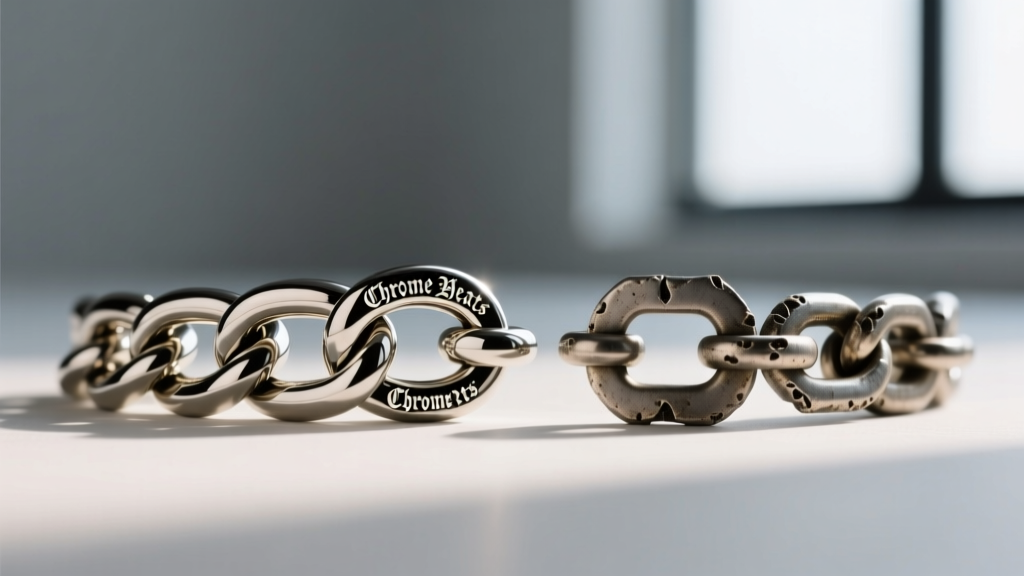
A necklace is only as authentic as its chain. Chrome Hearts produces several iconic chain styles, including the Paperchain, Cuban, and CH Plus chains. Authenticating the chain requires inspecting the link construction and the clasp hardware.
Link Soldering and Seam Integrity
Genuine Chrome Hearts chains feature meticulously soldered links. If you examine a real Paperchain or Cuban link under a loupe, the solder joints are smooth, flush, and virtually invisible to the naked eye. Counterfeit chains are often machine-stamped and left unsoldered, or they feature messy, blob-like solder joints that catch on clothing. Furthermore, authentic links have a distinct, weighted drape; fake chains often feel stiff or produce a hollow, tinny sound when dropped on a glass surface.
The Clasp and Jump Ring
Do not ignore the clasp. Authentic Chrome Hearts lobster clasps and toggle rings will bear their own micro-hallmarks, usually a tiny "CHROME HEARTS" or ".925" stamp. The jump ring connecting the clasp to the chain should be soldered shut on high-end pieces, or at the very least, feature a perfectly flush mechanical closure. Fakes often use cheap, generic brass lobster clasps that lack any stamping whatsoever.
Oxidation, Engraving, and Casting Flaws
Chrome Hearts jewelry is renowned for its dark, moody aesthetic, which is achieved through a chemical oxidation process (often using liver of sulfur) followed by hand-polishing. This leaves the recessed areas black while the raised surfaces shine brightly.
Hand-Engraved Floral Motifs
The floral and scroll motifs on pieces like the Large Dagger or the Plus Cross are not merely cast; they are hand-chased and engraved by artisans in the Hollywood workshop. This results in deep, V-shaped cuts with sharp, distinct edges. Fakes are typically mass-produced using rubber molds taken from a genuine piece. This "mold degradation" results in shallow, U-shaped grooves with rounded, muddy edges. The fine leaves and vines on a fake will look melted or blurred under a 10x jeweler's loupe.
The Antiquing Test
On a genuine piece, the black oxidation is deeply embedded in the silver's pores and crevices. Counterfeiters often use a superficial black spray paint or cheap enamel to mimic the antiqued look. You can test this by taking a soft, damp microfiber cloth and gently rubbing a recessed area. If the black residue easily transfers to the cloth or chips away to reveal bright, unoxidized brass underneath, the piece is counterfeit. For more on the brand's official finishing standards, refer to the Chrome Hearts Official archives.
Red Flags: A Quick Checklist for Buyers
When evaluating a potential purchase on the secondary market, keep this rapid-fire checklist in mind:
- Price Anomalies: Chrome Hearts rarely depreciates. A brand new Large Dagger pendant retails for well over $1,000. If you find one listed for $250, it is a scam.
- The Leather Pouch: Authentic pieces come in a specific cross-embossed leather pouch with a drawstring. Fakes often come in cheap velvet bags or poorly stitched synthetic leather with misaligned cross patterns.
- Casting Seams: Run your fingernail along the outer edge of a cross or dagger. Genuine pieces are hand-filed to be perfectly smooth. Fakes often have a raised, vertical "mold line" running down the side where the two halves of the casting mold met.
- Receipt Verification: Genuine receipts feature specific store stamps, dot-matrix or specialized thermal printing, and exact SKU matching. Fakes often include poorly photoshopped receipts with incorrect fonts or misspelled store locations.
"The craftsmanship of Chrome Hearts lies in the imperfections of the hand-finish, not the perfection of a machine. Fakes look too uniform, too polished, and lack the soul of the Hollywood workshop." — Senior Jewelry Appraiser
Final Verdict: Trust but Verify
Mastering how to tell if chrome heart is real necklace jewelry requires a keen eye and an understanding of silversmithing techniques. While the hallmarks, weight, and link soldering provide a robust framework for authentication, counterfeiters are constantly evolving. If you are making a significant investment on the secondary market, always request high-resolution macro photos of the hallmarks, the clasp, and the engraving crevices. When in doubt, utilize a professional luxury authentication service to guarantee your gothic grail is the real deal.


