Anatomy of a Bee Gold Necklace: Karats, Casting, and Chains
Discover the technical anatomy of a fine bee gold necklace. We break down karat weights, lost-wax casting, enamel types, and chain load capacities.

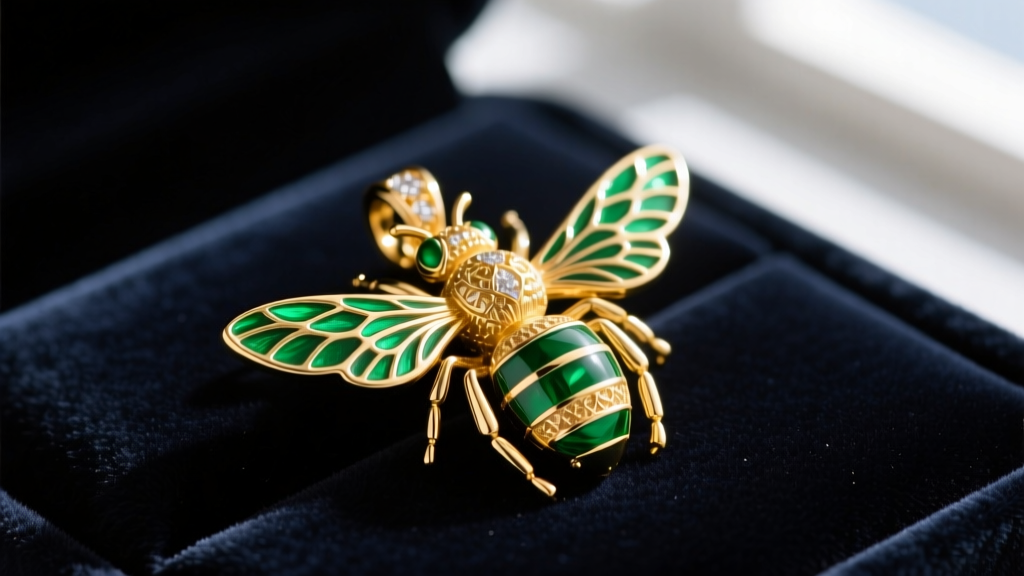
The apiary motif has fascinated jewelers since the Victorian era, symbolizing community, industriousness, and royalty. However, translating the intricate anatomy of an insect into a wearable, durable piece of fine jewelry requires a mastery of micro-sculpture, metallurgy, and structural engineering. A high-quality bee gold necklace is far more than a novelty charm; it is a complex intersection of material science and artisan craftsmanship. In this expert deep dive, we deconstruct the technical specifications that separate heirloom-grade insect pendants from mass-market costume jewelry, examining alloy hardness, casting methodologies, vitreous enamel mechanics, and the physics of chain pairing.
The Metallurgy of the Hive: Choosing the Right Gold Karat
The structural integrity of a bee pendant relies heavily on the gold alloy used. Pure 24k gold (99.9% Au) is far too malleable for the delicate legs, antennae, and stingers characteristic of apiary designs. Jewelers must rely on alloyed gold, balancing color richness with Vickers hardness (HV).
14k Gold (58.3% Au): The Structural Workhorse
14k gold typically contains 58.3% gold, alloyed with silver, copper, and zinc. This composition yields a Vickers hardness of approximately 130–150 HV. For a bee gold necklace featuring highly textured, protruding elements like segmented legs or a detailed stinger, 14k gold is often the superior choice. Its higher copper and zinc content provides the tensile strength necessary to resist bending during daily wear. Furthermore, 14k gold has a slightly lower melting point and excellent fluidity, which is critical when casting the micro-details of a bee’s compound eyes or wing venation.
18k Gold (75% Au): The Canvas for Enamel
18k gold (75% Au) sits at roughly 100–120 HV. While softer and more prone to scratching, its deeper, richer yellow hue is unmatched. More importantly, 18k gold is the metallurgical standard for high-end enameling. The specific thermal expansion rate of standard 18k yellow gold alloys closely matches that of vitreous glass enamels, preventing the glass from cracking or crazing during the firing and cooling process. According to research presented at the Santa Fe Symposium on Jewelry Manufacturing Technology, controlling the coefficient of thermal expansion (CTE) between the precious metal substrate and the glass flux is the single most critical factor in permanent enamel adhesion.
Manufacturing Techniques: Lost-Wax Casting vs. Die Striking
How the pendant is formed dictates its level of detail, weight distribution, and ultimate value. There are two primary methods used to produce a bee gold necklace, and understanding the difference is vital for assessing quality.
Investment (Lost-Wax) Casting
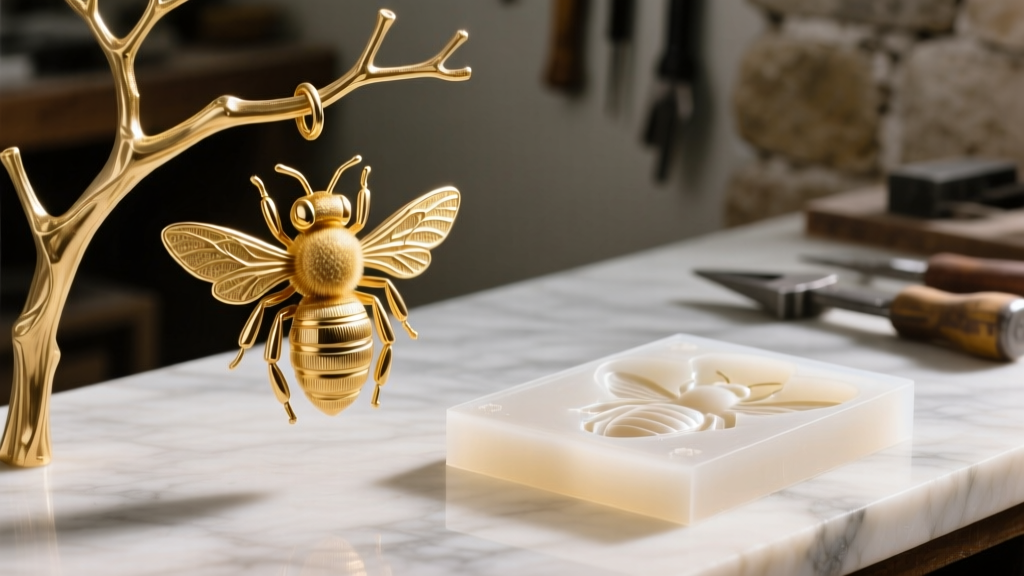
True artisan bee pendants are created via lost-wax casting. A master model is carved or 3D-printed in high-resolution castable resin, then encased in a vulcanized rubber mold to inject wax replicas. These waxes are attached to a central sprue (a wax tree), invested in a plaster-like silica slurry, and burned out in a kiln at 730°C. Molten gold is then forced into the cavity via centrifugal force or vacuum. This method allows for extreme three-dimensional undercuts, such as a bee’s legs wrapping around a honeycomb or a fully sculpted, 360-degree abdomen. When inspecting a cast piece, look closely at the belly of the bee; microscopic pitting or "gas porosity" indicates poor temperature control during the pour, a flaw that compromises structural integrity.
Die Striking and Stamping
Mass-market, lower-priced bee pendants are often die-struck. A sheet of gold is stamped between two hardened steel dies under immense hydraulic pressure. While this compresses the grain structure of the metal (making it very hard), it restricts the design to shallow, two-dimensional bas-relief. Die-struck bees lack undercuts, and the reverse side is typically hollow or flat. While durable, they lack the sculptural depth expected in fine jewelry.
The Art of the Wing: Enamel and Gemstone Inlay Mechanics
The wings and striped abdomen of a bee pendant frequently incorporate color. The technique used to achieve this color drastically affects the necklace's lifespan, value, and care requirements. The GIA Gem Encyclopedia categorizes these techniques into distinct historical and technical tiers.
Guilloché vs. Plique-à-jour
Guilloché involves engine-turning a geometric pattern into the gold wings, then fusing translucent vitreous enamel over the ridges at 800°C. The light catches the metal ridges beneath the glass, creating a shimmering, holographic effect that mimics the iridescence of real insect wings. Plique-à-jour takes this a step further by removing the metal backing entirely, suspending the enamel within a gold cloisonné framework like a stained-glass window. While breathtaking, plique-à-jour is exceptionally fragile; a simple drop onto a hard surface will shatter the glass membranes.
The Cold Enamel Compromise
Many mid-tier manufacturers use "cold enamel" (epoxy resin) to fill the wings and abdomen stripes. While cheap and available in any color, epoxy resin is not glass. It has a Mohs hardness of only 2-3 (compared to vitreous enamel at 5-6), meaning it will scratch easily. Furthermore, cold enamel is susceptible to UV degradation and will inevitably yellow or become brittle over a 10-to-15-year period. Always verify if the color is fired glass or painted resin before investing in a premium piece.
Chain Engineering: Matching Gauge and Clasp to the Pendant
A common failure point in any heavy pendant necklace is the chain and clasp assembly. A solid gold bee pendant, particularly one with a gemstone-set abdomen or thick 18k construction, can easily weigh between 5 and 15 grams. The chain must possess a breaking strength of at least five times the pendant's weight to account for dynamic shock loads (e.g., the pendant swinging and snapping taut).
Bail Friction and Wear
The bail (the loop connecting the bee to the chain) acts as a fulcrum. If a heavy 10g bee is hung on a soft, thin 14k cable chain, the friction will eventually saw through the chain links or the bail itself. To mitigate this, high-end pendants feature a hardened steel or platinum insert inside the gold bail to resist abrasion.
| Pendant Weight | Minimum Chain Width | Optimal Chain Style | Required Clasp Type |
|---|---|---|---|
| 1g – 3g (Delicate) | 0.9mm – 1.1mm | Cable / Box | Spring Ring (5mm) |
| 4g – 8g (Standard) | 1.2mm – 1.5mm | Rope / Curb | Small Lobster (10mm) |
| 9g – 15g (Heavy) | 1.8mm – 2.5mm | Wheat / Figaro | Heavy Lobster (15mm+) |
Spring ring clasps are notoriously unreliable for pendants over 5 grams due to their weak internal tension springs. A heavy-duty lobster clasp, featuring a solid forged lever and a robust internal coil, is mandatory for a substantial bee gold necklace to prevent accidental unclasping and loss.
Pricing Tiers and Authenticity Markers
Navigating the market requires an understanding of how gold weight, labor, and brand premium intersect. Based on current precious metal markets tracked by the World Gold Council, here is what you should expect to pay across different manufacturing tiers:
- Mass-Market / Die-Struck ($150 – $400): Typically hollow-backed, 10k or 14k gold, weighing under 2 grams. Features cold enamel or no color. Mass-produced via stamping.
- Boutique Artisan / Lost-Wax Cast ($600 – $1,800): Solid 14k or 18k gold, 4g to 10g. Features hand-finished guilloché enamel, micro-pavé diamond accents on the wings, and intricate 3D undercuts. Sold by independent jewelers or specialized studios.
- High Jewelry / Heritage Houses ($3,500 – $10,000+): 18k or 22k gold, often incorporating plique-à-jour, cabochon gemstones (like black onyx or lapis lazuli for the abdomen), and articulated, moving wings. Prices are driven by brand heritage and master-level artisan labor.
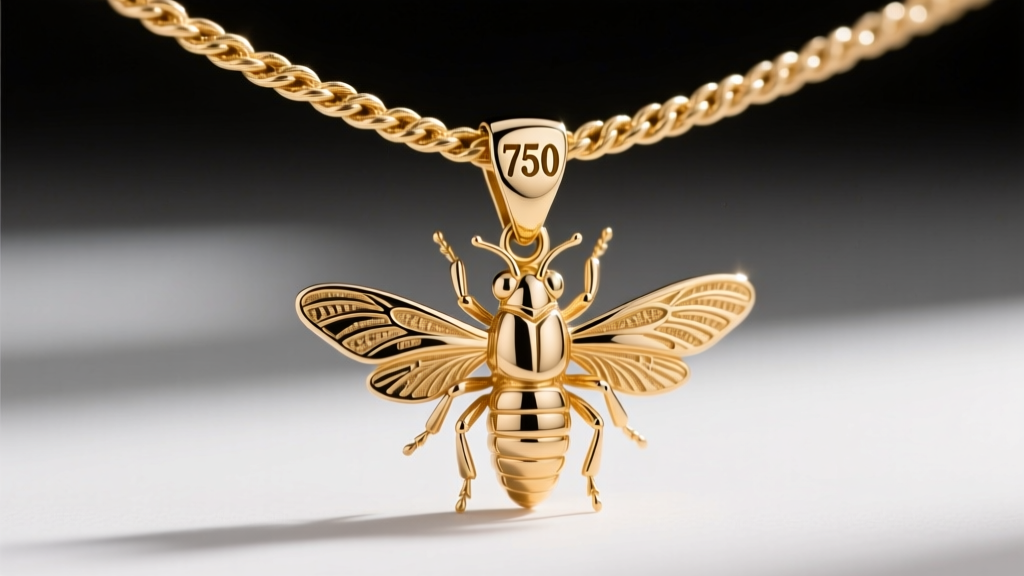
Always inspect the underside of the bail or the back of the bee's thorax for a stamped hallmark (e.g., "585" for 14k, "750" for 18k) alongside a maker's mark. Laser-engraved hallmarks on the chain clasp are acceptable, but the pendant itself should bear a physical stamp to verify its metallurgical claims.
Maintenance and Structural Failure Points
Proper maintenance of a bee gold necklace requires an understanding of its specific vulnerabilities. The most common structural failure is the bending of the antennae or legs. Because these protrusions act as levers, catching them on a sweater can easily bend 18k gold. If a leg bends, do not attempt to bend it back yourself; repeated flexing will cause work-hardening and eventual metal fatigue, snapping the appendage off entirely. Take it to a jeweler for laser welding or careful annealing.
Cleaning requires equal caution. While a plain gold bee can be safely cleaned in a 40kHz ultrasonic cleaner, doing so with an enameled piece is catastrophic. The high-frequency cavitation bubbles will instantly shatter plique-à-jour wings and can cause micro-fractures in guilloché enamel. Furthermore, ultrasonic waves will strip cold epoxy enamel from the metal backing. For enameled or gemstone-set bee pendants, restrict cleaning to a soft-bristled brush, lukewarm water, and a mild, phosphate-free dish soap, gently drying with a microfiber cloth to preserve the optical clarity of the glass and stones.


