The Ultimate Guide to Buying a Big Gold Chain Necklace
Learn how to choose, price, and style a big gold chain necklace. We cover karats, link styles, weight metrics, and clasp security for beginners.


What Qualifies as a 'Big' Gold Chain?
When jewelers and collectors refer to a big gold chain necklace, they are talking about specific metrics regarding width, weight, and visual presence. A true statement chain typically starts at a minimum width of 5 millimeters (mm) and scales up to 15mm or more for ultra-bold pieces. However, width alone can be deceptive. The true measure of a substantial chain is its weight, measured in grams or pennyweights (dwt).
For context, one pennyweight equals approximately 1.55 grams. A standard, lightweight everyday chain might weigh between 5 and 15 grams. A 'big' chain generally begins at the 30-gram mark, with serious statement pieces ranging from 50 grams to well over 150 grams. As you navigate the jewelry market in 2026, understanding these weight metrics is crucial, especially since gold prices are calculated strictly by weight. Buying a chain that looks thick but weighs only 10 grams is a primary indicator that you are looking at a hollow or electroformed piece, which we will discuss later.
Choosing the Right Gold Karat for Heavy Chains
Gold purity is measured in karats (k), with 24k representing 99.9% pure gold. While 24k gold boasts a rich, unmistakable yellow hue, it is a notoriously soft metal. According to the Gemological Institute of America (GIA), pure gold is highly susceptible to scratching, bending, and warping. When you introduce the sheer physical mass and gravitational pull of a heavy chain, a 24k or even 22k link will slowly stretch and deform at the stress points over time.
| Gold Karat | Purity % | Durability for Heavy Chains | Best Use Case |
|---|---|---|---|
| 10K | 41.7% | Excellent (Highly scratch/dent resistant) | Everyday wear, budget-conscious buyers, active lifestyles |
| 14K | 58.3% | Very Good (Ideal balance of strength and color) | The industry standard for heavy Cuban and Franco chains |
| 18K | 75.0% | Good (Softer, requires careful link geometry) | Luxury statement pieces, occasional or evening wear |
| 24K | 99.9% | Poor (Will stretch and warp under heavy weight) | Investment bullion, not recommended for heavy jewelry |
For a beginner buying their first big gold chain necklace, 14k gold is the undisputed sweet spot. It offers enough alloyed metals (like copper, silver, or zinc) to provide structural integrity, ensuring the links won't pull apart under their own weight, while still maintaining a beautiful, warm gold color.
Top Link Styles for Statement Pieces
The geometry of the chain links dictates not only the aesthetic but also the tensile strength and how the chain drapes against the collarbone.
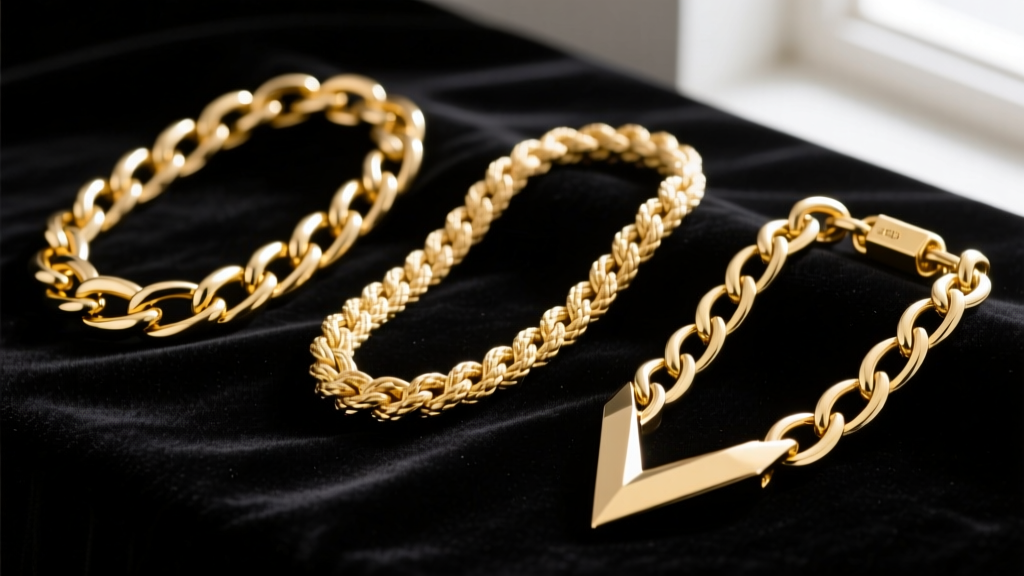
The Cuban Link
The Cuban link is the undisputed king of big gold chains. Characterized by tightly interlocking, flat, oval-shaped links that sit flush against one another, the Cuban chain offers a bold, uniform, and highly reflective surface. Because the links are flat, they distribute weight evenly across the chest, making them incredibly comfortable even at 100+ grams. Furthermore, their interlocking geometry provides excellent resistance to snapping.
The Franco Chain
If durability is your primary concern, the Franco chain is an engineering marvel. Made from V-shaped links woven together in a continuous, 360-degree pattern, Franco chains are virtually indestructible under normal wear. They have a smooth, snake-like drape and are exceptionally good at supporting heavy pendants, though they are often worn solo as a standalone statement piece.
The Rope Chain
Rope chains feature small gold links twisted together to mimic the appearance of a braided rope. While they offer incredible sparkle due to the multitude of light-catching angles, they are more prone to snagging on clothing or body hair. For a big gold chain, a solid, machine-made rope chain is stunning, but ensure it is fully soldered to prevent unraveling if a single link fails.
The Mechanics of Heavy Chain Clasps
A chain is only as strong as its clasp. This is where many beginners make a catastrophic mistake. A standard spring-ring clasp is entirely insufficient for a chain weighing over 20 grams; the internal spring will fail, or the thin wire loop will bend open, resulting in the loss of your investment.
Expert Rule of Thumb: Any solid gold chain exceeding 40 grams must be equipped with a box clasp featuring a secondary safety mechanism, such as a figure-8 wire latch or a side-safety catch.
A box clasp works by sliding a V-shaped metal tongue into a hollow box until it clicks securely into place. This mechanism can bear immense weight without popping open. The secondary figure-8 safety latch acts as an insurance policy; if the primary box clasp accidentally snags and opens, the secondary wire loop keeps the chain secured around your neck.
How to Calculate the Real Price (Avoiding Scams)
As gold prices continue their upward trajectory, understanding how to price a big gold chain necklace is vital to avoid being overcharged. The jewelry industry uses a transparent formula for solid gold chains, and you should too. Always check Kitco's daily gold trackers to find the current spot price of gold per gram for the specific karat you are buying.

The Pricing Formula
(Current Spot Price per Gram × Chain Weight in Grams) + Maker’s Premium = Fair Retail Price
The 'Maker’s Premium' (also known as the making charge) covers the labor, casting, polishing, and retail overhead. For simple machine-made chains like a standard Cuban, a fair premium is between 10% and 25% over the melt value. For intricate, hand-finished, or custom diamond-encrusted chains, the premium can easily exceed 50% to 100%.
The 'Hollow Chain' Trap
Some retailers sell massive, 12mm-wide chains that weigh only 15 grams. These are hollow chains, created using a process called electroforming. While they offer the 'big chain look' for a fraction of the price, they are incredibly fragile. A hollow chain will dent if bumped against a doorframe, cannot be easily repaired if it snaps, and holds virtually no resale value. Always demand a solid chain and verify the weight-to-width ratio. The World Gold Council emphasizes that the intrinsic value of gold jewelry is fundamentally tied to its actual precious metal mass.
Styling Your Statement Chain
A big gold chain necklace commands attention, meaning the rest of your outfit should serve as a canvas rather than a competitor.
- The Neckline: Crew neck t-shirts, turtlenecks, and unbuttoned Oxford shirts provide the perfect framing. Avoid busy patterns or graphic tees that clash with the chain's visual weight.
- The Length: For heavy chains, a 20-inch or 22-inch length is ideal. This places the chain just below the collarbone or at the upper chest, allowing it to drape naturally without choking the neck or swinging too low into the sternum.
- Layering: While layering is popular for delicate chains, a true big gold chain (8mm+) should generally be worn solo. If you must layer, pair it with a much thinner, contrasting chain (like a 2mm box chain) that sits at least two inches above or below the main piece to prevent metal-on-metal friction and scratching.
Investing in a big gold chain necklace is a rite of passage in personal style. By prioritizing solid 14k gold, selecting a structurally sound link pattern like the Cuban or Franco, and insisting on a secure box clasp, you will secure a timeless piece of wearable wealth that will last a lifetime.


