The Black Agate Necklace Trend: 2026 Dark Academia Style Guide
Explore the 2026 black agate necklace trend in dark academia fashion. Get expert styling tips, authenticity checks, and metal pairing guides.

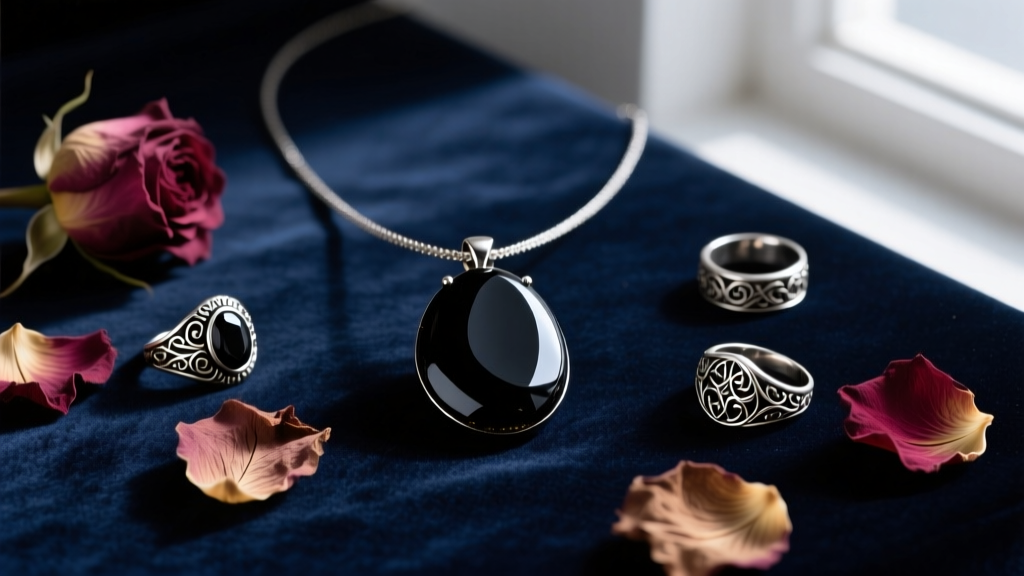
The transition from the ultra-minimalist “quiet luxury” movement of the early 2020s to the moody, intellectual aesthetic of 2026 has fundamentally shifted how we approach fine jewelry. At the forefront of this sartorial evolution is the black agate necklace. No longer relegated to vintage mourning jewelry or bohemian festival wear, black agate has emerged as the cornerstone of the modern dark academia and gothic minimalism wardrobes. Its deep, light-absorbing hue offers a sophisticated alternative to traditional diamonds and pearls, providing a grounding visual weight that anchors both structured tailoring and flowing romantic silhouettes.
The Cultural Resurgence of Dark Minimalism
In 2026, fashion is embracing a more introspective, scholarly aesthetic. The dark academia trend, which romanticizes classic literature, gothic architecture, and vintage tweed, requires jewelry that feels both historical and intentional. A black agate necklace perfectly bridges this gap. Unlike the high-flash dispersion of a brilliant-cut diamond, the vitreous luster of polished agate offers a subtle, glass-like sheen that whispers rather than shouts.
Designers are increasingly utilizing black agate in architectural, geometric pendants and heavy, graduated bead strands. The stone’s opacity makes it an ideal canvas for intricate gold engraving and oxidized silver detailing. Whether worn over a crisp white poplin collar to create stark, graphic contrast, or layered against a charcoal cashmere turtleneck for a tonal, stealth-wealth effect, the black agate necklace is the definitive accessory for the modern intellectual aesthetic.
Gemological Deep Dive: Natural vs. Treated Agate
To truly appreciate and invest in a black agate necklace, one must understand the gemological realities of the stone. According to the Mindat.org mineral database, agate is a cryptocrystalline variety of quartz, ranking at a durable 6.5 to 7 on the Mohs hardness scale. This makes it highly resistant to scratching and ideal for everyday wear. However, naturally occurring, purely black agate is exceptionally rare in nature.
The vast majority of commercial black agate on the market is actually gray or pale chalcedony that has undergone a permanent color enhancement process. As detailed in the GIA Gem Encyclopedia, this is typically achieved through a sugar-acid carbonization treatment. The porous agate is soaked in a hot sugar solution, which penetrates the microscopic crystal structure, and then submerged in concentrated sulfuric acid. The acid dehydrates the sugar, leaving behind microscopic carbon particles that permanently turn the stone a deep, uniform black. While this treatment is stable and universally accepted in the gem trade, it drastically affects the stone's valuation and collector appeal.
| Material Type | Visual Characteristics | Origin & Treatment | Market Value (Per Carat) |
|---|---|---|---|
| Natural Black Agate | Deep black with subtle gray banding or inclusions | Untreated, rare volcanic origin | $15 - $40 |
| Dyed Black Agate | Uniform, pitch-black, highly opaque | Gray chalcedony, sugar-acid treated | $1 - $5 |
| Black Onyx | Parallel banded, pure black | Often dyed, structurally distinct banding | $5 - $12 |
Strategic Metal Pairings for 2026
The metalwork accompanying your black agate necklace dictates its ultimate stylistic trajectory. Because black is achromatic, it relies entirely on the surrounding metal to establish its temperature and mood.
Oxidized Sterling Silver
For a true dark academia or neo-gothic look, oxidized sterling silver is the undisputed champion. The intentional tarnishing of the silver's crevices creates a gritty, antique patina that contrasts beautifully with the high-polish surface of the agate. Look for heavy gauge chains (2.5mm to 4mm) like curb or Figaro links, which provide a masculine, utilitarian edge to the feminine depth of the stone.
14k and 18k Yellow Gold
Yellow gold elevates black agate into the realm of vintage luxury and Art Deco revival. The warm, rich tones of 18k gold create a striking complementary contrast against the cool, void-like black of the stone. Delicate 1.2mm rope chains or intricate gold filigree bezels surrounding a smooth agate cabochon evoke the glamour of 1920s Parisian couture.
The Rose Gold Caveat
Style experts generally advise against pairing black agate with rose gold. The pinkish-copper undertones of rose gold tend to clash with the cool, stark neutrality of black agate, resulting in a muddy, disjointed visual effect. Stick to the high contrast of yellow gold or the moody harmony of oxidized silver.

Length, Layering, and Neckline Architecture
The architectural impact of a black agate necklace depends heavily on its length and how it interacts with the garment's neckline. In 2026, intentional layering and precise length selection are paramount.
- The 16-Inch Choker: A graduated black agate bead choker sits flush against the collarbone. This length is ideal for deep V-necks or off-the-shoulder tops, drawing the eye horizontally and emphasizing the neck's elegance. It works exceptionally well with structured blazers, providing a soft, organic contrast to sharp lapels.
- The 18-Inch Princess: The most versatile length, resting just below the collarbone. An 18-inch black agate pendant necklace is the perfect companion for crewnecks, boatnecks, and button-down shirts. It acts as a central focal point without overwhelming the face.
- The 24 to 30-Inch Opera: A long, single strand of black agate beads or a heavy chain featuring a large agate talisman. This length creates a vertical line that elongates the torso, making it highly flattering over high-necked garments, turtlenecks, and flowing silk slip dresses.
When layering, combine the visual weight of black agate with contrasting textures. A heavy, opaque black agate strand pairs beautifully with a delicate, high-shine 14k gold paperclip chain and a single, luminous freshwater pearl. This triad of textures—matte stone, shiny metal, and organic pearl—creates a rich, multi-dimensional aesthetic that defines the 2026 layering ethos.

Investment & Pricing Guide
When shopping for a black agate necklace, understanding the pricing tiers will protect you from overpaying for treated materials. Because the sugar-acid dyeing process is so prevalent, many fast-fashion and mid-tier brands sell dyed chalcedony at premium natural-stone prices.
Buyer’s Rule of Thumb: If a black agate necklace features perfectly uniform, pitch-black beads with no visible banding, gray undertones, or natural inclusions, and is priced under $50, it is almost certainly dyed. While perfectly fine for fashion jewelry, it should not be marketed or priced as a rare gemological specimen.
For authentic, untreated natural black agate, expect to pay between $150 and $400 for a well-crafted strand, depending on the bead size and polish quality. Artisan pieces featuring hand-carved natural agate cameos or intaglios set in custom 18k gold settings will easily command $800 to $2,500. Ultimately, the value of a black agate necklace in 2026 lies not just in its raw material rarity, but in the craftsmanship of its setting and its powerful ability to anchor the modern, intellectual wardrobe.


