Black Hills Gold Cross Necklace: Metallurgy, Hallmarks & Buying Guide
Discover the metallurgy, karat standards, and authentic hallmarks of a Black Hills Gold cross necklace. An expert guide to tri-color alloys and care.


A Black Hills Gold cross necklace is far more than a simple expression of faith or regional pride; it is a complex metallurgical artifact. Characterized by its striking tri-color foliage—typically grape leaves and vines in rose, green, and yellow gold—this jewelry style requires precise alloying, multi-stage soldering, and specialized texturing techniques. For collectors, jewelers, and buyers seeking an authentic piece, understanding the technical specifications, karat standards, and federal authentication mandates is critical. This deep dive explores the exact science and craftsmanship that define a genuine Black Hills Gold cross pendant.
The Metallurgy of Tri-Color Gold: Alloy Compositions
To achieve the signature pastel hues of Black Hills Gold, master metallurgists must manipulate the atomic lattice of pure 24-karat gold by introducing specific alloying metals. Pure gold is inherently yellow and too malleable for intricate jewelry work. According to the Gemological Institute of America (GIA), altering the color and structural integrity of gold requires precise ratios of copper, silver, and zinc.
- Green Gold (Electrum Variations): The distinctive pale green hue is achieved by alloying gold primarily with silver, often with trace amounts of zinc to prevent oxidation and brittleness. A typical 12-karat green gold alloy contains roughly 50% pure gold, 40-45% silver, and 5-10% zinc.
- Rose Gold: The warm, pinkish-red tone is created by increasing the copper content. A 12-karat rose gold leaf usually consists of 50% pure gold and 45-50% copper, with a minor silver additive to stabilize the color and prevent the copper from tarnishing too rapidly.
- Yellow Gold Base: The central cross or base plate is traditionally cast or stamped in standard yellow gold, alloyed with a balanced mix of silver and copper to maintain a rich yellow tone while providing the tensile strength needed to support the soldered foliage.
The visual contrast in a high-quality Black Hills Gold cross necklace is not just about color; it is about light reflection. The leaves are typically 'diamond-cut'—faceted with sharp engraving tools to catch the light—while the background base plate is sandblasted or acid-etched to create a matte, frosted finish. This juxtaposition of high-polish facets against a matte background is a hallmark of premium manufacturing.

Karat Standards: Why 10K and 12K Dominate the Foliage
A common misconception among novice buyers is that higher karat weights always equate to higher quality. In the context of Black Hills Gold, this is metallurgically false. While the base of the cross might be cast in 14K gold for structural rigidity, the intricate leaves and vines are almost universally crafted in 10K or 12K gold. There are two vital engineering reasons for this:
1. Color Saturation and Alloy Thresholds
To achieve a visible green or rose tint, the alloying metals (silver and copper) must comprise a significant percentage of the total mass. If a jeweler attempts to make an 18K green gold leaf, the 75% pure gold content will completely overpower the silver, resulting in a faint, sickly yellow-green that lacks the vibrant pastel contrast required for Black Hills Gold aesthetics. At 12K (50% pure gold), the silver and copper ratios are high enough to produce vivid, distinct colors.
2. Soldering and Thermal Dynamics
Assembling a tri-color cross involves attaching dozens of individual leaves and vines to the base plate. This requires torch soldering. If the leaves were 18K or 24K, their melting points would be too close to the melting point of the solder itself. The heat required to flow the solder would melt or warp the delicate leaf edges. 10K and 12K alloys have lower melting points and higher thermal stability, allowing artisans to use 'hard,' 'medium,' and 'easy' solders in sequence without compromising the structural integrity of the previously attached components.
Authenticating Your Piece: FTC Mandates and Hallmarks
The term 'Black Hills Gold' is not a generic descriptor for tri-color jewelry; it is a legally protected geographic designation. In the 1970s, the Federal Trade Commission (FTC) ruled that for jewelry to be marketed as Black Hills Gold, it must be manufactured in the Black Hills region of South Dakota. Furthermore, the designs must adhere to the traditional grape leaf and vine motifs.
When evaluating a Black Hills Gold cross necklace, you must look for the manufacturer's hallmark stamped discreetly on the bail or the back of the cross plate. Below is a technical breakdown of the major legacy manufacturers and their identifying marks:
| Manufacturer | Common Hallmark | Established | Technical Specialty |
|---|---|---|---|
| Landstrom's | L, Landstrom's | 1987 (Legacy to 1870s) | Pioneers of the diamond-cut faceting technique and proprietary anti-tarnish alloys. |
| Coleman Black Hills Gold | Coleman, CBHG | 1985 | Known for heavy-cast 14K bases and intricate, multi-layered vine soldering. |
| Mount Rushmore Gold | MRG | 1930s | Specializes in high-relief stamping and deep sandblasted background textures. |
| Stamper Black Hills Gold | Stamper | 1970s | Focuses on traditional, heritage grape leaf patterns with high-copper rose gold. |
For a comprehensive look at the heritage and origins of these manufacturing standards, Landstrom's Black Hills Gold Heritage provides extensive archival documentation on the evolution of these regional techniques.
Chain Pairing Mechanics for Heavy Pendants
Black Hills Gold crosses are notoriously dense. Because the foliage is created through die-stamping and subsequent hand-soldering, the resulting pendant is essentially a multi-layered composite of solid gold. A standard 1.5-inch tri-color cross pendant can easily weigh between 4.5 and 8.5 grams. Pairing this with the wrong chain is a primary cause of jewelry failure.
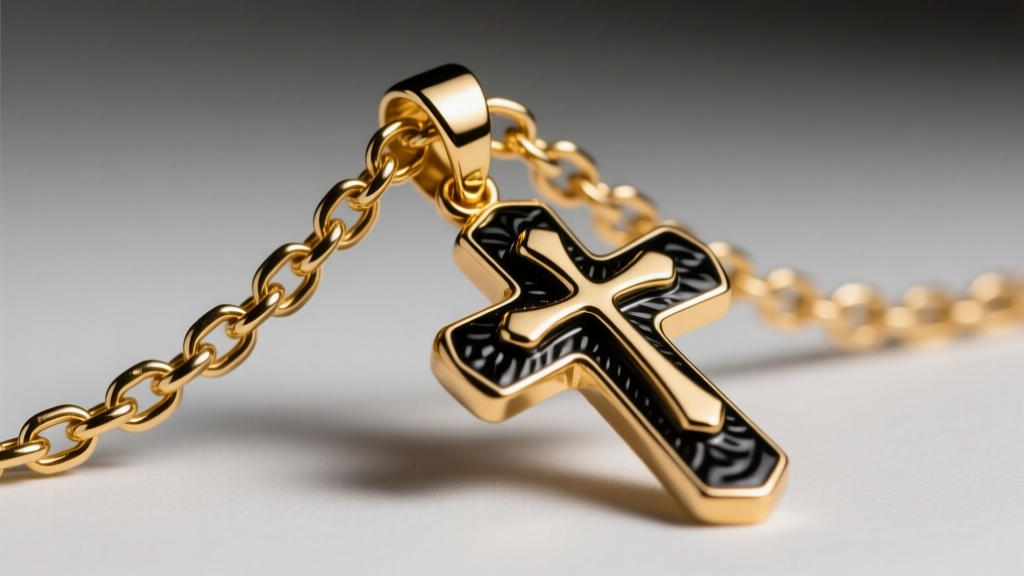
Recommended Chain Architectures
- Box Chains (1.2mm - 1.8mm): The interlocking square links provide exceptional tensile strength and distribute the pendant's weight evenly. A 14K or 10K yellow gold box chain is the industry standard for BHG crosses.
- Wheat (Spiga) Chains: Woven in a braided pattern, wheat chains offer high flexibility and immense weight-bearing capacity, making them ideal for larger, 2-inch cathedral-style crosses.
- Rope Chains (2.0mm+): While aesthetically pleasing, rope chains must be of a substantial gauge to prevent the twisted links from unraveling under the pendulum motion of a heavy cross.
Chains to Avoid
Snake Chains and Herringbone Chains: These rely on a continuous, flush-surface linkage that is highly susceptible to kinking. The concentrated weight of a Black Hills Gold cross pulling against the bail will quickly deform the micro-links of a snake chain, leading to irreversible structural damage.
Expert Maintenance: Preserving the Tri-Color Patina
The maintenance of a Black Hills Gold cross necklace requires an understanding of its composite nature. Because the piece consists of multiple alloys soldered together, thermal shock and harsh chemical exposure can cause micro-fractures at the solder joints.
Ultrasonic Cleaning Risks: While ultrasonic cleaners are excellent for removing sebum and lotion from standard gold chains, they pose a specific risk to Black Hills Gold. The high-frequency vibrations can exploit microscopic weaknesses in the hard solder joints connecting the delicate leaves to the base plate. If your cross has vintage soldering or visible wear, avoid ultrasonic cleaning entirely.
Chemical Exposure: The copper content in the rose gold leaves makes them susceptible to oxidation when exposed to chlorine (e.g., swimming pools) or household bleach. This can result in a dark, irreversible patina on the rose elements. Clean your necklace using only a mild, phosphate-free dish soap, warm distilled water, and a remarkably soft baby-hair brush to gently agitate the sandblasted background crevices without scratching the diamond-cut facets.
By understanding the precise alloy compositions, respecting the FTC's geographic mandates, and pairing your pendant with a structurally sound chain, you ensure that your Black Hills Gold cross necklace remains both a metallurgical triumph and a lasting heirloom.


