Black Onyx and Diamond Necklace: Material Properties & Care
Discover the material properties, durability, and care requirements of a black onyx and diamond necklace. Expert guide on settings and maintenance.

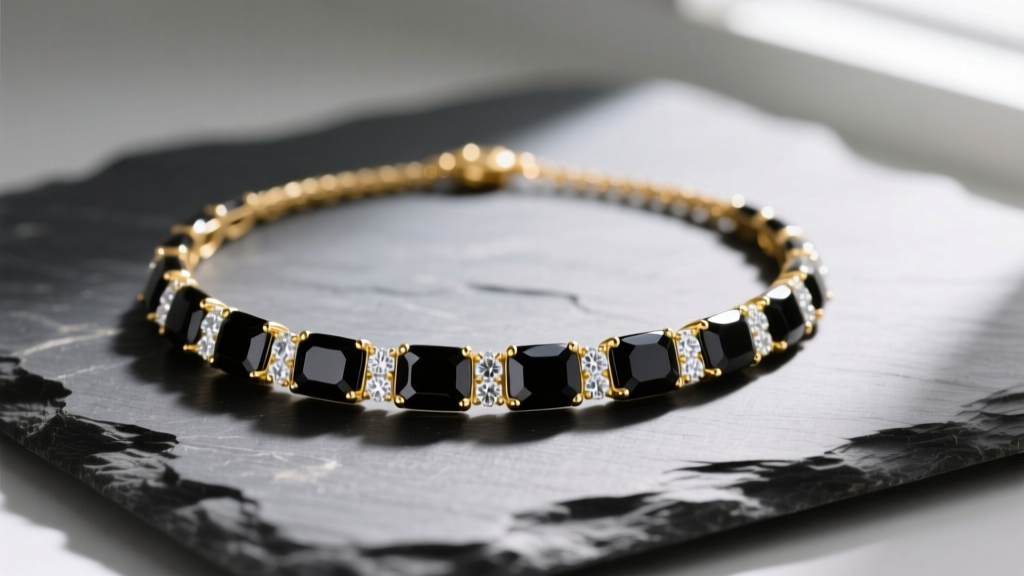
The Crystallographic Juxtaposition
When evaluating a black onyx and diamond necklace, you are looking at a masterclass in material contrast. From a gemological perspective, these two stones sit on opposite ends of the mineralogical spectrum. Diamond is pure carbon (C) crystallizing in the isometric (cubic) system, formed under extreme heat and pressure deep within the Earth's mantle. Black onyx, conversely, is a microcrystalline variety of quartz (SiO2) belonging to the trigonal crystal system. Specifically, true onyx is defined by its parallel banding, distinguishing it from the curved banding of agate, though commercial jewelry frequently uses the term interchangeably for heavily treated banded chalcedony.
This fundamental chemical divergence dictates everything from how the stones interact with light to how they must be engineered into a cohesive pendant. Understanding these properties is critical for collectors and buyers who want to ensure their necklace withstands daily wear without compromising its structural integrity or aesthetic brilliance.
Optical Physics: Refractive Index and Luster
The visual impact of a black onyx and diamond necklace relies entirely on optical physics. Diamond possesses a remarkably high Refractive Index (RI) of 2.417 and a dispersion rate of 0.044, which yields its signature adamantine luster and fiery brilliance. Light enters the stone, bends sharply, and reflects internally before exiting back to the viewer's eye.
Black onyx, with an RI of 1.530 to 1.540, operates on a completely different optical principle. Because it is heavily included with carbon or has been artificially carbonized, it is entirely opaque. It does not transmit light; it absorbs it. The luster of polished onyx is vitreous to waxy. When paired together, the high-dispersion brilliance of the diamonds creates a striking visual halo against the light-absorbing void of the onyx. This high-contrast interplay is why Art Deco jewelers favored this exact pairing in the 1920s, and it remains a staple in modern high jewelry.
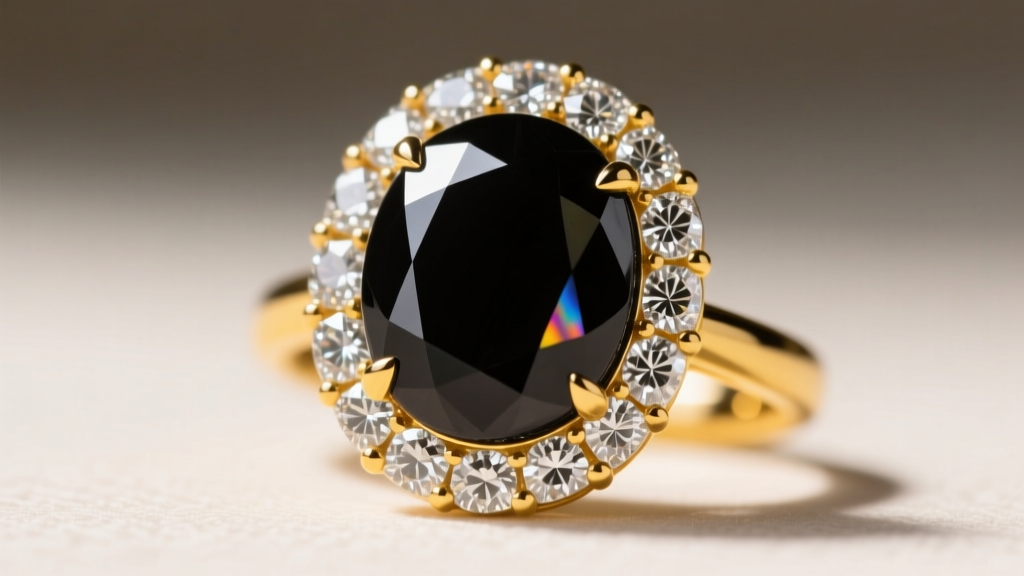
Mohs Hardness vs. Toughness: A Durability Breakdown
A common misconception in jewelry is conflating hardness with toughness. Hardness measures scratch resistance, while toughness measures impact resistance and structural cohesion. This distinction is the most critical factor in designing and wearing a black onyx and diamond necklace.
| Material Property | Diamond (Accent Stones) | Black Onyx (Center Stone) |
|---|---|---|
| Chemical Composition | Carbon (C) | Silicon Dioxide (SiO2) |
| Mohs Hardness | 10 (Absolute maximum) | 6.5 - 7.0 |
| Toughness | Good (but has cleavage planes) | Fair (Brittle, no cleavage) |
| Specific Gravity | 3.52 | 2.60 - 2.65 |
| Cleavage/Fracture | Perfect octahedral cleavage | No cleavage; conchoidal fracture |
While diamond is virtually scratch-proof, it possesses perfect octahedral cleavage, meaning a sharp, direct blow to a specific crystallographic plane can split the stone. Onyx lacks cleavage, meaning it breaks in irregular, curved patterns (conchoidal fracture). However, onyx is notably brittle. Dropping an onyx pendant on a hard tile floor can easily result in chipping or a complete fracture, a failure mode rarely seen in diamonds.
The Reality of Sourcing: Natural vs. Treated Onyx
According to the Gemological Institute of America (GIA), naturally occurring pure black onyx is exceptionally rare. The vast majority of black onyx used in modern necklaces begins its life as light gray or white banded agate. To achieve the deep, uniform black hue required for high-contrast diamond pairings, the material undergoes a permanent thermal and chemical treatment known as the 'sugar process.'
Gemological Insight: The agate is boiled in a concentrated sugar solution, allowing sucrose to penetrate the porous microcrystalline structure. It is then submerged in hot sulfuric acid, which carbonizes the sugar, leaving behind permanent black carbon deposits within the stone's pores. This treatment is universally accepted in the gem trade and does not negatively impact the stone's long-term stability, provided it is cared for correctly.
When purchasing a black onyx and diamond necklace, buyers should not view this treatment as a deception, but rather as a necessary gemological process to achieve the desired aesthetic. However, the presence of these carbon deposits and residual porosity dictates strict limitations on how the stone can be cleaned and maintained.
Setting Mechanics: Protecting the Softer Stone
Because onyx is significantly softer and more brittle than diamond, the metalwork of the necklace must be engineered to absorb kinetic shock. The setting style is not merely an aesthetic choice; it is a structural necessity.
- Bezel Settings (Highly Recommended): A full or partial bezel wraps a rim of gold or platinum entirely around the girdle of the onyx cabochon. This protects the most vulnerable edges from lateral impacts and prevents the stone from popping out if the necklace is snagged.
- Prong Settings (Use with Caution): While prongs maximize light exposure for diamonds, they leave the edges of an onyx stone exposed. If prongs are used for the center onyx, they should be wide, flat 'V-prongs' positioned over the corners of the stone to distribute pressure and guard against chipping.
- Channel Settings: Ideal for the diamond accents on the necklace bail or surrounding halo. Channel setting protects the diamond girdles while providing a secure, flush mount that won't snag on clothing.
Specific Gravity and Chain Engineering
An often-overlooked aspect of necklace design is specific gravity (SG). Diamond has an SG of 3.52, making it relatively dense. However, a large black onyx cabochon (SG 2.60) possesses significant volume and mass. A 30mm x 20mm oval onyx cabochon will feel surprisingly heavy on the neck.
If the pendant is suspended on a delicate 0.8mm box chain, the weight discrepancy will cause the chain to kink, stretch, or eventually snap at the soldered jump rings. For a substantial black onyx and diamond pendant, experts recommend a minimum chain thickness of 1.5mm to 2.0mm, utilizing robust link styles such as rope, wheat, or heavy cable chains. The bail (the loop connecting the pendant to the chain) must also be cast with a reinforced inner lining to prevent the heavy onyx from wearing through the metal over years of friction.
Maintenance: The Ultrasonic Cleaner Danger
The most common cause of catastrophic failure in black onyx jewelry is improper cleaning. As noted by gemologists at GIA's diamond care guidelines, diamonds can withstand harsh chemicals and ultrasonic vibrations. Black onyx cannot.
Never place a black onyx and diamond necklace in an ultrasonic cleaner. The high-frequency acoustic cavitation bubbles generated by ultrasonic machines create microscopic shockwaves. Because treated onyx is porous and contains carbon deposits, these shockwaves can cause internal fracturing along the stone's natural banding planes. Furthermore, steam cleaners can force moisture and heat into the microscopic pores, potentially altering the stone's surface luster or causing the carbonized inclusions to shift, leading to a dull, patchy appearance.
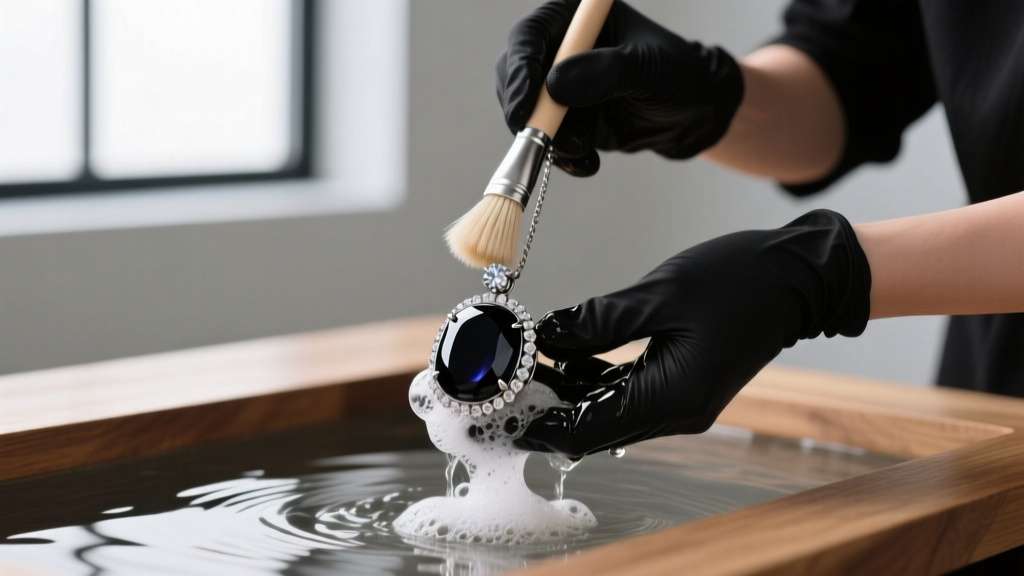
The Correct Cleaning Protocol:
- Mix a few drops of mild, phosphate-free dish soap in lukewarm (never hot) water.
- Submerge the necklace for no more than 3 to 5 minutes.
- Gently agitate the diamond accents with a baby-soft toothbrush to remove sebum and lotion buildup.
- Do not scrub the onyx aggressively; simply let the soapy water lift surface oils.
- Rinse under a gentle stream of tepid water and pat dry with a microfiber cloth.
Market Pricing Tiers for Black Onyx and Diamond Necklaces
Pricing for these necklaces is heavily skewed by the diamond carat weight and the karat of the precious metal used, as commercial-grade black onyx is relatively inexpensive. Here is a breakdown of what to expect in the current market:
- Entry-Level ($300 - $800): Features sterling silver or 10k/14k gold. The onyx is standard commercial grade (dyed agate), and the diamond accents are melee stones (under 0.10 ctw) with I1-I2 clarity. Often mass-produced with cast-in-place stones.
- Mid-Range ($800 - $2,500): Crafted in 14k or 18k gold. Features precision-cut onyx cabochons with excellent polish and bezel settings. Diamond halos or accents range from 0.25 to 0.75 ctw, typically in the SI1-SI2 clarity range with G-H color.
- Fine & High Jewelry ($2,500 - $10,000+): Designer or bespoke pieces utilizing platinum or 18k gold. Features hand-carved onyx, intricate milgrain detailing, and high-quality diamonds (VS clarity, E-F color) exceeding 1.00 ctw. Brands like David Yurman or vintage Cartier pieces frequently occupy this tier.
Final Verdict
A black onyx and diamond necklace is an exercise in balanced extremes. The diamond provides immortal brilliance and scratch resistance, while the onyx offers deep, grounding opacity and a canvas for striking geometric design. By respecting the material limitations of the softer quartz variant—specifically through protective bezel settings, robust chain selection, and strict avoidance of ultrasonic cleaners—collectors can ensure this high-contrast masterpiece remains structurally sound and visually arresting for generations.


