Boxed Chain Necklace Materials: Silver, Gold & Steel Compared
Compare sterling silver, solid gold, and stainless steel for your boxed chain necklace. Discover gauge strengths, durability, and pricing.

The Anatomy of a Boxed Chain Necklace: Why Material Matters
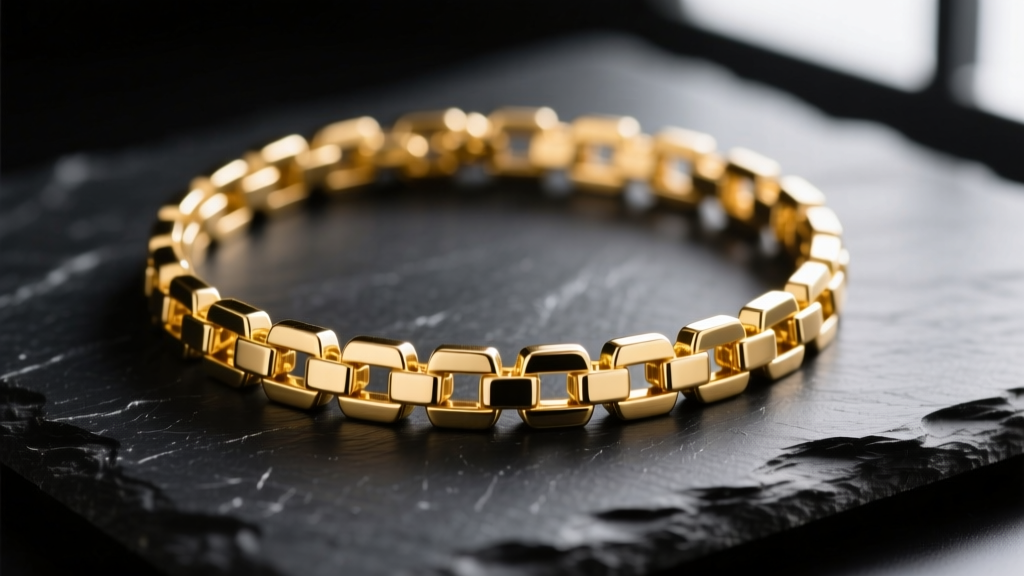
The boxed chain necklace—often referred to in the industry as a Venetian chain—is a masterclass in geometric jewelry design. Unlike cable or curb chains that rely on rounded, overlapping loops, a box chain is constructed from square wire that is stamped, folded, and interlocked into a continuous series of cubic links. This creates a sleek, modern, and highly reflective surface that is unparalleled in its ability to catch the light. However, this very structure introduces unique metallurgical vulnerabilities. The 90-degree inner corners of each link act as stress concentrators. When subjected to tensile strain or lateral bending, the material properties of the metal dictate whether the chain will gracefully endure the stress, permanently deform, or catastrophically snap.
Choosing the right metal for a boxed chain necklace is not merely an aesthetic decision; it is a structural necessity. A metal that performs beautifully in a rounded cable chain might fail prematurely in a box chain due to the sharp angles and friction points inherent in the Venetian weave. In this comprehensive material comparison, we analyze the exact metallurgical properties, gauge requirements, and real-world failure modes of the most popular metals used in box chains today.
Metal-by-Metal Breakdown: Durability and Properties
Sterling Silver (925): The Classic but Delicate Choice
Sterling silver is an alloy comprising 92.5% pure silver and 7.5% copper. The addition of copper is essential, as pure silver (999) is far too soft to hold the rigid square shape of a box link. According to data from Rio Grande Jewelry Supply, annealed 925 sterling silver has a Vickers Hardness (HV) of roughly 65. While work-hardening during the manufacturing process can push this to 100+ HV, it also introduces brittleness. In a boxed chain necklace, sterling silver is highly susceptible to "accordion stretching." If a heavy pendant swings and creates sudden tensile shock, the soft silver links can pull apart and fail to compress back into their original cubic formation. For silver box chains, a minimum gauge of 1.5mm is strongly recommended to compensate for the metal's lower tensile strength.
Stainless Steel (316L): The Indestructible Workhorse
Marine-grade 316L stainless steel contains 16-18% chromium, 10-14% nickel, and 2-3% molybdenum, granting it exceptional corrosion resistance and a Vickers Hardness of 150-200 HV. When crafted into a boxed chain necklace, 316L steel is virtually impervious to stretching. You can hang a 50-gram pendant from a 1.2mm steel box chain, and the links will not deform. However, this extreme rigidity is a double-edged sword. Steel lacks malleability; if a box link is bent sharply past its yield point (such as being kinked in a jewelry box), it will snap rather than bend. Furthermore, steel chains are typically finished with PVD (Physical Vapor Deposition) coatings for color variations like black or rose gold, which can wear off at the high-friction inner corners of the links over several years of daily use.
Solid Gold (14K vs 18K): Balancing Luxury and Tensile Strength
When investing in a luxury boxed chain necklace, understanding gold alloys is critical. Pure 24K gold is entirely unsuitable for chains. The Gemological Institute of America (GIA) notes that 18K gold (75% pure gold) has a Vickers Hardness of approximately 110 HV, making it relatively soft and prone to stretching in a Venetian weave. Conversely, 14K gold (58.5% pure gold) is alloyed with higher percentages of copper, silver, and zinc, raising its hardness to roughly 130-140 HV. For a box chain, 14K gold is metallurgically superior. The higher alloy content provides the necessary tensile strength to maintain the structural integrity of the square links while still offering the rich, luxurious luster expected of fine jewelry.
Titanium (Grade 23): The Hypoallergenic Lightweight
Grade 23 Titanium (Ti-6Al-4V ELI) is an aerospace-grade alloy that offers an incredible strength-to-weight ratio. A 2.0mm titanium boxed chain necklace weighs roughly 45% less than an identically sized 316L stainless steel chain, making it exceptionally comfortable for all-day wear. It is also 100% hypoallergenic and impervious to tarnish. The primary drawback of titanium is its repairability. Because titanium oxidizes instantly when exposed to high heat in the presence of oxygen, it cannot be soldered with a standard jeweler's torch. If a titanium box chain breaks, it requires specialized laser welding in an argon gas chamber, meaning many local bench jewelers will simply refuse to repair it.
Gauge Thickness vs. Metal Hardness: The Golden Ratio
The gauge (thickness) of the wire used to stamp the box links must be inversely proportional to the softness of the metal. Below is a structural matrix to help you select the correct gauge based on your intended pendant weight and material choice.
| Gauge (mm) | Chain Classification | Ideal Metals | Max Pendant Weight | Structural Vulnerability |
|---|---|---|---|---|
| 0.8mm - 1.0mm | Micro / Delicate | 14K Gold, Steel | Under 5 grams | High risk of kinking and clasp ring failure. |
| 1.2mm - 1.5mm | Standard / Everyday | All Metals | 5g - 15g | Silver may stretch over time; Gold/Steel remain stable. |
| 1.8mm - 2.2mm | Heavy / Statement | Silver, Steel, Titanium | 15g - 35g | Stiff drape; can cause neck fatigue if worn in heavy steel. |
| 2.5mm+ | Statement / Standalone | Steel, Titanium | Standalone wear | Extremely rigid; prone to snapping if folded sharply. |
Common Failure Modes in Box Chains (And How to Avoid Them)
To maximize the lifespan of your boxed chain necklace, you must understand how these specific chains fail. The Jewelers of America organization frequently cites improper storage and pendant-mismatching as the leading causes of chain degradation.
- Accordion Stretching: Exclusive to softer metals like sterling silver and 18K gold. This occurs when the chain is pulled sharply, causing the interlocking boxes to separate and lose their friction-fit. Prevention: Never wear soft metal box chains thicker than 1.2mm with heavy pendants, and never sleep in them.
- Lateral Kinking: Box chains are designed to flex in a single plane (up and down). If the chain is twisted laterally and folded upon itself, the square links will bend out of their geometric alignment, creating a stiff, damaged "kink" that catches on clothing. Prevention: Always store box chains laid perfectly flat or hanging vertically from a dedicated jewelry stand.
- Jump Ring Fatigue: The weakest point of any box chain is the soldered jump ring connecting the lobster clasp to the final box link. The sharp edge of the box link can act like a file, slowly sawing through the jump ring over years of friction. Prevention: Have a jeweler inspect the clasp jump ring annually and upgrade to a thicker, hard-soldered oval jump ring if necessary.
2026 Pricing Guide: What You Should Actually Pay
Pricing for a boxed chain necklace varies wildly based on material spot prices, manufacturing complexity, and brand markup. For a standard 18-inch to 20-inch chain in a versatile 1.5mm gauge, expect the following retail pricing tiers in the current market:
- Sterling Silver (925): $45 to $95. (Beware of prices under $30, which often indicate silver-plated brass cores that will eventually peel at the link corners).
- Stainless Steel (316L): $25 to $65. (Higher prices usually reflect premium PVD color coatings or branded clasps).
- 14K Solid Gold: $500 to $950. (Gold box chains are priced strictly by gram weight plus a manufacturing premium. The complex stamping of Venetian links commands a higher labor cost than simple cable chains).
- Titanium (Grade 23): $80 to $160. (CNC-machined titanium links with integrated custom clasps will push the price toward the higher end of this spectrum).
Final Verdict: Choosing Your Ideal Box Chain
The perfect boxed chain necklace requires a harmonious balance between your aesthetic preferences, your budget, and the physical demands of your daily lifestyle. If you desire a delicate, luxurious chain for a lightweight diamond solitaire pendant, a 1.0mm 14K solid gold box chain is the undisputed champion, offering the necessary hardness to prevent stretching while maintaining a brilliant, faceted sparkle. For everyday, heavy-duty wear where the chain is meant to be a standalone statement piece, a 2.0mm 316L stainless steel or Grade 23 titanium box chain provides indestructible rigidity and a modern, industrial weight.
Expert Maintenance Tip: Never use ultrasonic cleaners on oxidized or antiqued silver box chains. The high-frequency vibrations can loosen the microscopic friction-fits of the square links and strip the intentional dark patina from the inner corners, ruining the chain's three-dimensional contrast. Stick to a soft microfiber cloth and mild dish soap for routine cleaning.