Care & Cleaning Guide for a 24k Gold Necklace Women Wear
Learn expert metallurgical care, safe cleaning protocols, and storage rules to protect the luster and structure of your pure 24k gold jewelry.

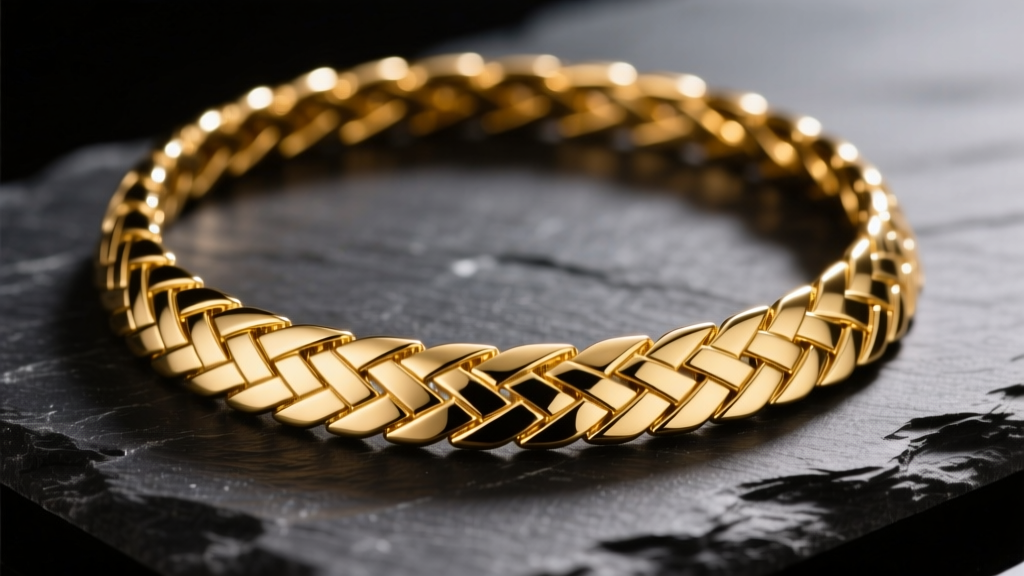
Owning pure, 99.9% gold jewelry is an investment in both luxury and elemental beauty. However, when investing in a 24k gold necklace women often wear as a daily luxury or heirloom piece, standard jewelry care advice falls dangerously short. Pure gold behaves entirely differently than the 14k or 18k alloys most jewelers are trained to service. Its extreme softness, unique luster, and structural vulnerabilities require a highly specialized maintenance protocol to prevent irreversible stretching, micro-scratching, and clasp failure.
In this comprehensive 2026 guide, we bypass generic cleaning tips and dive deep into the metallurgical realities of 24k gold, providing you with an expert-level framework for cleaning, storing, and preserving your pure gold necklaces.
The Metallurgical Reality: Why 24k Gold Demands Special Care
To understand how to care for 24k gold, you must first understand its physical properties on the Vickers Hardness (HV) scale. Standard 14k gold, alloyed with copper, silver, or zinc, sits at approximately 135 HV. Pure 24k gold, however, registers at a mere 25 to 30 HV. This makes it roughly five times softer than its alloyed counterparts and comparable in hardness to a human fingernail or pure lead.
Because of this extreme malleability, 24k gold does not 'tarnish' in the traditional sense—it is a noble metal and highly resistant to oxidation. However, it is profoundly susceptible to mechanical deformation. A delicate 20-gauge 24k chain can permanently stretch under the weight of a heavy pendant, and a high-polish 24k herringbone chain will accumulate microscopic surface scratches from friction against clothing, gradually dulling its mirror-like finish into a matte, satin appearance.
The Step-by-Step 24k Cleaning Protocol
According to the Jewelers of America, the safest way to clean high-purity gold at home relies on gentle chemical lifting rather than mechanical abrasion. Follow this exact protocol to remove sebum, lotions, and environmental dust without scratching the surface.
Step 1: The pH-Neutral Bath
Fill a glass bowl with lukewarm distilled water. Tap water contains trace minerals and chlorine that can leave micro-deposits on the gold. Add three drops of a pH-neutral, lotion-free dish soap (such as original Dawn). Avoid any soaps containing moisturizers or exfoliating beads, which will leave a filmy residue or cause micro-abrasions.
Step 2: The Soak and Agitation
Submerge the necklace and let it soak for exactly 3 to 5 minutes. Do not exceed this time, as prolonged exposure to any surfactant can weaken the structural integrity of delicate link solders. Gently agitate the water with your fingers to create suds that lift oils from the crevices of rope or Cuban link chains.
Step 3: The Targeted Sweep (If Necessary)
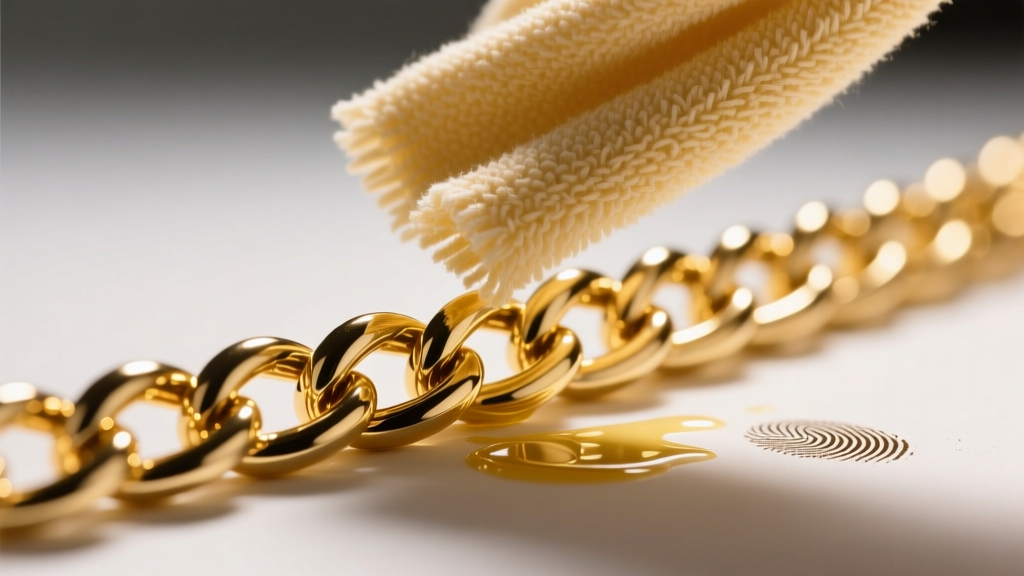
If debris remains trapped in the links, use an ultra-soft, baby-bristle toothbrush. Apply zero downward pressure; let the very tips of the bristles sweep the surface. Never use standard toothbrushes, as their nylon bristles are hard enough to leave micro-scratches on 25 HV gold.
Step 4: The Rinse and Dry
Rinse the necklace under a gentle stream of lukewarm distilled water. Pat it dry using a clean, lint-free microfiber cloth. Never use paper towels or tissue paper; the wood pulp fibers in these products act like sandpaper on pure gold.
The Clasp Conundrum: Managing Bimetallic Vulnerabilities
One of the most closely guarded secrets in fine jewelry is that a '24k gold necklace' is almost never 100% pure gold from end to end. Because 24k gold is too soft to hold the tension required for a secure spring-ring or lobster clasp, manufacturers must use 14k or 18k gold, or sometimes platinum, for the clasp and the jump rings connecting it.
This creates a bimetallic junction. When exposed to saltwater, heavy sweat, or harsh chemicals, the difference in electrical potential between the 24k chain and the lower-karat clasp can trigger galvanic corrosion. This localized corrosion specifically attacks the less noble metal (the clasp solder), leading to sudden, catastrophic chain breakage. To prevent this, always rinse the clasp area thoroughly with fresh water after wearing the necklace at the beach or gym, and inspect the jump ring connecting the clasp to the chain every six months for signs of thinning or stress.
Cleaning Agents & Methods: Safe vs. Unsafe for 24k Gold
Many commercial jewelry cleaning methods will destroy a pure gold piece. Use this decision matrix before applying any treatment to your necklace.
| Cleaning Method / Agent | Safety Rating for 24k Gold | Metallurgical Impact & Reasoning |
|---|---|---|
| Ultrasonic Cleaners | NEVER USE | High-frequency acoustic cavitation creates microscopic shockwaves that can easily snap delicate 24k links or severely warp hollow ropes. |
| Steam Cleaners | NEVER USE | The intense heat and high-pressure vapor can soften the gold further, causing tension-set stones to pop out and thin chains to stretch. |
| Baking Soda Paste | NEVER USE | Baking soda has a Mohs hardness of 2.5, which is harder than pure gold. It will permanently scour the mirror finish, leaving a cloudy matte texture. |
| Chlorine / Bleach | NEVER USE | While pure gold is immune, chlorine will rapidly destroy the alloyed solder points at the clasp and cause stress corrosion cracking. |
| Mild Dish Soap & Distilled Water | SAFE & RECOMMENDED | Effectively lifts organic oils and environmental dust without introducing abrasives or harmful chemical reactions. |
| Isopropyl Alcohol (99%) | SITUATIONAL | Safe for spot-cleaning stubborn resin or adhesive, but can dry out and degrade any porous gemstones (like pearls or opals) set in the pendant. |
Storage Architecture: Preserving the High-Polish Luster
How you store your 24k gold is just as critical as how you clean it. The most common mistake collectors make is hanging their pure gold chains on jewelry tree hooks or display stands. Because 24k gold is so dense and soft, the constant pull of gravity on a hanging chain will cause the links to slowly elongate over time, permanently altering the drape and weakening the structural integrity of the necklace.
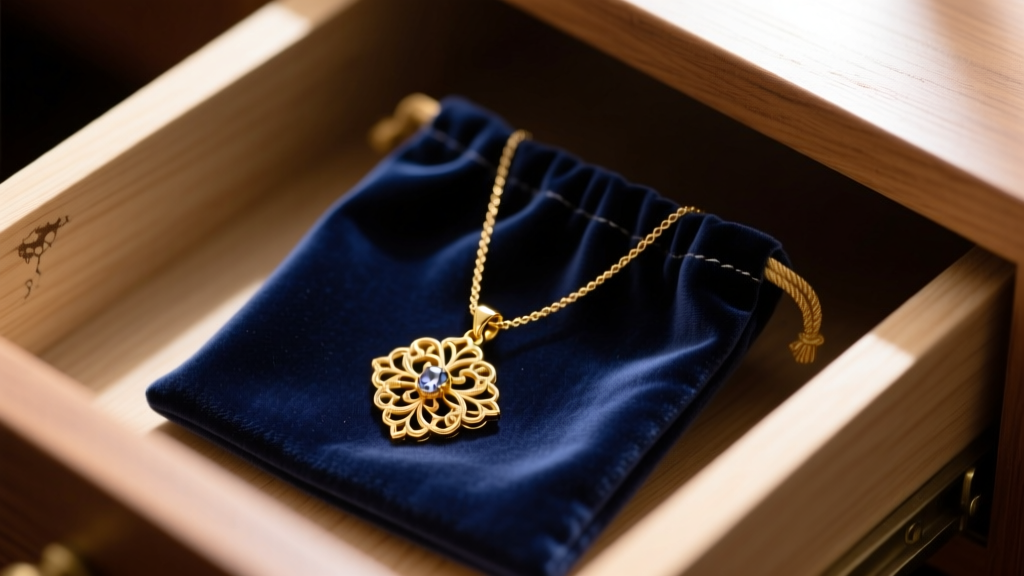
Always store 24k gold flat. Place the necklace inside an individual, anti-tarnish flannel pouch or a soft velvet-lined compartment. While pure gold does not tarnish, the flannel prevents airborne dust (which often contains microscopic silica particles) from settling on the chain and acting as an abrasive when the piece is moved. Ensure the clasp is unfastened and laid out in a gentle curve; forcing a thick 24k chain into a tight circle can create permanent kinks in the links.
Troubleshooting: Scratches, Dents, and Professional Restoration
Despite your best efforts, daily wear will eventually result in surface scratches. When this happens, do not take the piece to a standard mall jeweler who may offer to 'buff it out.' Traditional polishing wheels use abrasive compounds that remove a microscopic layer of gold to reveal a fresh surface. On a 24k piece, this means you are literally losing your investment.
Instead, seek out a master jeweler who specializes in high-karat gold and ask for burnishing. Burnishing uses a hardened steel or agate tool to apply extreme pressure to the scratched area, compressing and smoothing the displaced gold back into a mirror finish without removing any metal mass. According to the Gemological Institute of America (GIA), preserving the original mass and surface integrity of high-purity gold is paramount for both its aesthetic and resale value. Expect to pay between $45 and $85 for professional burnishing, a worthwhile expense to maintain the elemental purity of your jewelry.
Final Thoughts on 24k Maintenance
A 24k gold necklace is not merely an accessory; it is a wearable asset that demands respect for its elemental nature. By avoiding harsh mechanical cleaners, understanding the bimetallic risks of the clasp, and committing to flat, abrasion-free storage, you ensure that the deep, buttery luster unique to 99.9% pure gold remains pristine for generations.


