How to Clean and Care for a Graduated Diamond Tennis Necklace
Expert guide to cleaning and maintaining your graduated diamond tennis necklace. Learn safe ultrasonic limits, prong care, and storage tips to protect gems.


The Unique Anatomy of a Graduated Diamond Tennis Necklace
A graduated diamond tennis necklace is a masterpiece of jewelry engineering, but its unique structure demands specialized care. Unlike a traditional tennis necklace where every diamond is identical in carat weight and basket size, a graduated piece features a seamless transition from smaller diamonds at the clasp to significantly larger, heavier stones at the center drape. This asymmetrical weight distribution fundamentally changes how the necklace behaves on the body and how it endures physical stress.
The center stones—often ranging from 1.50 to 3.00 carats each—create a lower center of gravity. When you lean forward, the kinetic energy and tensile stress are concentrated on the articulated links and shared prongs immediately adjacent to the center cluster. Over time, this localized stress can lead to metal fatigue in the settings. Understanding this structural vulnerability is the first step in developing a proper maintenance routine that ensures your investment remains secure and brilliant for decades.
Daily Wear Risks: Chemical Exposure and Prong Fatigue
Diamonds are a 10 on the Mohs scale of hardness, meaning they are highly resistant to scratching. However, the precious metal alloys holding them are not. The most insidious threat to a graduated diamond tennis necklace is chemical exposure, specifically to chlorine. According to the Gemological Institute of America (GIA), exposure to chlorinated pool water or harsh household cleaners can cause stress corrosion cracking in karat gold alloys. This microscopic degradation weakens the prongs, making them brittle and prone to snapping, which is especially dangerous for the heavy center stones of a graduated design.
Furthermore, daily cosmetics, lotions, and natural sebum create a microscopic film on the pavilion (the bottom facets) of the diamonds. Because a graduated necklace relies on the dramatic light return of its large center stones to create its signature 'drape' effect, even a thin layer of oil will drastically reduce the refractive index, making the diamonds appear cloudy and lifeless. This is not damage to the stone, but rather a blockage of light performance that requires regular, targeted cleaning.
The Step-by-Step Cleaning Protocol
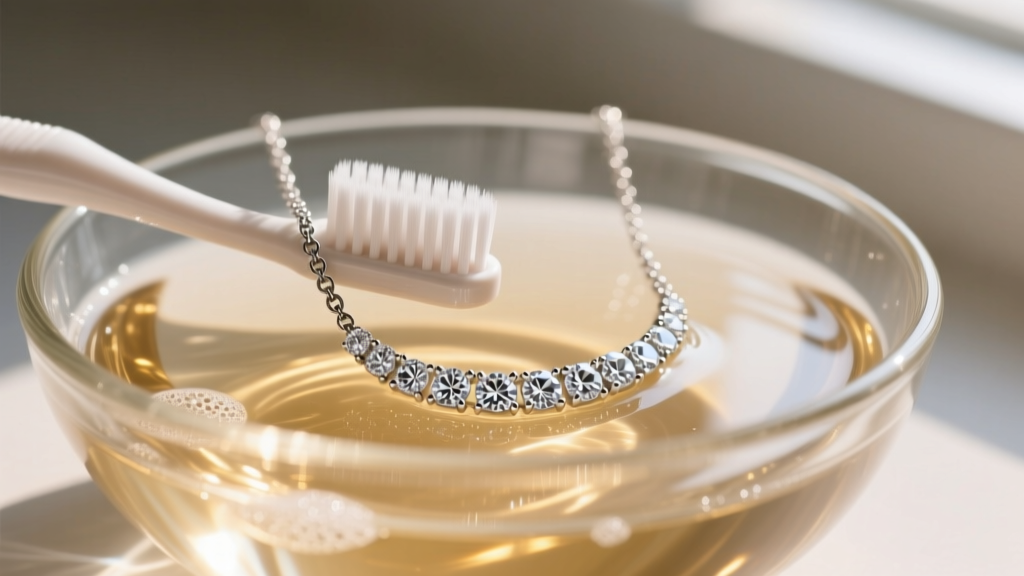
To safely restore the brilliance of your graduated diamond tennis necklace without compromising the integrity of the settings, follow this professional-grade cleaning protocol at home once every two weeks.
1. Prepare the Solution
Fill a small glass bowl with warm (not hot) distilled water. Add three drops of a mild, ammonia-free, and phosphate-free dish detergent. Avoid commercial jewelry dips, as they often contain harsh acids that can strip the rhodium plating from white gold settings and damage the polish of the metal links.
2. The Pavilion-First Brushing Technique
Submerge the necklace for 15 minutes to loosen cosmetic buildup. Using a brand-new, extra-soft baby toothbrush, gently scrub the diamonds. The critical technique here is to brush from the back (pavilion) upward toward the front (crown). Dirt and oils accumulate heavily on the pavilion facets, blocking light return. Brushing upward pushes the debris out from under the setting rather than packing it deeper into the gallery.
3. The Rinse and Dry
Rinse the necklace thoroughly under a gentle stream of lukewarm water. Crucial Safety Step: Always place a mesh strainer over the drain before rinsing any fine jewelry. Pat the piece dry with a lint-free microfiber cloth, avoiding paper towels, which contain wood fibers that can micro-scratch the gold or platinum settings.
The Ultrasonic Cleaner Debate: A Safety Matrix
Ultrasonic cleaners use high-frequency sound waves to create microscopic cavitation bubbles that blast dirt from hard-to-reach places. While highly effective, they are not universally safe for graduated diamond tennis necklaces. The intense vibrations can easily shake loose a stone if the prongs are already experiencing fatigue. Furthermore, the varying basket sizes in a graduated necklace mean that the larger center stones may resonate differently than the smaller edge stones, creating uneven vibrational stress across the chain.
| Cleaning Method | Safety Level | Best Use Case | Risks to Graduated Settings |
|---|---|---|---|
| Warm Soapy Water | Highly Safe | Bi-weekly maintenance | None, if using a soft brush |
| Ultrasonic Cleaner | Moderate Risk | Deep cleaning (only if prongs are verified tight) | Can loosen stones in worn shared-prong settings |
| Steam Cleaner | High Risk | Professional use only | Thermal shock can fracture diamonds with existing inclusions |
| Commercial Dips | Unsafe | Never | Strips rhodium, damages alloy integrity |

Professional Maintenance and Prong Re-Tipping
Home cleaning is essential for brilliance, but it cannot prevent mechanical wear. The care guidelines from leading luxury jewelers emphasize the necessity of professional inspections. For a graduated diamond tennis necklace worn weekly, you should schedule a professional inspection every 12 months. If worn daily, this interval should be reduced to every 6 months.
During this inspection, a jeweler will use a 10x triplet loupe to check for 'prong lifting'—a condition where the metal tip holding the diamond girdle pulls slightly away from the stone. Because the center stones of a graduated necklace endure the most gravitational pull, their prongs will inevitably wear down faster than those on the sides. A jeweler can perform 're-tipping,' a process where a tiny bead of matching metal is laser-welded onto the worn prong, restoring its structural grip without requiring a complete setting replacement.
Expert Insight: If your graduated necklace is crafted in 14k or 18k white gold, the rhodium plating on the back of the center drape will likely wear off within 8 to 12 months due to friction against the skin and collarbones. Plan for a professional rhodium re-plating during your annual maintenance visit to maintain a uniform, bright white appearance.
Proper Storage to Prevent Girdle Chipping
A common misconception is that because diamonds are the hardest natural material, they cannot be damaged in storage. While a diamond cannot be scratched by another diamond under normal circumstances, two diamonds knocking forcefully against each other can cause 'girdle chipping.' The girdle is the narrow outer edge of the diamond where the prongs grip it; it is the most vulnerable point of the stone's anatomy.
When storing your graduated diamond tennis necklace, never toss it into a jewelry box where the heavy center stones can swing and strike the smaller side stones. Always fasten the clasp to prevent tangling, which can bend the delicate articulated links. Store the necklace flat in a fabric-lined compartment, or ideally, wrap it in a soft, anti-tarnish microfiber pouch. By combining meticulous home cleaning with strategic professional maintenance, your graduated diamond tennis necklace will retain its breathtaking drape and fiery brilliance for a lifetime.


