What Characters From The Necklace Reveal About Paste vs Real Diamonds
Explore how the characters from The Necklace highlight the technical differences between 19th-century paste jewelry and real diamonds.

The Literary Premise: A Catastrophic Misidentification
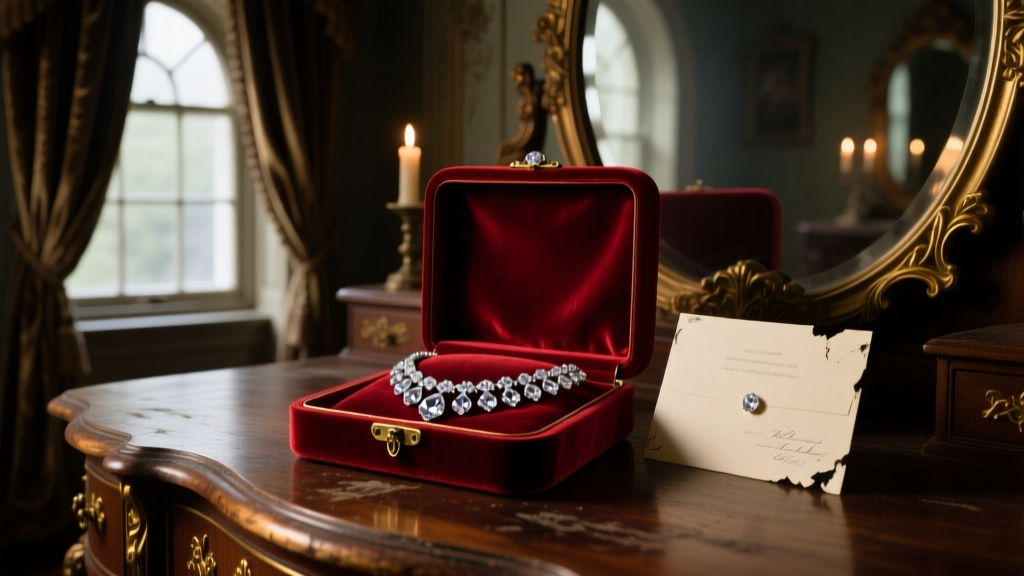
Guy de Maupassant’s 1884 short story The Necklace (La Parure) is a staple of French literature, celebrated for its biting irony and devastating twist ending. The narrative follows Mathilde Loisel, a woman of modest means who borrows what she believes to be an exquisite diamond necklace from her wealthy friend, Madame Forestier, to attend a high-society Parisian ball. After losing the piece, Mathilde and her husband plunge themselves into a decade of crippling poverty to purchase a 40,000-franc diamond replacement. Only at the story's conclusion does Mathilde discover the original was "paste"—a high-quality imitation worth a mere 500 francs.
While literary critics have spent over a century analyzing the themes of vanity, class struggle, and deception, gemologists and jewelry historians view the story through a different lens: a catastrophic failure of material identification. When we examine the characters from the necklace's narrative, we are actually looking at a masterclass in the historical and technical distinctions between genuine carbon diamonds and 19th-century lead-glass simulants. How could Mathilde be so easily fooled? More importantly, how would a modern jeweler separate the two?
Material Science: Diamond vs. 19th-Century Paste
To understand Mathilde’s fatal error, we must first define what "paste" meant in the 1880s Parisian jewelry market. Unlike modern plastic or cheap acrylics, 19th-century paste was a highly sophisticated, high-lead-content glass. Originally perfected by Georges Frédéric Strass in the 1720s, this material—often referred to as "Strass glass"—was created by adding up to 40% lead oxide to the glass melt.
The addition of lead oxide fundamentally altered the optical properties of the glass, making it the premier diamond simulant of the Victorian era. According to the Antique Jewelry University (AJU), high-quality paste was not considered "cheap" or "tacky"; it was a respected art form, often set in sterling silver or gold and worn by European aristocracy during travel to avoid the risk of losing genuine heirlooms.
Gemological Comparison Chart
| Property | Natural Diamond | 19th-Century Lead Paste | Modern Cubic Zirconia (CZ) |
|---|---|---|---|
| Refractive Index (RI) | 2.417 | 1.70 - 1.90 | 2.15 - 2.18 |
| Dispersion (Fire) | 0.044 | 0.050 - 0.060 | 0.058 - 0.066 |
| Mohs Hardness | 10 | 5.0 - 6.0 | 8.0 - 8.5 |
| Specific Gravity | 3.52 | 3.00 - 3.80 | 5.60 - 6.00 |
| Optical Character | Isotropic (Singly Refractive) | Isotropic (Singly Refractive) | Isotropic (Singly Refractive) |
As the data illustrates, while lead paste possesses a higher dispersion than diamond (giving it an artificially "fiery" rainbow flash under direct light), it falls drastically short in refractive index and hardness. This discrepancy in material science is exactly what a trained eye would use to expose the forgery.
The Gemological Giveaways: Spotting the Fake
If Mathilde had taken Madame Forestier’s necklace to a reputable Palais-Royal jeweler before replacing it, the deception would have been uncovered in less than three minutes. Here are the specific technical failure modes of 19th-century paste that give it away under magnification.
1. Facet Abrasion and Wear
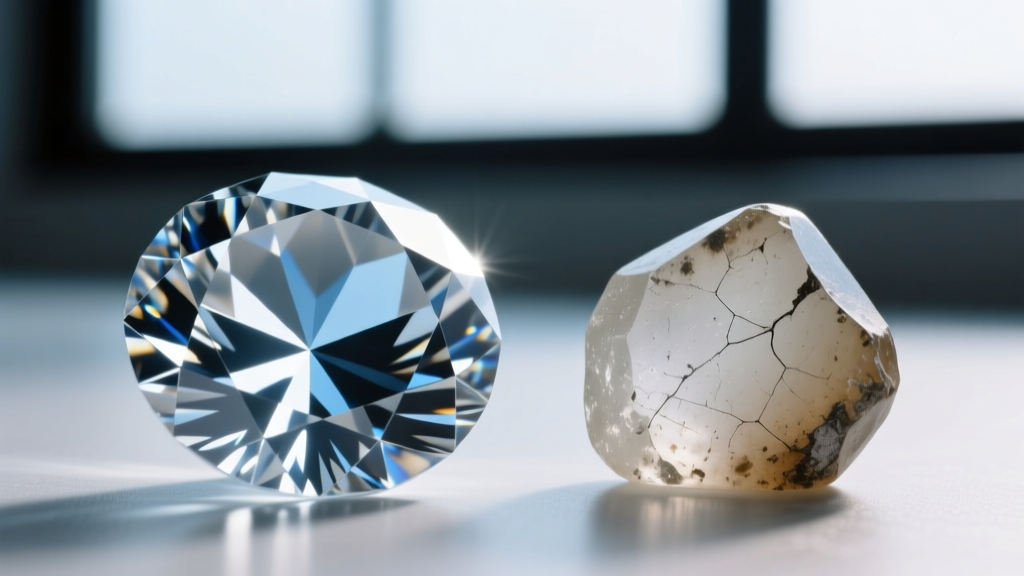
The most undeniable proof of paste jewelry is found at the facet junctions. Diamond, ranking a perfect 10 on the Mohs scale of mineral hardness, is virtually immune to everyday abrasion. A diamond worn for ten years will retain razor-sharp facet edges. Paste, however, ranks around a 5.5. Over a decade of wear against clothing, skin, and storage boxes, the facet edges of a paste gemstone will become rounded, chipped, and scratched. Under a 10x triplet loupe, a gemologist would immediately spot the "fuzzy" or abraded facet junctions on Madame Forestier’s necklace, instantly identifying it as glass.
2. Internal Inclusions vs. Gas Bubbles
Natural diamonds are formed deep within the Earth's mantle under extreme heat and pressure, resulting in characteristic internal inclusions such as mineral crystals, feathers, and needle-like structures. Paste glass, being a man-made molten material, does not contain these natural flaws. Instead, as the glass cools, it traps tiny, perfectly spherical gas bubbles and exhibits "swirl marks" from the stirring process. A quick inspection with a loupe would reveal these telltale spherical bubbles, confirming the stones were cast in a mold rather than cut from a rough crystal.
3. The Foil-Back Illusion
Because lead glass lacks the high refractive index (RI) necessary to bounce light back to the viewer's eye through total internal reflection, 19th-century jewelers often "foiled" the back of paste stones. A thin layer of silver or gold foil was applied to the pavilion (bottom) of the gemstone to act as a mirror. If Mathilde had looked closely at the setting, she might have noticed the closed-back collet settings designed to protect the delicate foil from moisture and tarnish—a construction method rarely used for genuine diamonds, which rely on open-back settings to maximize light return.
The 1884 Parisian Market Context
It is crucial to understand that Madame Forestier was not necessarily trying to deceive Mathilde; she was simply participating in the fashion of the era. In late 19th-century Paris, high-end paste jewelry was sold by prestigious jewelers and was considered an acceptable accessory for the bourgeoisie. The craftsmanship involved in cutting and polishing Strass glass was highly specialized. The stones were often set in real gold or silver, featuring intricate milgrain detailing and secure prong work. Mathilde’s assumption that a beautiful setting equated to genuine diamonds is a cognitive bias that still plagues inexperienced jewelry buyers today.
"The tragedy of Mathilde Loisel is not merely one of vanity, but of a profound lack of gemological literacy. She valued the perception of the material over the physical reality of the stone."
Modern Equivalents: How the Story Plays Out in 2026
If The Necklace were rewritten for the modern jewelry market, the technical landscape would be vastly more complex. Today, the "paste" of the 19th century has been replaced by advanced simulants and synthetic stones. In 2026, a borrower would have to navigate Cubic Zirconia (CZ), Moissanite, and Lab-Grown Diamonds.

Thermal and Electrical Conductivity Testing
The modern equivalent of the jeweler's loupe is the electronic diamond tester. According to the Gemological Institute of America (GIA), diamonds are exceptional conductors of heat, whereas glass, CZ, and paste are thermal insulators. A modern thermal conductivity tester would have beeped negatively on Madame Forestier’s necklace in seconds. However, the rise of Moissanite (which conducts heat similarly to diamond) and Lab-Grown Diamonds (which are physically and chemically identical to mined diamonds) means that today’s Mathilde would require an advanced electrical conductivity tester or a spectrometer to definitively identify the origin and nature of the stones.
The Pricing Trap
In 1884, the price gap between a 40,000-franc diamond necklace and a 500-franc paste necklace was an 80-fold difference. In today's market, the gap between a natural diamond tennis necklace and a high-quality lab-grown diamond equivalent might only be 3x to 5x, while a CZ replica might cost 100x less. The visual deception is now nearly perfect to the naked eye, making third-party grading reports (from labs like GIA or AGS) the only true safeguard against catastrophic financial loss.
Conclusion: The True Cost of Assumption
The characters from the necklace serve as a timeless warning for jewelry collectors, stylists, and buyers. Mathilde Loisel’s decade of suffering was entirely preventable with a basic understanding of material science, loupe inspection, and market verification. Whether you are evaluating a 19th-century antique estate piece or purchasing a modern diamond pendant, the lesson remains identical: never let the setting, the occasion, or the reputation of the lender blind you to the physical properties of the gemstone. True style and smart acquisition rely on empirical verification, not assumptions. Always demand a grading report, inspect the facet junctions, and respect the profound technical differences between carbon and glass.


