Chicago Necklace Trends 2026: The Industrial Link Guide
Discover the 2026 Chicago necklace trend. Explore industrial link styles, hardware gauges, PVD coatings, and expert layering techniques.


The Renaissance of the Chicago Necklace
The jewelry landscape of 2026 has decisively pivoted away from the ultra-delicate, barely-there chains of the early 2020s. In its place, a brutalist, architecturally driven aesthetic has taken center stage: the Chicago necklace. Rooted in the industrial hardware of mid-century manufacturing and the bold streetwear movements of the late 20th century, the modern Chicago necklace is a masterclass in structural tension and material weight. This guide deconstructs the 2026 Chicago link trend, analyzing metallurgical standards, gauge specifications, and advanced styling frameworks for the contemporary collector.
The Anatomy and Evolution of the Chicago Link
What separates a standard curb chain from a true Chicago necklace? The distinction lies in the link geometry and the finishing technique. Traditional curb chains feature flattened, interlocking oval links. The Chicago link, however, incorporates beveled edges, hexagonal interior cutouts, or a distinct 'screw' motif that mimics heavy-duty industrial fasteners. In 2026, designers are pushing this aesthetic by combining matte-brushed surfaces with high-polish bevels, creating a dual-tone effect that catches light dynamically without relying on gemstone accents. According to trend forecasts highlighted by Vogue, this shift toward hardware-as-jewelry reflects a broader cultural desire for grounding, tangible luxury in an increasingly digital world.
Metallurgy and Gauge: The 2026 Standards
To achieve the substantial drape required of a Chicago necklace without causing cervical strain, material selection is paramount. The market is currently dominated by three primary metals, each with distinct Vickers hardness (HV) ratings and wear profiles.
- 316L Surgical Stainless Steel: The workhorse of the industrial trend. With a hardness of roughly 150-200 HV, it resists scratching and tarnishing. It is heavily favored for entry-level and mid-tier Chicago chains ($45–$150).
- Grade 5 Titanium (Ti-6Al-4V): For oversized, 12mm+ gauge statement pieces, titanium is the 2026 standard. It offers the tensile strength of steel at nearly half the weight, making massive Chicago links wearable for 12+ hours.
- PVD Coated Brass/Steel: Physical Vapor Deposition (PVD) is the definitive coloring method for 2026. Unlike traditional electroplating, PVD bonds titanium nitride to the metal in a vacuum chamber, creating a matte black or 18k gold finish that will not flake or fade from skin acidity.

Gauge Sizing Framework
- 5mm - 7mm (The Whisper Gauge): Ideal for layering or wearing tucked beneath unbuttoned collars.
- 8mm - 10mm (The Standard Gauge): The most versatile width, providing undeniable presence without overwhelming the collarbone.
- 11mm - 15mm (The Statement Gauge): Reserved for outerwear styling and high-fashion editorial looks.
Chicago Hardware Variations: A Comparative Breakdown
| Variation | Link Geometry | Avg Weight (18in) | Best Application |
|---|---|---|---|
| Classic Chicago Curb | Flattened, beveled ovals | 120g - 180g | Everyday streetwear, t-shirts |
| Chicago Hex Link | Hexagonal cutouts, sharp edges | 150g - 240g | High-fashion layering, outerwear |
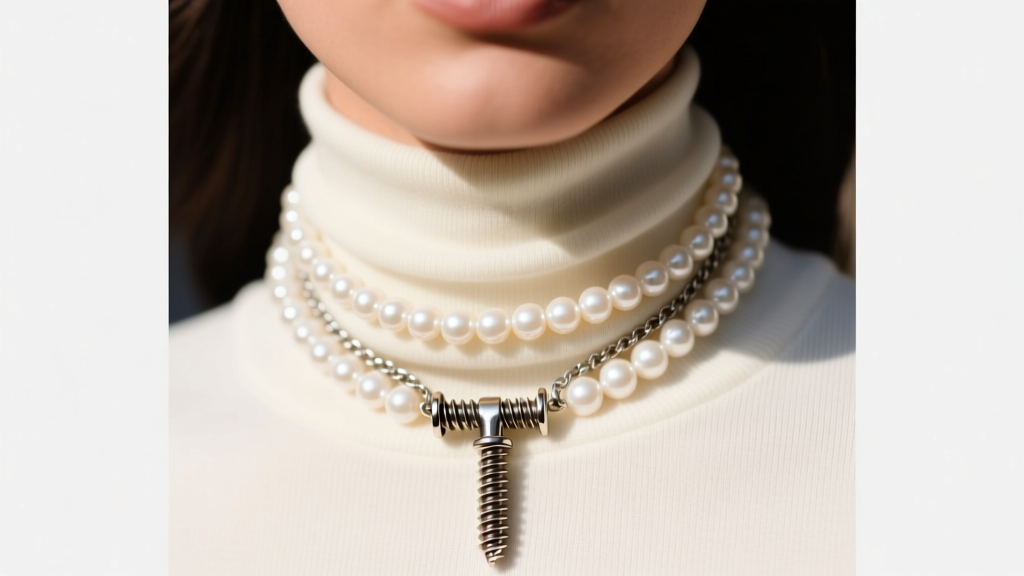
| Chicago Screw Pendant | Cylindrical, threaded hardware | 40g - 80g | Minimalist V-necks, solo wear |
Clasp Mechanics and Hardware Integrity
A frequent failure point in heavy industrial jewelry is the clasp. The traditional lobster clasp is entirely inadequate for a Chicago necklace exceeding 150 grams. In 2026, premium iterations utilize custom-machined barrel clasps or hidden push-button box clasps with secondary safety figures. When evaluating a Chicago chain, inspect the internal spring mechanism of the clasp; it should engage with a sharp, audible click and exhibit zero lateral wiggle. Furthermore, the jump rings connecting the clasp to the chain must be soldered shut or feature a flat-head screw closure to prevent the heavy links from pulling the ring apart under their own kinetic weight.
Strategic Styling: Necklines and Layering Frameworks
The sheer visual weight of a Chicago necklace demands a deliberate approach to styling. The 'necklace-over-everything' approach of 2024 has been replaced by calculated integration with garment architecture.
The High-Low Tension Rule
The most sophisticated way to wear a heavy Chicago chain in 2026 is through high-low tension: pairing brutalist hardware with organic, delicate elements. Layering a 10mm matte steel Chicago Hex chain with a 2mm irregular baroque pearl choker creates a striking juxtaposition. The rigid geometry of the metal links acts as a frame, elevating the organic imperfections of the pearls.
Neckline Geometry Pairings
- The Turtleneck / Mock Neck: A 12mm Chicago chain worn over a fine-gauge merino turtleneck is a staple of modern minimalist streetwear. The fabric provides a high-friction base that prevents the heavy metal from shifting, while the solid color block allows the link geometry to pop.
- The Deep V-Neck: Avoid wearing heavy Chicago links directly against bare skin in a deep V, as the weight will pull the garment downward and distort the neckline. Instead, opt for a 6mm Chicago chain with a Chicago screw pendant that rests exactly at the sternum.
- The Crewneck: A classic white tee or heavy cotton crewneck requires an 8mm to 10mm chain worn inside the collar, resting against the collarbone, allowing the custom-machined barrel clasp to sit off-center for an asymmetric, effortless look.
Maintenance Protocols for Heavy Hardware
Caring for a Chicago necklace requires moving beyond standard jewelry wipes. The deep crevices of hex and screw links trap sebum, dead skin, and environmental pollutants, which can dull the PVD coating and cause localized skin irritation.
Ultrasonic Cleaning: For uncoated 316L steel and solid titanium, an ultrasonic cleaner (operating at 40kHz) with a mild degreasing solution is the most effective method to dislodge debris from the interlocking joints. Warning: Never use ultrasonic cleaners on PVD-coated black or gold Chicago chains, as the microscopic cavitation bubbles can compromise the coating's adhesion over time.
Drying and Polishing: Always use a high-pressure air duster or compressed air to blow water out of the link joints before it can spot-dry. Follow up with a microfiber cloth to restore the high-polish bevels. The Gemological Institute of America (GIA) consistently recommends avoiding harsh chemical dips, which are entirely unnecessary for non-precious industrial metals and can strip factory-applied protective sealants.
Final Verdict: The Endurance of Industrial Luxe
The Chicago necklace is not a fleeting micro-trend; it is a permanent recalibration of how we view masculine and gender-fluid jewelry. By prioritizing architectural geometry, advanced metallurgy like PVD and Grade 5 Titanium, and deliberate styling frameworks, the Chicago link has cemented its place in the 2026 permanent collection. Whether you opt for a subtle 6mm steel curb or a massive 14mm titanium hex chain, investing in precision-machined hardware guarantees a piece that will outlast seasonal whims and anchor your wardrobe for decades.


