The Anatomy of a Chunky White Beaded Necklace: An Expert Guide
Discover the technical anatomy of a chunky white beaded necklace. Explore bead grading, stringing mechanics, weight distribution, and material density.

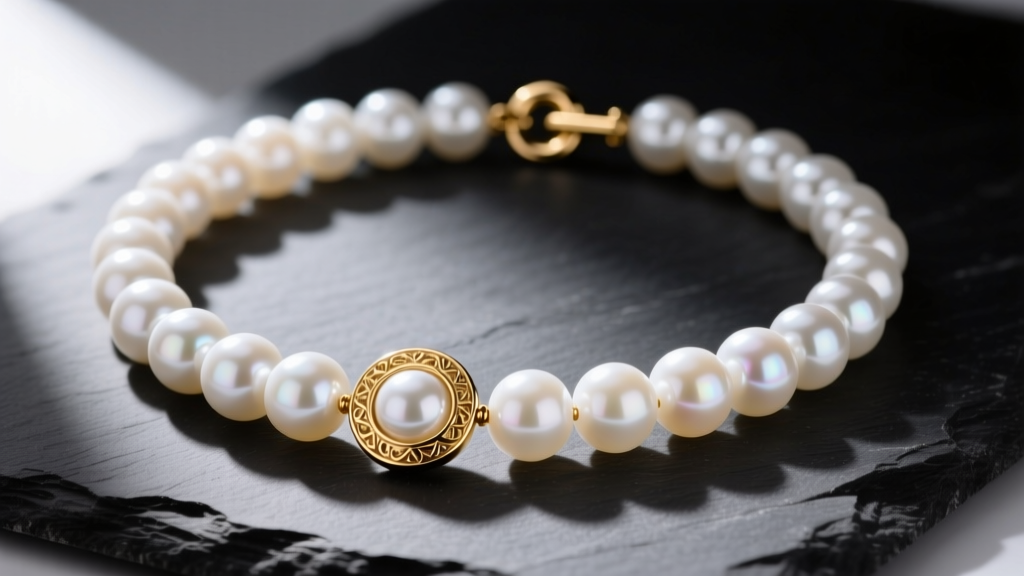
The Material Matrix: Density and Visual Weight
When evaluating a chunky white beaded necklace, the first technical consideration is the specific gravity (SG) of the bead material. 'Chunky' typically denotes bead diameters ranging from 14mm to 25mm. At these dimensions, material density dictates whether the piece will sit elegantly on the clavicle or cause severe cervical strain. White beads are predominantly crafted from five core materials, each with distinct structural properties and optical finishes.
Freshwater pearls remain the premium standard, offering a natural luster and an SG of approximately 2.7. However, a uniform strand of 16mm freshwater pearls can easily exceed 120 grams. For designers seeking the chunky aesthetic without the punitive weight, high-fired ceramic porcelain (SG ~2.4) and cast acrylic resins (SG ~1.1) are heavily utilized. According to gemological standards outlined by the Gemological Institute of America (GIA), natural and cultured pearls also possess a Mohs hardness of 2.5 to 3.0, making them highly susceptible to abrasion when strung tightly against one another in a chunky configuration.
| Material | Specific Gravity | Mohs Hardness | Est. Weight (18-inch, 16mm beads) | Optical Finish |
|---|---|---|---|---|
| Freshwater Pearl | 2.70 - 2.74 | 2.5 - 3.0 | 95g - 110g | Orient / Luster |
| Howlite (Natural) | 2.53 - 2.59 | 3.5 | 85g - 95g | Matte / Chalky |
| High-Fired Ceramic | 2.30 - 2.50 | 6.0 - 7.0 | 75g - 85g | Glazed / Glossy |
| Milk Glass | 2.50 - 2.80 | 5.5 | 90g - 105g | Opaque / Translucent |
| Cast Acrylic Resin | 1.18 - 1.20 | 2.0 | 35g - 45g | Matte / High-Gloss |
Stringing Mechanics: Preventing Catastrophic Failure
The most common point of failure in heavy beaded jewelry is the stringing medium. A chunky white beaded necklace exerts immense kinetic force on its core thread, particularly at the nape of the neck where the bending radius is sharpest. Traditional silk thread, while historically appropriate for fine pearls, lacks the sheer tensile strength required for beads exceeding 12mm in diameter with sharp, unlined drill holes.
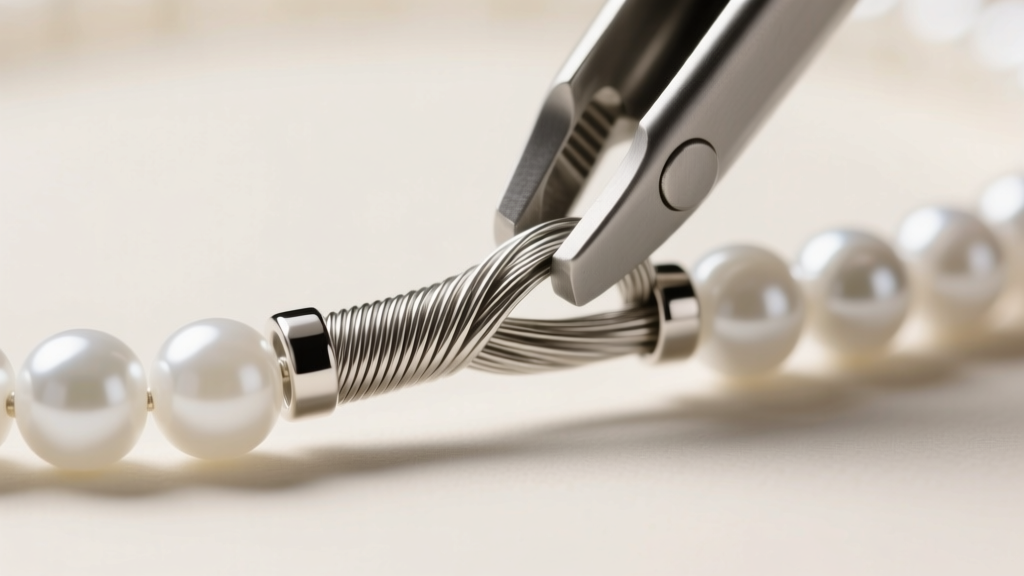
For beads in the 14mm to 25mm range, professional jewelers rely on multi-strand micro-wires. According to manufacturing specifications from Beadalon, a 49-strand stainless steel wire with a nylon jacket and a diameter of 0.024 inches (0.61mm) provides a tensile strength of up to 30 pounds. This is critical because the drill holes on large ceramic or glass beads often feature micro-fissures that can act like tiny saws against softer threads.
Expert Rule of Thumb: Never use a wire diameter that exceeds 1/3 of the bead's drill hole diameter. If your chunky beads have 1.5mm drill holes, a 0.024-inch (0.61mm) wire allows enough flexibility for the necklace to drape naturally without kinking, while leaving sufficient clearance for the crimp beads to pass through the hole twice during the finishing process.
The Crimping Protocol
Securing a heavy strand requires more than a simple crush crimp. A crushed crimp tube creates jagged edges that can compromise the nylon coating of the wire over time. Instead, utilize a micro-crimper tool to fold a 2mm x 2mm sterling silver or copper crimp tube into a U-shape, and then fold it again into a tight, rounded bead. This encapsulates the wire and distributes the sheer stress evenly across the metal.
Clasp Engineering for High-Load Applications
A 100-gram necklace requires a clasp mechanism that can withstand sudden lateral pulls. Standard lobster clasps and spring rings are entirely unsuited for this application; their internal springs frequently fail under loads exceeding 50 grams, and their small jump rings easily pull open.
- Toggle Clasps: The most reliable choice for chunky beads. The technical requirement is that the T-bar must be at least 1.5 times longer than the inner diameter of the receiving ring. For a 15mm inner-diameter ring, the bar must be a minimum of 22.5mm to prevent accidental slip-through during movement.
- Screw Thread Clasps: Excellent for uniform strands, but they require the wearer to blindly align microscopic threads behind their neck, which can be frustrating.
- Magnetic Clasps: Only viable if they feature a secondary mechanical locking mechanism (such as a bayonet twist or a safety latch). Neodymium magnets alone will detach if the necklace is caught on a garment.
Ergonomics and Weight Distribution
Designing or selecting a chunky white beaded necklace is not just about material weight; it is about weight distribution. A uniform strand of 18mm beads creates a rigid, unyielding circle that forces the heaviest beads to rest directly on the trapezius muscles, leading to rapid fatigue.
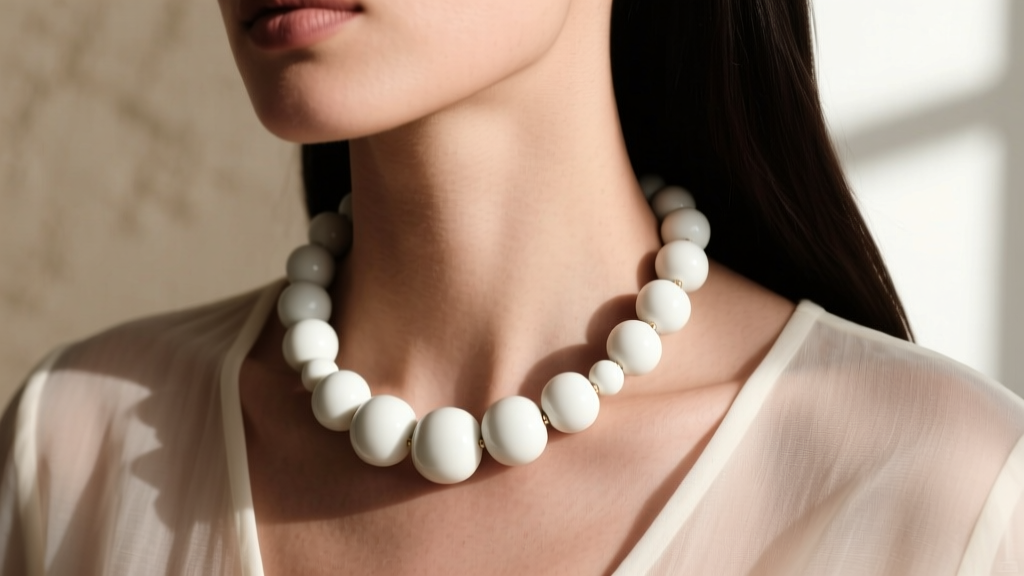
The solution is graduated bead sizing. By placing the largest beads (e.g., 20mm) at the center front (the nadir of the necklace) and progressively stepping down to smaller beads (e.g., 12mm) toward the clasp, you achieve two engineering benefits:
- Center of Gravity Shift: The mass is concentrated at the front, allowing the necklace to hang plumb against the sternum rather than riding up the back of the neck.
- Flexibility at the Nape: Smaller beads at the posterior allow for a tighter, more comfortable bending radius, reducing the stiffness that plagues uniform chunky necklaces.
Care, Maintenance, and Optical Preservation
White beads, regardless of their base material, are highly susceptible to environmental discoloration. The porous nature of howlite and the organic structure of freshwater pearls mean they will readily absorb oils, cosmetics, and acidic perspiration. This leads to a yellowing effect that destroys the stark white contrast of the piece.
For non-porous materials like glazed ceramic or milk glass, a simple wipe-down with a damp microfiber cloth and a mild, pH-neutral surfactant is sufficient. However, for porous materials, preventative maintenance is mandatory. Always apply perfumes, hairsprays, and lotions at least 15 minutes before donning the necklace. Store the piece flat in a UV-protected, acid-free archival box; hanging a heavy chunky necklace for long-term storage will cause permanent structural stretching of the stringing medium, resulting in unsightly gaps between the beads.


