Gold Curved Bar Necklace: Ultimate Cleaning & Care Guide
Discover expert cleaning, maintenance, and storage tips for your gold curved bar necklace to preserve its shine, shape, and engravings.

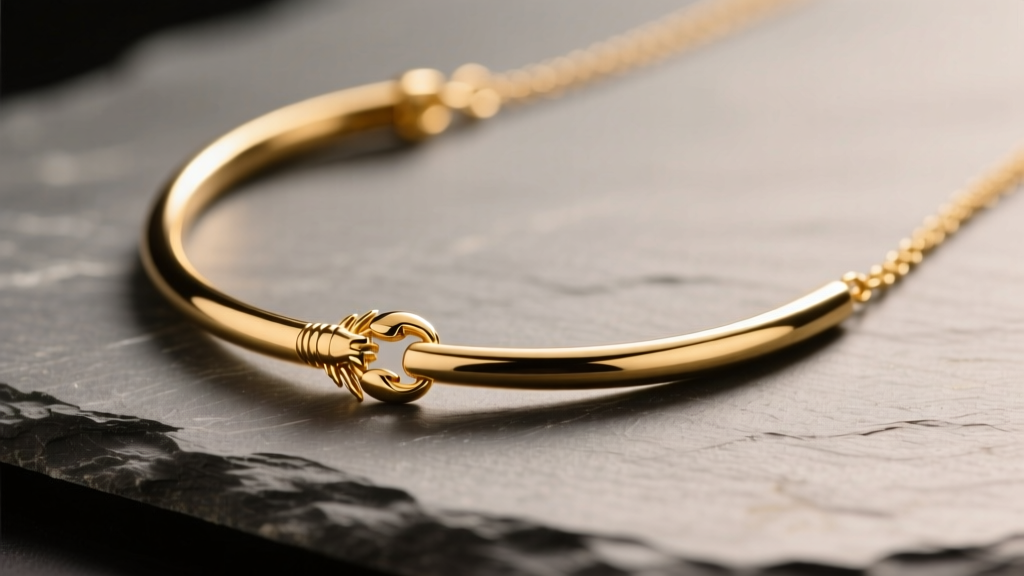
The gold curved bar necklace has cemented its status as a minimalist wardrobe staple. Its sleek geometry and understated elegance make it perfect for layering or wearing solo. However, as we navigate the jewelry trends of 2026, the focus has shifted heavily toward longevity and sustainable wear. A curved bar necklace is not just a simple chain; its specific architectural shape, combined with the metallurgical properties of gold, requires a highly targeted approach to care and maintenance. If you want your piece to retain its structural integrity and brilliant luster, generic jewelry cleaning advice will not suffice.
This comprehensive guide breaks down the exact protocols for cleaning, storing, and maintaining your gold curved bar necklace, whether it is crafted from solid 14k gold, 18k gold, or high-quality gold vermeil.
Understanding Your Necklace's Metallurgical Composition
Before applying any cleaning solution, you must identify the exact composition of your necklace. The term 'gold' encompasses a wide spectrum of manufacturing standards, and treating a plated piece like solid gold will result in irreversible damage.
Solid Gold (14k and 18k)
Solid gold is an alloy. Pure 24k gold is too soft to hold the rigid, curved shape of a bar pendant without bending or warping. Therefore, jewelers mix pure gold with alloys like copper, silver, and zinc. 14k gold (58.3% pure gold) is highly durable and resistant to warping, making it ideal for curved bars that rest against the collarbone. 18k gold (75% pure gold) offers a richer, warmer yellow hue but is slightly softer. According to the Gemological Institute of America (GIA), the alloy metals in 14k and 18k gold can occasionally react to environmental sulfur or chlorine, leading to surface tarnish that requires gentle polishing.
Gold Vermeil vs. Flash Plating
Gold vermeil is a step above standard plating. By Federal Trade Commission (FTC) guidelines, vermeil must have a sterling silver base and a gold layer of at least 2.5 microns thick. Flash-plated necklaces, often found in fast-fashion retail, use a brass or copper base with a gold layer of less than 0.5 microns. Vermeil can withstand mild soapy soaks, but flash-plated curved bars should only be wiped with a damp cloth, as submerging them will accelerate the flaking of the microscopic gold layer.
The Geometry of Grime: Why Curved Bars Trap Debris
The defining feature of this necklace—the concave inner curve—is also its biggest vulnerability. When worn, the inner arch rests directly against the skin of the chest and collarbone. This creates a micro-environment that traps sebum (body oils), dead skin cells, and residual skincare products like hyaluronic acid serums or SPF lotions.
Furthermore, many curved bar necklaces feature personalized engravings. Whether stamped or laser-etched, these microscopic grooves act as magnets for dust and polish residue. Over time, this trapped grime oxidizes, creating a dark, dull film that makes the gold look tarnished even when the metal itself is perfectly clean. Addressing this requires a targeted mechanical cleaning approach rather than just a chemical soak.
Step-by-Step Cleaning Protocol for Solid Gold & Vermeil
For solid gold and high-quality vermeil curved bar necklaces, follow this precise cleaning regimen to restore brilliance without damaging the metal or the chain links.
Step 1: The Distilled Water Soak
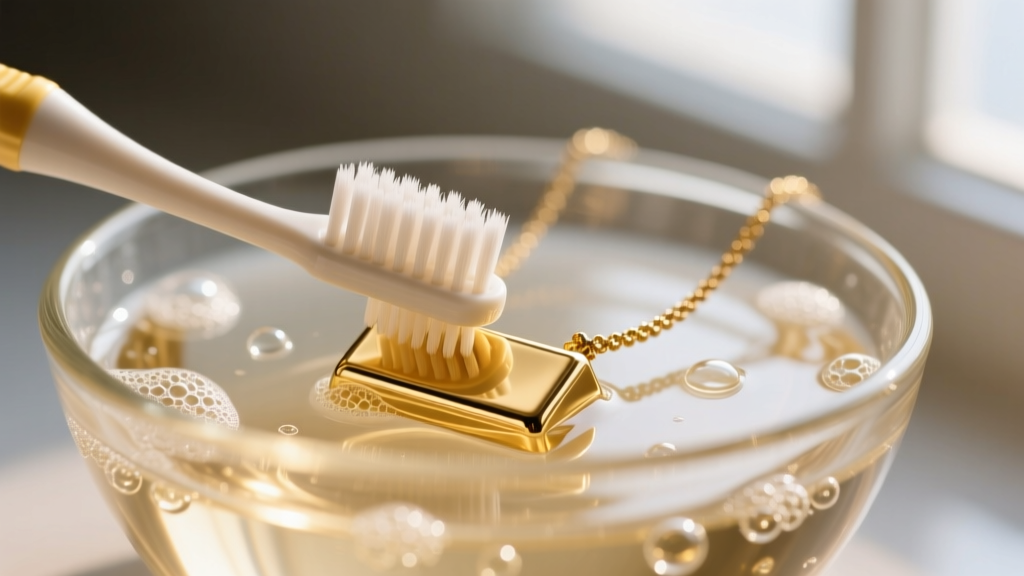
Never use tap water. Tap water contains chlorine, fluoride, and hard minerals like calcium that can leave microscopic spots on the gold's surface. Fill a small glass bowl with distilled water and add two drops of a mild, phosphate-free degreasing dish soap (such as original blue Dawn). Stir to create a gentle lather. Submerge the necklace for exactly 3 to 5 minutes. If your piece is vermeil, limit the soak to 60 seconds to protect the silver core from prolonged moisture exposure.
Step 2: Detailing the Curve and Engravings
Remove the necklace from the solution. Using a brand-new, ultra-soft baby toothbrush, gently brush the inner curve of the bar. Critical technique: Always brush in the direction of the curve, never laterally across it. If your bar has engraved text or coordinates, use the very tip of the bristles to flick dirt out of the grooves in an upward motion. Do not scrub back and forth over engravings, as this can gradually wear down the edges of the lettering over time.
Step 3: The Rinse and Dry
Rinse the necklace under a gentle stream of lukewarm distilled water. To dry, lay the piece flat on a lint-free microfiber cloth. Pat the curved bar gently. Never rub a wet gold chain with a paper towel; paper towels are made of wood pulp fibers that can cause micro-scratches on high-polish 18k gold surfaces.
Critical Cleaning Mistakes to Avoid
Many well-intentioned jewelry owners ruin their pieces by relying on outdated internet hacks. Below is a breakdown of common cleaning methods and why they are detrimental to a gold curved bar necklace.
| Cleaning Method | Why It Damages Your Necklace | Safe Alternative |
|---|---|---|
| Ultrasonic Cleaners | High-frequency vibrations can loosen the solder joints connecting the chain to the bar loops. They will also strip gold vermeil and flash plating entirely. | Manual soaking and soft-bristle brushing. |
| Whitening Toothpaste | Contains hydrated silica and baking soda, which are highly abrasive. They will leave permanent micro-scratches on the polished surface of the curved bar. | Mild liquid dish soap and distilled water. |
| Alcohol or Hand Sanitizer | While it kills bacteria, high-concentration isopropyl alcohol can degrade the protective rhodium plating sometimes used on white gold bars and dry out porous gemstone accents. | Use only jewelry-specific, alcohol-free wipes for quick sanitizing. |
| Boiling Water | Extreme thermal shock can warp the structural integrity of a hollow or semi-hollow curved bar, causing it to bend or dent irreparably. | Lukewarm distilled water only. |
Clasp and Chain Maintenance
The chain and clasp of your necklace endure just as much stress as the pendant. Most curved bar necklaces utilize a standard lobster clasp or a spring-ring clasp. Over time, the tiny internal spring mechanism can become clogged with lotion or skin cells, causing the clasp to stick open or fail to snap shut securely.
To maintain the clasp, use a wooden toothpick to gently dislodge any visible debris from the hinge. Apply a microscopic drop of sewing machine oil or specialized jewelry hinge lubricant to the moving joint, then wipe away any excess with a cotton swab. To prevent the delicate chain from tangling around the curved bar during wear, ensure the chain is the correct length; a 16-inch choker length keeps the bar high and stable, while an 18-inch length allows the bar to move freely, increasing the risk of the chain wrapping around the pendant's solder rings.
Proper Storage to Prevent Bending and Tangling
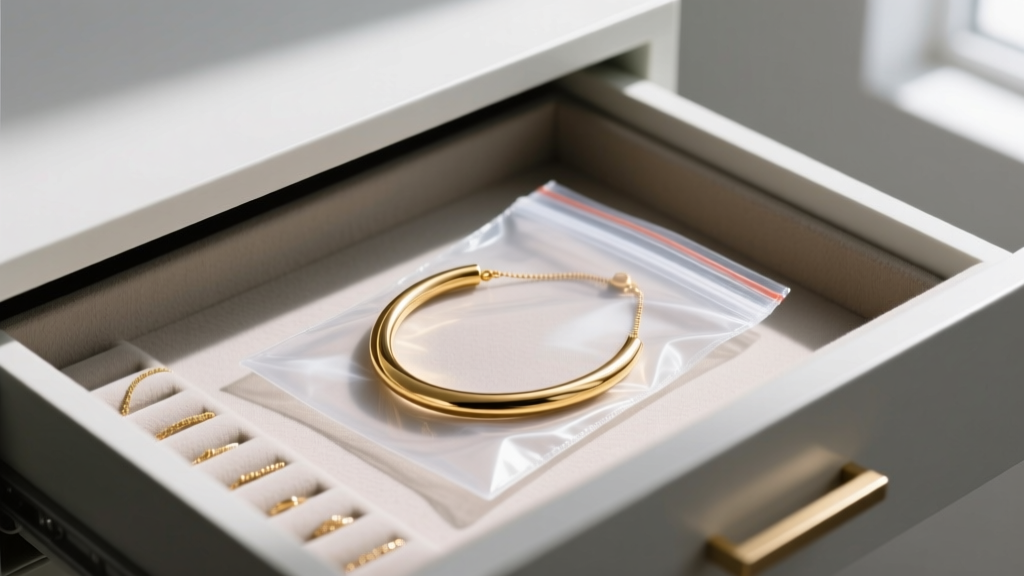
Storage is where most structural damage to curved bar necklaces occurs. Because of the elongated, arched shape, applying uneven pressure to the center of the bar can cause it to bend or snap at the solder points where the chain attaches.
- Store Flat, Never Hanging: While hanging necklaces prevents chain tangles, a heavy curved bar pendant pulling downward on a delicate cable chain for months can stretch the links. Store the piece flat in a dedicated drawer or tray.
- Use Polyethylene Bags: Store the necklace in an individual, food-grade polyethylene zip bag. Polyethylene is non-reactive and will not off-gas chemicals that cause tarnishing.
- Anti-Tarnish Strips: Place a 3M anti-tarnish strip inside the storage bag. These strips absorb atmospheric sulfur and hydrogen sulfide, which are the primary culprits behind the dulling of the copper and silver alloys mixed into 14k and 18k gold.
- The Straw Trick for Travel: When packing for travel, unclasp the necklace, thread one end of the chain through a plastic drinking straw, and re-clasp it. This guarantees the chain will remain perfectly rigid and impossible to tangle around the curved bar in your luggage.
Routine Maintenance Schedule
To keep your gold curved bar necklace looking pristine, establish a consistent maintenance routine. For daily wearers, a gentle wipe-down with a dry microfiber cloth every evening takes less than ten seconds and removes the day's accumulation of oils and acids before they can bond to the metal. Perform the full distilled-water soak and brush cleaning once a month. If your necklace features a hollow curved bar, handle it with extreme care; hollow jewelry is highly susceptible to denting if dropped against a hard surface like a marble bathroom counter. By respecting the metallurgy and geometry of your piece, your curved bar necklace will remain a flawless, shining staple in your collection for decades to come.


