The Coin Bead Necklace: 2026 Trend & Style Guide
Discover the 2026 coin bead necklace trend. Explore expert layering techniques, material grades, durability insights, and gemstone pairings.

The Evolution of the Coin Bead Necklace
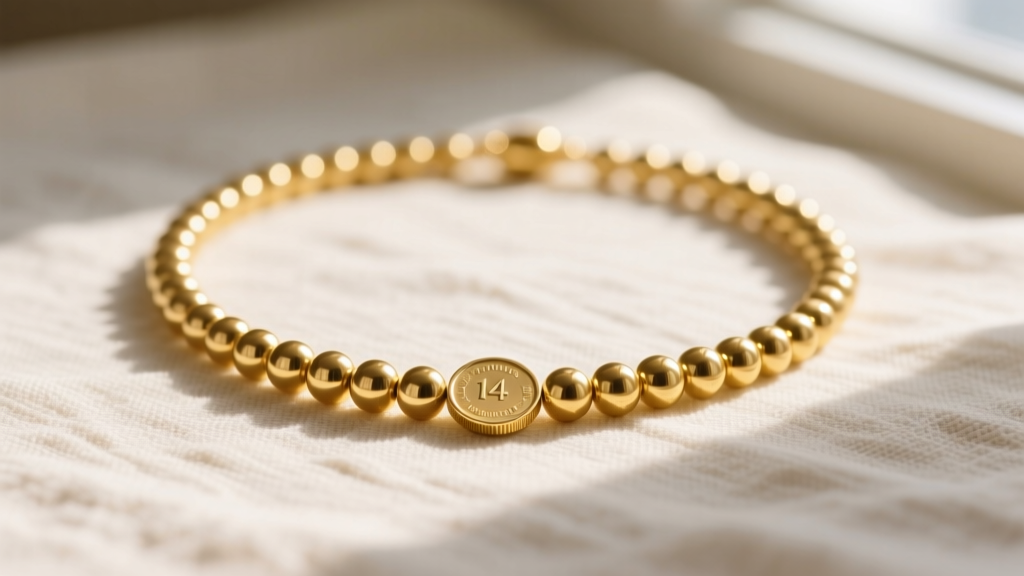
The coin bead necklace has transcended its origins as a casual, bohemian summer staple to become a cornerstone of high jewelry layering in 2026. No longer confined to uniform strands of brass or shell, today's coin bead necklace represents a masterclass in textured minimalism and kinetic movement. Drawing inspiration from 1970s heishi traditions and ancient Egyptian faience discs, modern iterations utilize CNC precision to create flawless metallic planar surfaces. As we analyze the current market, it is clear that collectors and stylists are demanding higher material grades, precision engineering, and sophisticated asymmetry. This comprehensive guide breaks down the anatomy, durability, and strategic styling of the modern coin bead necklace.
The Anatomy of a Coin Bead Necklace
Unlike traditional round or faceted beads, coin beads—often referred to in the trade as disc or heishi-style beads—are defined by their flat, planar geometry. A standard metallic coin bead ranges from 2mm to 8mm in diameter, with a razor-thin profile of 0.5mm to 1.5mm. This unique aspect ratio creates a fluid, fabric-like drape that mimics the movement of liquid metal.
The manufacturing process dictates the bead's behavior and light interaction. Stamped coin beads, cut from sheet metal, offer sharp, uniform edges that catch the light brilliantly, creating a strobe-like 'spangle' effect when the wearer moves. Cast coin beads, conversely, feature softer, slightly irregular edges that provide a more organic, artisanal feel. Sandblasted or matte-finished coin beads absorb light rather than reflecting it, offering a subdued, industrial aesthetic. The drill hole size is equally critical; high-end 14k gold coin beads typically feature a 0.8mm to 1.0mm laser-drilled hole, ensuring a clean pass-through without snagging the stringing material.
2026 Trend Forecast: The Evolution of the Disc
According to recent market analyses highlighted by JCK industry reports, the 2026 jewelry landscape is heavily favoring 'mixed-media tension.' The coin bead necklace is at the forefront of this movement, bridging the gap between delicate chain work and bold statement pieces.
The Asymmetric & Graduated Movements
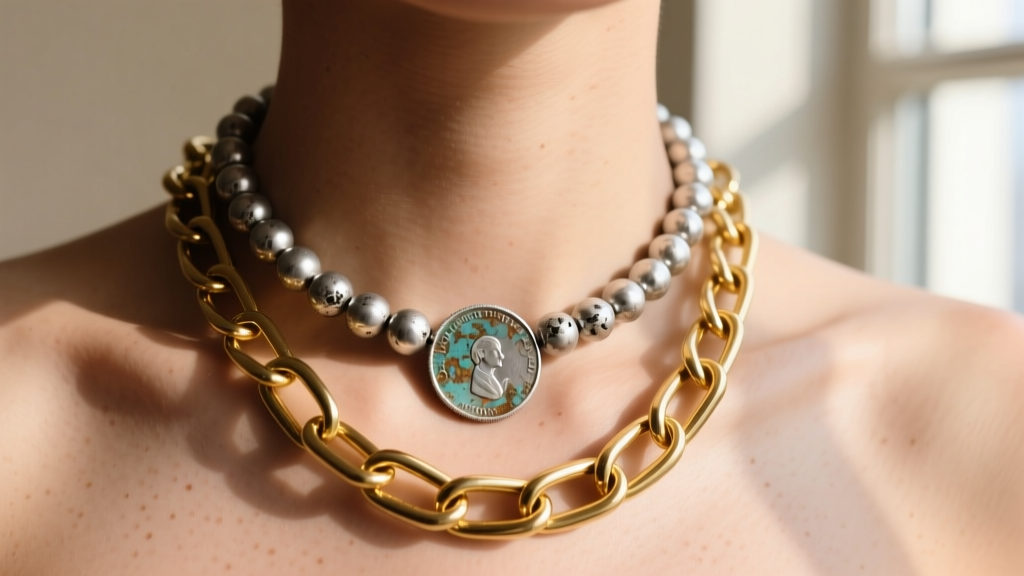
Uniform strands are taking a backseat to graduated designs. We are seeing necklaces that start with delicate 2mm coin beads at the clasp and gradually increase to 6mm discs at the center focal point. This not only reduces the overall weight of the piece but creates a sophisticated, intentional silhouette. Furthermore, asymmetric color blocking—pairing oxidized sterling silver discs with bright 14k yellow gold intervals—is dominating editorial spreads, as noted in Vogue trend archives.
Strategic Layering: A Data-Driven Approach
Layering a coin bead necklace requires an understanding of visual weight and spatial distribution. Because coin beads reflect light across a wide surface area, overcrowding a neckline leads to visual clutter. Below is our proprietary layering matrix for 2026:
| Layer Position | Ideal Length | Bead Diameter | Best Neckline |
|---|---|---|---|
| Choker (Base) | 14 - 15 inches | 2mm - 3mm | Boat Neck, Off-Shoulder |
| Princess (Middle) | 16 - 17 inches | 4mm - 5mm | Scoop Neck, V-Neck |
| Matinee (Outer) | 18 - 20 inches | 6mm - 8mm | Deep V, Button-Down |
The Rule of Kinetic Contrast
When stacking, never pair two coin bead necklaces of the exact same diameter and length. The friction between the flat surfaces will cause them to tangle, scratch, and lay flat against the skin. Always intersperse a coin bead strand with a structural chain, such as a 2.5mm paperclip or a 1.5mm box chain, to allow the discs to move freely and catch the light independently.
Durability & Failure Modes: What Jewelers Don't Tell You
The most common point of failure in a metallic coin bead necklace is not the clasp, but the stringing material interacting with the bead's inner drill hole.
Stringing Wire vs. Link Chain
If your coin beads are strung on a continuous wire, the material must be a 49-strand stainless steel micro-wire (typically 0.018 inches in diameter) coated in nylon. Standard silk thread or cheap nylon monofilament will be severed within months by the microscopic burrs left inside stamped metal beads. The sheer surface area of a 6mm disc creates a pendulum effect that puts immense tensile stress on the stringing core.
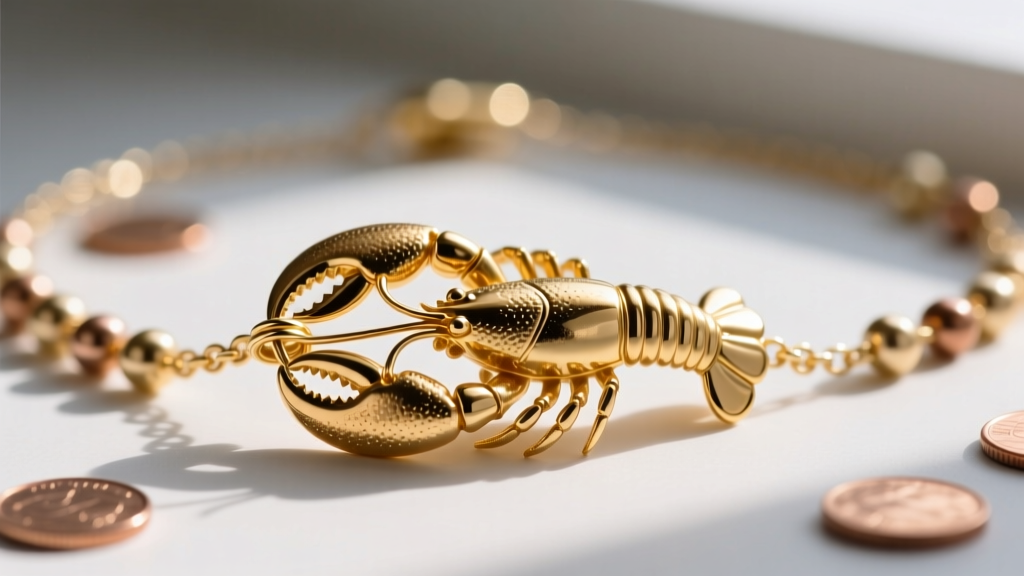
Furthermore, the termination point requires a French wire or a specialized wire guard. A standard crimp bead, when crushed, leaves a sharp edge that can fray the wire over time. High-end jewelers use a 2mm sterling silver crimp tube that is folded and finished with a metal crimp cover, ensuring a seamless, protected transition to the lobster claw clasp.
Gemstone Integration: Mohs Scale & Porosity
In 2026, integrating gemstone coin beads into metallic strands is highly popular, but it requires strict adherence to gemological hardness. The GIA Gem Encyclopedia outlines the Mohs scale of mineral hardness, which is critical when mixing materials in a high-friction necklace.
- Malachite & Turquoise (Mohs 3.5 - 6): These porous, softer stones will easily scratch if rubbed against harder 14k gold or steel coin beads. They must be separated by micro-spacer beads or knotted wire to prevent surface degradation.
- Lapis Lazuli (Mohs 5 - 5.5): Contains pyrite inclusions that can create galvanic reactions or physical abrasion against silver discs if not properly sealed and spaced.
- Jade & Agate (Mohs 6.5 - 7): Excellent candidates for coin bead cutting. They polish beautifully, resist scratching from metal beads, and withstand daily wear against the clavicle without losing their luster.
A true masterclass in layering isn't about adding more; it's about engineering the negative space between the discs to maximize kinetic light reflection.
Neckline Mapping: Styling for Architecture
The flat geometry of a coin bead necklace interacts uniquely with clothing necklines, requiring deliberate styling choices.
- The Boat Neck: Demands a 14-inch choker with 3mm beads. The horizontal line of the boat neck is echoed by the horizontal alignment of the small discs, creating a cohesive, architectural frame for the collarbone.
- The Deep V-Neck: Requires an 18-inch matinee length with graduated 6mm beads. The V-shape draws the eye downward, and the larger, heavier beads at the terminus act as a visual anchor, preventing the necklace from floating aimlessly on the chest.
- The Button-Down Shirt: Worn unbuttoned to the sternum, this calls for a 16-inch princess length. The coin beads will rest against the cotton or silk lapels, and the metallic spangle will contrast beautifully with the matte fabric.
Price Tiers & Investment Guide
Understanding the pricing architecture of the coin bead necklace market ensures you invest in pieces that retain their structural and aesthetic integrity.
- Entry-Level (Brass & Plated): $25 - $45. Expect electroplated brass with a high risk of tarnishing within a single season due to skin acidity reacting with the large surface area of the discs.
- Mid-Tier (Sterling & Gold-Filled): $85 - $160. Look for heavy gold-filled (14/20) wire and beads. Ensure the sterling silver is rhodium-plated if you wish to avoid the maintenance of polishing flat discs.
- Investment Grade (Solid 14k & 18k): $350 - $1,200+. Solid gold coin beads are stamped from precious metal sheets. They offer lifelong durability, hypoallergenic properties, and a distinct, heavy drape that plated alternatives cannot replicate.
Final Verdict for 2026
The coin bead necklace has matured from a fleeting festival trend into a permanent fixture of the modern jewelry wardrobe. By prioritizing 49-strand wire construction, respecting gemstone hardness scales, and utilizing graduated layering matrices, you can curate a collection that offers unparalleled kinetic beauty and lifelong durability.


