Copper Cross Necklace Deep Dive: Patina, Alloys & Chain Gauge Guide
Explore the metallurgy of a copper cross necklace. Learn about patina control, skin-safe sealing, alloy grades, and optimal chain gauges for daily wear.


The Metallurgy of C11000 Copper in Jewelry
A copper cross necklace is far more than a symbolic or aesthetic choice; it is a living piece of metallurgy that interacts dynamically with its environment and the wearer's biology. Unlike inert metals such as platinum, titanium, or even high-karat gold, copper is a highly reactive transition metal. To truly understand how to wear, maintain, and appreciate a copper cross pendant, one must look at the material science governing its behavior.
Most high-quality, pure copper jewelry is crafted from C11000, also known as Electrolytic Tough Pitch (ETP) copper, which boasts a purity of 99.9%. From a fabrication standpoint, pure copper presents unique challenges. It has a Mohs hardness of just 3.0 and a Vickers hardness of roughly 50 HV in its annealed (softened) state. Because of its high melting point (1,085°C or 1,985°F) and its tendency to absorb atmospheric gases during melting, pure copper is rarely cast using traditional lost-wax jewelry methods. Cast copper often suffers from internal porosity, surface pitting, and structural weakness.
Die-Struck vs. Cast Fabrication
Instead of casting, premium copper cross pendants are typically die-struck or stamped from heavy-gauge sheet metal. This cold-working process induces work-hardening, which compresses the crystalline lattice of the metal, increasing its tensile strength and making the pendant significantly more resistant to bending, warping, and scratching. When sourcing a copper cross necklace, look for manufacturers that specify "die-struck," "stamped," or "cold-forged." These pieces will feature sharper edge definition and vastly superior structural longevity compared to their cast counterparts.
The Chemistry of Patina and Verdigris
The most misunderstood aspect of wearing a copper cross necklace is the development of patina and the infamous "green skin" effect. This is not an allergic reaction or a sign of toxic heavy metals; it is a predictable, harmless chemical synthesis. When copper is exposed to moisture, oxygen, and the chlorides and lactic acid present in human sweat, it undergoes a multi-stage oxidation process.
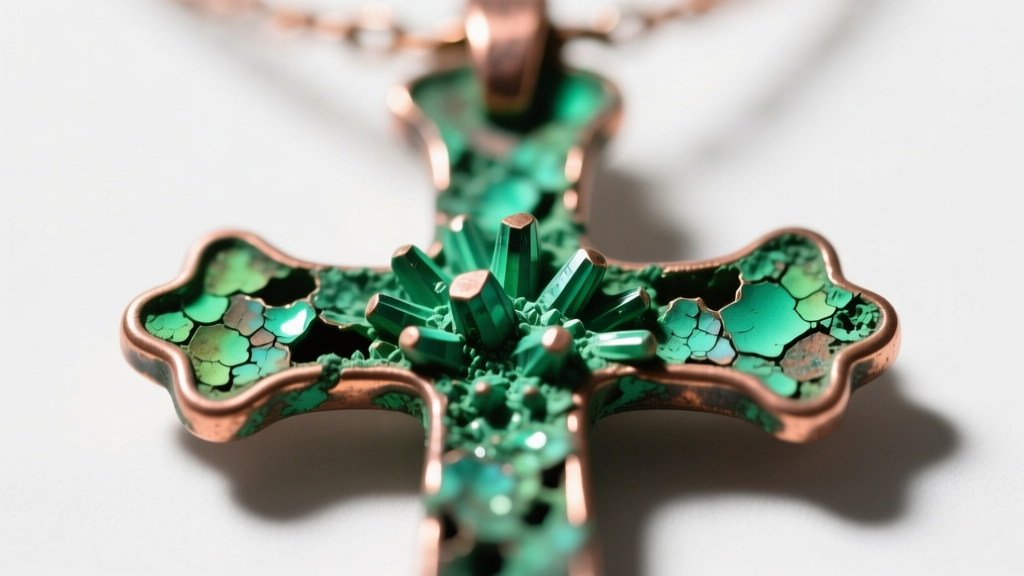
- Stage 1 (Cuprite): Copper reacts with ambient oxygen to form cuprite (Cu2O), yielding a dull red, pinkish, or orange hue.
- Stage 2 (Tenorite): Further oxidation creates tenorite (CuO), turning the metal a dark, earthy brown or matte black.
- Stage 3 (Verdigris): In the presence of chlorides (salt from sweat) and carbon dioxide, copper forms copper chloride and copper carbonate. This is the bright green compound that transfers to the epidermis.
The rate of this reaction is heavily dictated by the wearer's individual skin pH. Individuals with highly acidic sweat (a pH below 5.5) will accelerate the verdigris process, sometimes turning a bright copper cross completely dark within a single week of continuous wear.
Advanced Sealing and Coating Technologies
If you wish to maintain the bright, salmon-pink luster of raw copper and prevent skin discoloration, you must interrupt the oxidation process using chemical barriers. Avoid generic clear nail polynomials or cheap acrylic sprays; these yellow, crack, and trap moisture against the metal, accelerating localized galvanic corrosion.
Expert Tip: For museum-grade preservation of reactive metals, micro-crystalline waxes and nano-ceramic polymers are the industry standards. They provide an impermeable barrier without altering the optical refraction of the metal surface.
Renaissance Wax: Originally developed for the British Museum to protect antiquities, this micro-crystalline wax requires buffing and reapplication every few weeks. It preserves the natural, warm tactile feel of the copper but will eventually wear off at high-friction contact points.
Nano-Ceramic Coatings: Products like ProtectaClear nano-ceramic coatings are proprietary, clear polymers specifically engineered for reactive metals. Applied via dipping or spraying, they cross-link to form a microscopic, impermeable barrier (typically 2 to 4 microns thick). This completely halts oxidation and prevents copper salts from contacting the skin, making it ideal for daily-wear copper cross necklaces.
Chain Gauge and Structural Integrity
Pure copper lacks the ultimate tensile strength of sterling silver, stainless steel, or titanium. A heavy, solid copper cross pendant can easily distort a delicate copper chain over time due to gravity, friction, and the metal's inherent malleability. Selecting the correct wire gauge for the chain is critical for preventing catastrophic link failure.
| Wire Gauge | Diameter (mm) | Tensile Suitability | Best Pendant Weight |
|---|---|---|---|
| 24-Gauge | 0.51 mm | Low | Under 5g (Hollow/Stamped) |
| 22-Gauge | 0.64 mm | Moderate | 5g - 12g (Standard Solid) |
| 20-Gauge | 0.81 mm | High | 12g - 25g (Heavy Die-Struck) |
| 18-Gauge | 1.02 mm | Very High | 25g+ (Oversized Statement) |
Link Style Considerations
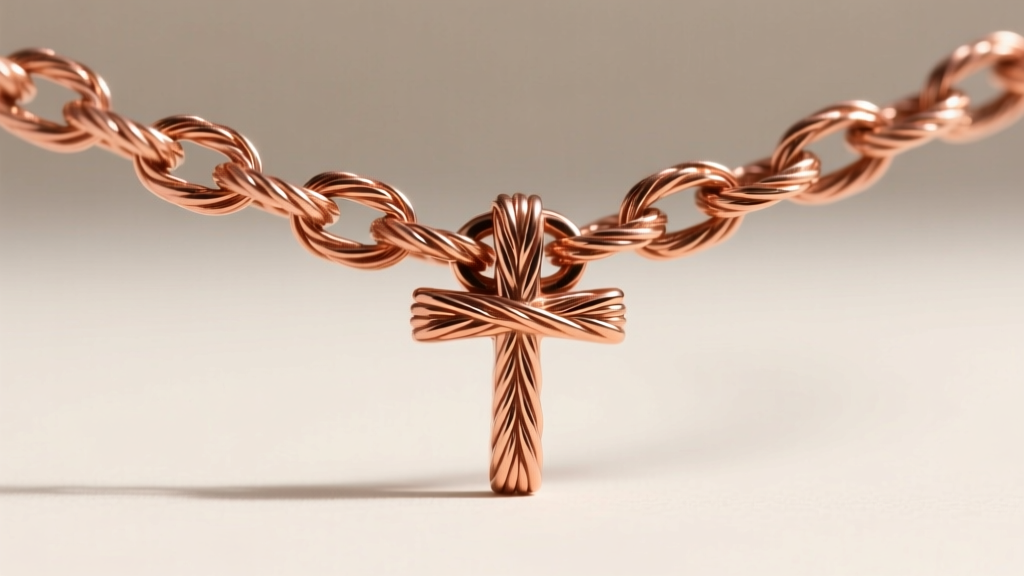
Beyond gauge thickness, the geometry of the chain link dictates its strength. Cable chains offer a classic look but present single points of failure at the soldered joints. Rolo chains, featuring interlocking, uniform D-shaped rings without solder, distribute tension more evenly and are highly recommended for heavy copper crosses. Wheat (Spiga) chains offer the highest structural redundancy, as the woven, multi-directional links prevent localized stress fractures, making them the premier choice for heirloom-weight copper pendants.
Maintenance and Chemical Restoration Protocols
When a copper cross necklace becomes heavily oxidized or coated in stubborn verdigris, mechanical polishing (using abrasive pastes or polishing cloths) will remove microscopic layers of the base metal. Over years of polishing, this will eventually soften the engraved details and thin the bail. Instead, utilize a mild chemical reduction bath to restore the metal without abrasion.
According to metallurgical data from suppliers like Rio Grande, organic acids are highly effective at stripping copper oxides. A solution of warm distilled water, a tablespoon of citric acid powder, and a pinch of non-iodized salt will strip tenorite and cuprite in minutes, revealing the bright, raw copper beneath.
Crucial Final Step: You must immediately rinse the pendant in a baking soda and water solution to neutralize the acid. Failure to neutralize the citric acid will result in rapid, aggressive micro-pitting on the copper's surface. Dry the piece thoroughly with a microfiber cloth, and immediately apply your chosen micro-crystalline wax or nano-ceramic sealant to lock in the restored finish.


