Cube Necklace Guide: Technical Sizing & Metal Grades
Explore the engineering behind the cube necklace. We analyze metal grades, dimensional tolerances, bail structures, and structural failure modes.

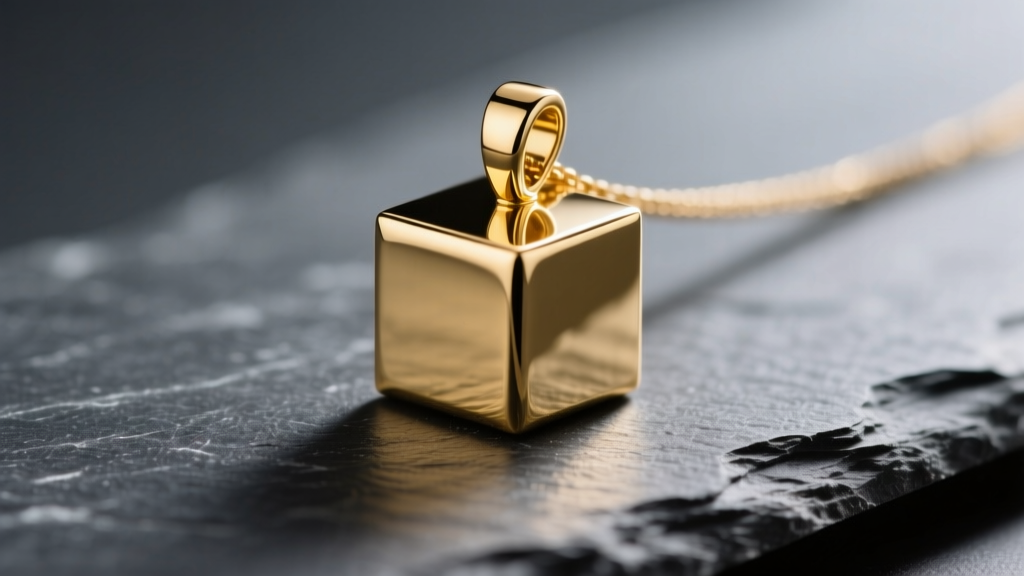
The cube necklace has transcended fleeting geometric trends to become a staple of modern minimalist jewelry. However, beneath its deceptively simple exterior lies a complex interplay of metallurgy, structural engineering, and physics. Unlike teardrop or spherical pendants, the cubic form introduces unique stress concentrators at its vertices and requires precise bail placement to dictate how it rests against the clavicle. In this technical deep dive, we dissect the anatomy of the cube necklace, examining alloy hardness, dimensional tolerances, and the mechanical failure points that separate heirloom-quality pieces from disposable fast fashion.
The Physics of the Cube: Center of Mass and Hanging Dynamics
A perfect cube possesses a geometric center of mass that aligns exactly with its volumetric center. When designing or selecting a cube pendant, the placement of the bail (the loop that connects the pendant to the chain) fundamentally alters its hanging dynamics. A bail placed precisely on the center of the top face forces the cube to hang with its bottom face parallel to the floor, presenting a flat, orthogonal profile to the viewer. Conversely, a bail drilled diagonally through a corner axis causes the cube to hang at a 45-degree angle, presenting a dynamic, diamond-like silhouette.
Furthermore, the cube's sharp 90-degree corners act as natural snag points. High-end manufacturers utilize a technique called micro-chamfering, applying a 0.2mm to 0.5mm radius to all edges and vertices. This preserves the optical illusion of a sharp geometric edge while eliminating the microscopic burrs that catch on silk, knitwear, and hair.
Solid vs. Hollow Construction: Structural Integrity
The most critical purchasing decision regarding a cube pendant is its internal architecture. Hollow cubes are manufactured via electroforming or by soldering two stamped halves together. While they offer a larger visual footprint for a lower gold weight (and thus a lower price), they are highly susceptible to catastrophic deformation.
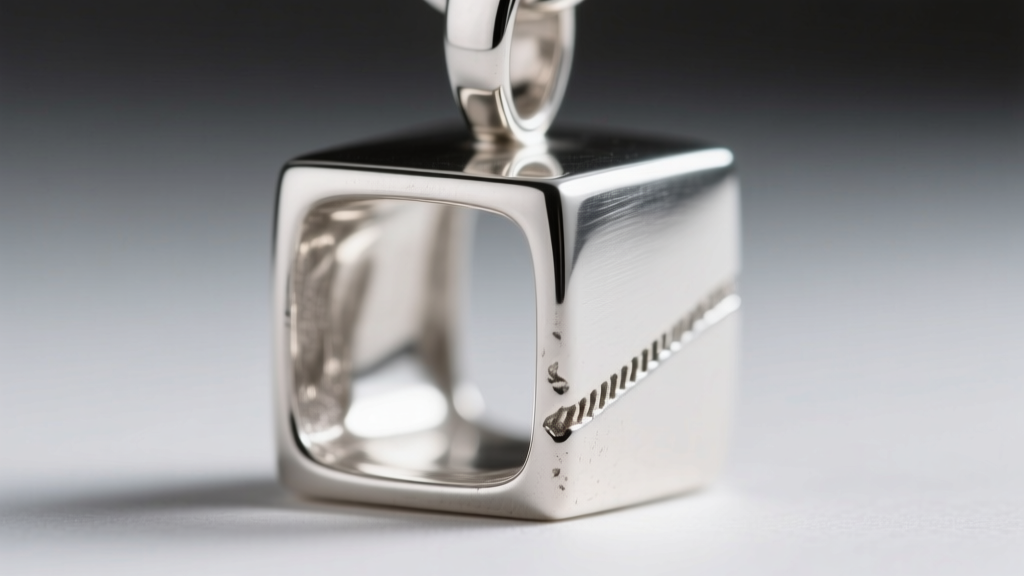
When a hollow cube is subjected to compressive force—such as being leaned against a steering wheel or accidentally crushed in a gym locker—the thin metal walls buckle. Once a hollow cube dents, it cannot be hammered out without breaking the solder seams or compromising the structural integrity of the alloy. For daily wear, a solid cast cube or a CNC-milled billet cube is mandatory. If budget constraints necessitate a hollow design, ensure the wall thickness is no less than 0.8mm, and avoid any cube larger than 12mm, as the surface area increases the lever-arm effect of any applied pressure.
Metallurgical Breakdown: Alloy Hardness and Wear Resistance
The flat planes of a cube pendant act as mirrors, reflecting light but also highlighting scratches, scuffs, and oxidation. The choice of metal alloy dictates the pendant's long-term surface preservation. We measure this using the Vickers Hardness (HV) scale, which quantifies a metal's resistance to indentation and abrasion.
| Alloy Grade | Vickers Hardness (HV) | Tarnish / Corrosion Resistance | Best Use Case |
|---|---|---|---|
| Sterling Silver (925) | 60 - 75 HV | Poor (Oxidizes, requires polishing) | Occasional wear, budget-friendly geometric pieces |
| 14k Yellow/White Gold | 130 - 150 HV | Excellent (Does not tarnish) | Daily wear, heirloom pieces, standard luxury |
| 18k Yellow Gold | 110 - 130 HV | Excellent (Rich color, softer than 14k) | High-end luxury, softer edge wear over decades |
| 316L Stainless Steel | 150 - 190 HV | Superior (Molybdenum prevents pitting) | Heavy daily wear, active lifestyles, industrial aesthetics |
| Grade 5 Titanium (Ti-6Al-4V) | 340 - 360 HV | Absolute (Biocompatible, inert) | Hypoallergenic requirements, ultra-lightweight large cubes |
According to the FTC Jewelry Guides, precious metal purities must be accurately hallmarked. When purchasing a gold cube necklace, always verify the stamp (e.g., 585 for 14k, 750 for 18k) and ensure the alloying metals (like copper or palladium) align with your skin's sensitivity and the desired color temperature.
Bail Engineering and Chain Pairing Mechanics
The bail is the primary mechanical failure point of any pendant necklace. For a cube necklace, the bail must not only support the pendant's weight but also manage the friction generated as the heavy geometric shape swings and rotates.
Tube Bails vs. Loop Bails
A traditional loop bail (a wire soldered to the top) creates a concentrated wear point on the chain. For cubes heavier than 8 grams, a hidden tube bail is structurally superior. A tube bail is essentially a hollow cylinder integrated into the top plane of the cube. It distributes the chain's friction across a wider surface area and lowers the pendant's center of gravity, preventing it from flipping upside down.
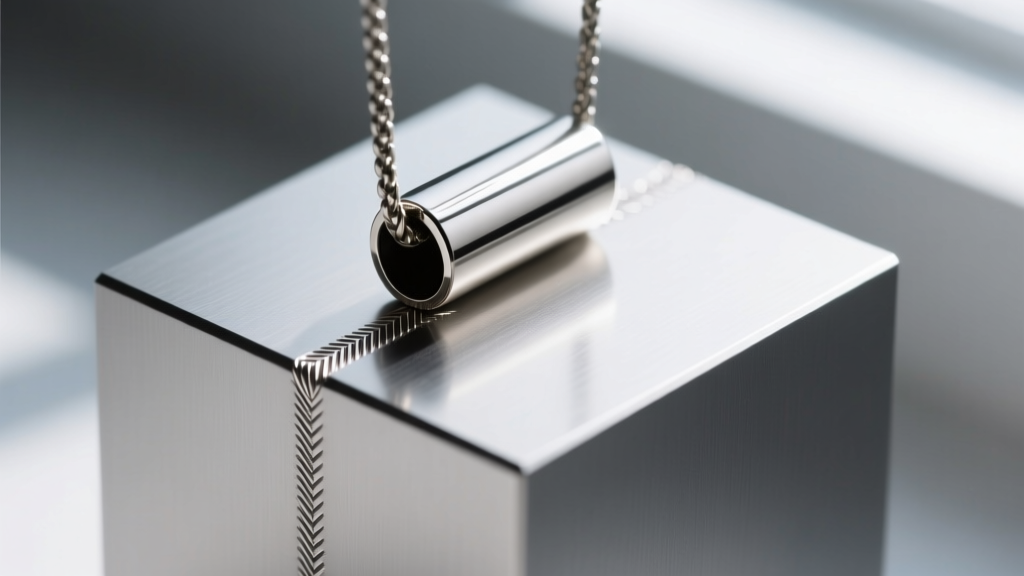
The 1.5x Rule: The internal diameter of the bail must be at least 1.5 times the thickness of the chain. If you are using a 2.0mm box chain, the bail's internal clearance must be a minimum of 3.0mm. Failing to adhere to this ratio causes the chain links to bind, leading to accelerated metal-on-metal abrasion and eventual chain snap.
Chain Selection for Geometric Pendants
Pairing a cube pendant requires balancing visual geometry with mechanical sympathy.
- Box Chains: While visually complementary to the cube, box chains have sharp internal corners that can act like a file against the inside of a soft gold bail. If using a box chain, opt for a rounded-edge variation.
- Rope Chains: The helical structure of a rope chain provides a smooth, rolling contact surface inside the bail, drastically reducing friction wear. It also offers a brilliant textural contrast to the flat planes of the cube.
- Wheat (Spiga) Chains: Highly recommended for heavy solid cubes (15mm+). The woven, directional links offer immense tensile strength and resist kinking under the pendulum-like swing of a heavy geometric pendant.
Dimensional Tolerances and Sizing Guide
Selecting the correct cube size involves balancing visual impact with physical weight. Because a cube occupies three-dimensional space equally, its volume (and thus its weight in solid metals) increases cubically relative to its edge length. A seemingly small increase in millimeter size results in a massive jump in gold weight and price.
- 5mm - 7mm (The Micro Cube): Weighs 1.5g to 3.0g in solid 14k gold. Ideal for layering or delicate, everyday minimalism. Best paired with a 1.0mm to 1.2mm cable chain.
- 8mm - 10mm (The Standard): Weighs 5.0g to 10.0g. The optimal size for a standalone statement piece that sits comfortably on the collarbone without pulling the neckline. Requires a 1.5mm to 2.0mm chain.
- 12mm - 15mm (The Statement): Weighs 18.0g to 35.0g+. A bold, architectural piece. Due to the weight, it must be paired with a heavy-duty clasp (such as a custom lobster or box lock) rather than a standard spring-ring, which will fail under the dynamic load.
Maintenance and Structural Troubleshooting
Maintaining the optical purity of a cube necklace requires specific care protocols. The flat facets of a polished cube will show fingerprint oils and micro-scratches more readily than textured or hammered pendants.
"When polishing a geometric pendant, never use a high-speed rotary buffing wheel with aggressive rouge. The wheel will inevitably catch the sharp corners, rounding them off and destroying the architectural integrity of the cube. Always use a low-speed magnetic tumbler or hand-polish with a microfiber cloth and gentle jeweler's paste." — Master Bench Jeweler Guidelines
If your cube necklace features a matte or brushed finish, be aware that friction from clothing will slowly burnish the high-contact areas (the bottom edge and corners) back to a high polish over time. To restore a matte finish, a jeweler must use a fiberglass scratch pen or a localized sandblasting cabinet, carefully masking off the bail and any polished accents.
Ultimately, the cube necklace is a triumph of geometric minimalism, but its longevity relies entirely on precision manufacturing. By prioritizing solid construction, respecting the Vickers hardness of your chosen alloy, and adhering to proper bail-to-chain ratios, you ensure that your geometric pendant remains a structurally sound and visually striking artifact for decades. For further verification of precious metal standards and hallmarking laws, always consult the Gemological Institute of America (GIA) resources before making high-value acquisitions.


