Decoding the Khloe Kardashian Cross Necklace: An Expert Guide
An expert technical breakdown of the Khloe Kardashian cross necklace, covering diamond specs, chain metallurgy, and precise layering mechanics.

The Cultural and Technical Weight of the Khloe Kardashian Cross Necklace
When analyzing celebrity jewelry trends, few pieces carry the immediate visual recognition and stylistic weight of the Khloe Kardashian cross necklace. Often spotted layered over streetwear or contrasting with high-end couture, Khloe’s preference for diamond-encrusted cross pendants has solidified the motif as a staple in modern luxury jewelry. However, replicating this aesthetic requires more than just purchasing any cross pendant; it demands a strict adherence to specific metallurgical standards, diamond grading matrices, and structural engineering. In this expert deep dive, we deconstruct the exact technical specifications required to achieve a celebrity-grade cross necklace, moving beyond superficial style advice into the tangible metrics of fine jewelry manufacturing.
Anatomy of a Celebrity-Grade Cross Pendant
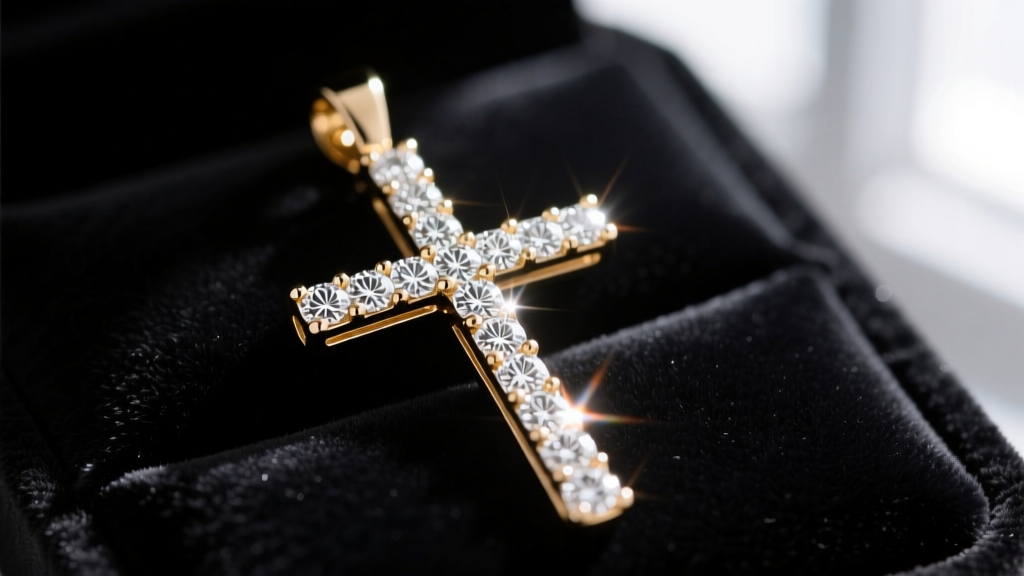
The visual impact of a high-end cross pendant is dictated by its dimensional ratios and the precision of its stone setting. Mass-market crosses often suffer from poor proportions—either too elongated or too stubby—which disrupts the natural geometry of the neckline. A true Kardashian-style cross typically adheres to the classic Latin cross ratio, measuring approximately 35mm to 45mm in height and 22mm to 28mm in width. This specific footprint provides enough surface area for intricate diamond work without overwhelming the wearer's clavicle.
Dimensional Ratios and Bail Engineering
The bail—the loop that connects the pendant to the chain—is a critical point of failure in poorly constructed jewelry. For a heavy diamond cross weighing between 12 and 20 grams, a standard soldered jump ring is insufficient. Expert jewelers utilize a tapered, solid-cast hidden bail or a reinforced double-ring bail milled from a single block of 18k gold. This prevents the bail from warping under the kinetic stress of daily wear. According to the Jewelers of America, regular inspection of the bail's connection point is essential, as friction against the chain can slowly degrade the metal over time.
Diamond Melee vs. Center Stone Specifications
The brilliance of the Khloe Kardashian cross necklace stems from the meticulous selection of diamond melee. Celebrity-grade crosses typically utilize VS1-VS2 clarity melee diamonds in the F-G color range. Because melee stones (usually 0.01 to 0.05 carats each) do not receive full grading reports from the Gemological Institute of America (GIA), reputable jewelers rely on calibrated sieve sizes to ensure uniform light return across the pave matrix. If the cross features a center stone, it is generally a custom-cut baguette or a round brilliant weighing between 0.50 and 1.00 carats, serving as an anchor for the surrounding micro-pave halo.
Chain Metallurgy: The Foundation of the Pendant
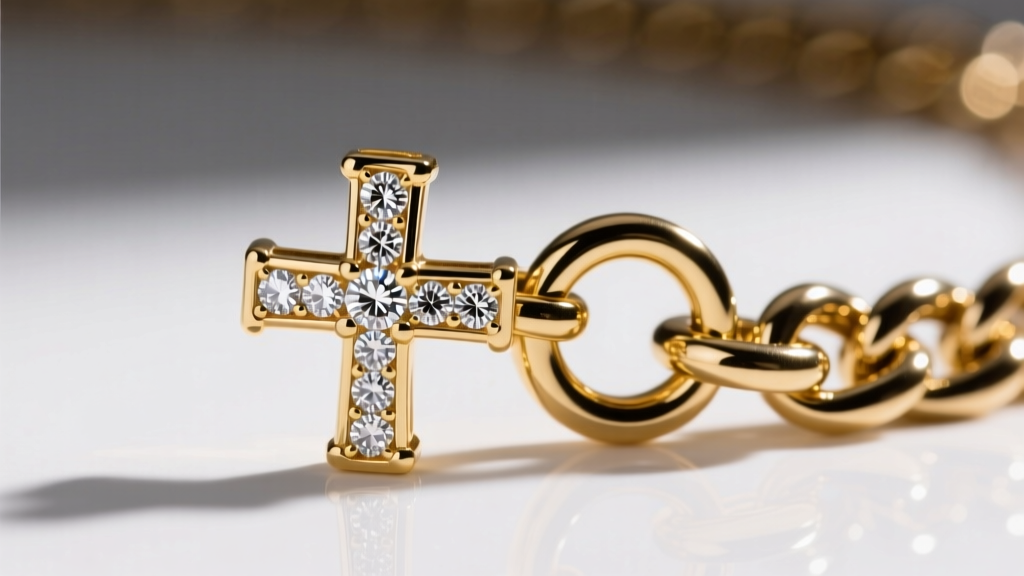
A pendant is only as secure as the chain that holds it. The Kardashian aesthetic heavily favors substantial, high-polish chains that complement the heavy diamond cross. The choice of gold purity and chain link style directly impacts both the tensile strength and the drape of the necklace.
| Chain Type | Width (mm) | Tensile Strength | Best For |
|---|---|---|---|
| Cuban Link | 3.5 - 5.0 | High | Heavy Cross Pendants (15g+) |
| Rope Chain | 2.5 - 4.0 | Medium-High | Medium Pendants, High Sparkle |
| Tennis Chain | 3.0 - 5.0 | Medium | Formal Events, Diamond-to-Diamond |
| Figaro Chain | 3.0 - 4.5 | Medium | Vintage Aesthetics, Layering |
18k yellow gold comprises 75% pure gold, alloyed with a precise matrix of silver and copper to achieve the warm, rich hue favored in high-end celebrity jewelry. However, 18k gold has a lower Vickers hardness (~125 HV) compared to 14k gold (~140 HV). For heavy crosses exceeding 15 grams, a 14k gold Cuban link is technically superior for tensile strength, though 18k remains the prestige standard for the pendant itself. Furthermore, the clasp must be a solid-cast lobster clasp; stamped sheet-metal clasps are prone to snapping under the pendulum effect of a heavy cross.
Sourcing and Replicating the Look
Acquiring a piece that mirrors the Khloe Kardashian cross necklace involves navigating the modern diamond market, where lab-grown and natural stones offer distinct advantages depending on the buyer's priorities. The Federal Trade Commission (FTC) Jewelry Guides mandate strict disclosure regarding the origin of these stones, ensuring consumers know exactly what they are purchasing.
Lab-Grown vs. Natural Diamond Matrices
Lab-grown diamonds produced via Chemical Vapor Deposition (CVD) offer identical optical and physical properties to mined stones but often exhibit distinct strain patterns under cross-polarized light. When sourcing a high-end cross replica, prioritize CVD stones with post-growth annealing to eliminate any brownish undertones. A 4.00 Total Carat Weight (TCW) lab-grown cross can be sourced for roughly $3,500 to $5,000, whereas the exact natural diamond equivalent commands a premium of $12,000 to $18,000. For the visual aesthetic of the Kardashian look, the light performance of a well-cut lab matrix is indistinguishable to the naked eye.
Prong Setting vs. Bezel Setting Durability
The setting style dramatically alters the maintenance requirements of the necklace. While micro-prong settings maximize the visible surface area of the diamonds, creating a 'wall of light' effect, they are highly susceptible to snagging on knitwear. For daily wear, a shared-prong or honeycomb bezel setting offers superior structural integrity. In a honeycomb setting, the metal is milled into a hexagonal lattice that secures the girdle of each melee stone, reducing the risk of diamond loss by over 60% compared to traditional bright-cut pave.
Layering Mechanics: The Multi-Pendant Strategy
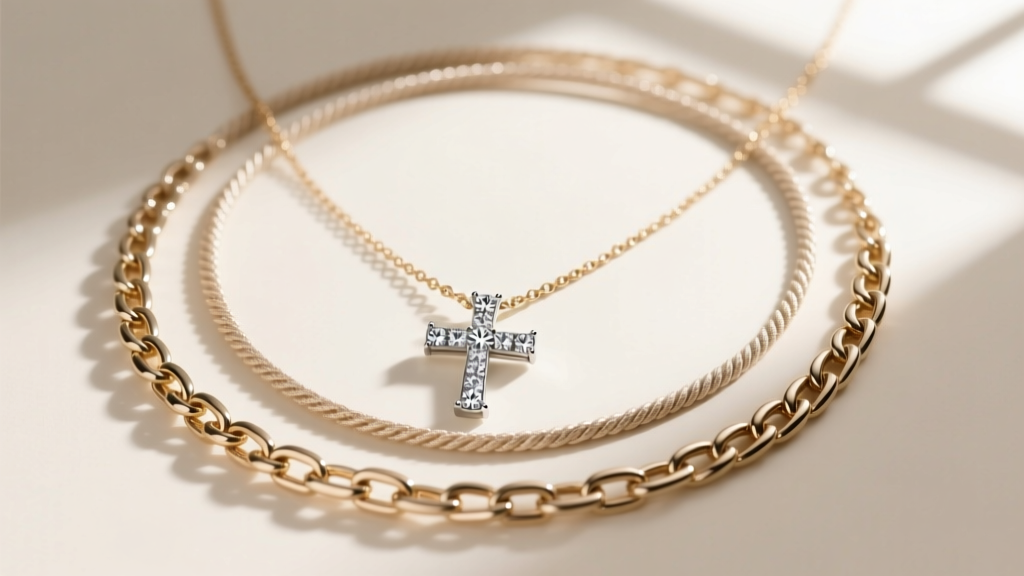
Khloe Kardashian rarely wears a single chain in isolation; her signature look involves strategic layering. However, layering heavy diamond pieces requires an understanding of spatial geometry to prevent the chains from tangling and the pendants from scratching one another. The Kardashian layering technique relies on a strict 2-inch to 3-inch differential between chains. A 20-inch rope chain paired with an 18-inch Cuban link ensures the pendants rest at distinct anatomical zones—the clavicle and the upper sternum. This prevents the 'tangle effect' caused by chains of similar lengths rubbing against each other. When layering a diamond cross with a secondary pendant, such as a solid gold initial or a smaller crucifix, ensure the secondary piece is at least 40% lighter in gram weight to maintain visual hierarchy and prevent the heavier cross from dominating the drape of the lighter chain.
Final Expert Verdict
The Khloe Kardashian cross necklace is not merely a trend; it is a masterclass in proportion, metallurgy, and diamond selection. By prioritizing precise dimensional ratios, opting for reinforced bail engineering, and understanding the tensile limitations of various gold alloys, collectors and enthusiasts can invest in pieces that offer both the immediate visual impact of celebrity style and the long-term structural integrity of heirloom-grade fine jewelry.


