How to Detangle a Necklace Chain Without Breaking Fine Links
Learn how to detangle a necklace chain safely. Expert troubleshooting for micro-knots, lubricant choices, and tools to save fragile gold and silver links.

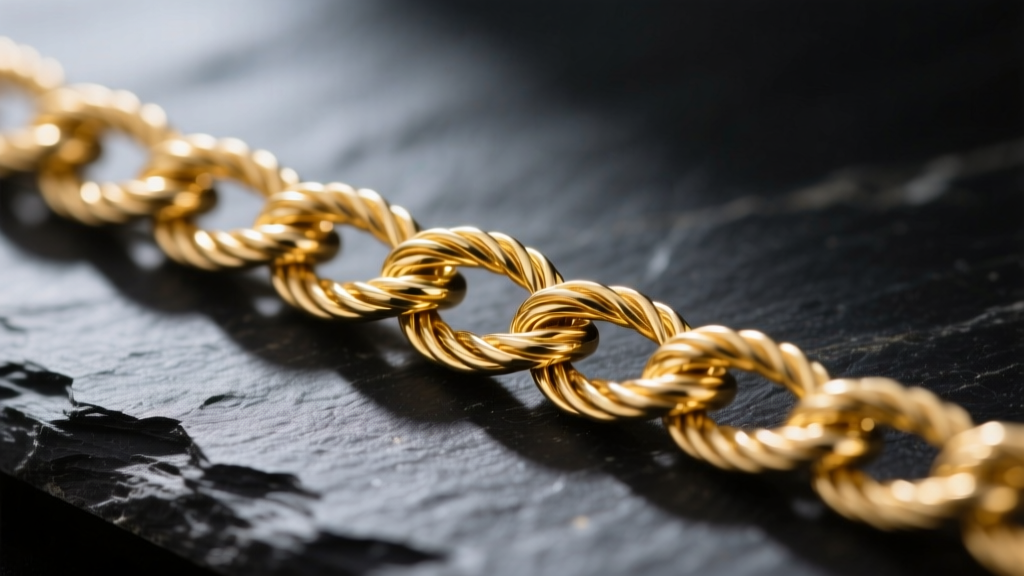
Learning how to detangle a necklace chain without causing structural damage requires patience, the right lubricants, and an understanding of metal fatigue. When a fragile 22-gauge (0.64mm) cable chain or a fluid herringbone necklace folds in on itself, the friction between the micro-links increases exponentially. Pulling at the ends only tightens the knot, leading to work-hardening and eventual link failure. This expert troubleshooting guide provides a metallurgical and practical framework for rescuing your most delicate necklaces.
The Anatomy of a Chain Knot: Why Fine Links Tangle
Not all chains tangle with the same frequency or severity. The geometry of the chain dictates its vulnerability. According to gemological and metallurgical standards outlined by the Gemological Institute of America (GIA), the surface area and interlocking potential of a chain's links determine its friction coefficient.
High-Risk Chain Profiles
- Cable and Box Chains (0.8mm - 1.2mm): The open loops act as tiny hooks. When stored loose, a single link can pass through two others, creating a complex slipknot.
- Herringbone and Snake Chains: These flat, flush-linked chains rarely form traditional "knots." Instead, they suffer from structural folding (kinking), where the chain bends against its natural articulation axis, permanently displacing the links.
- Rope Chains: The twisted geometry creates high surface friction. Once a knot forms, the spiraled links grip each other tightly, making dry extraction nearly impossible.
It is also vital to understand link construction. Flash-soldered links (where the jump ring is sealed with a micro-weld) are more resilient to pulling but will snap catastrophically if the knot is forced. Unsoldered links, common in cheaper mass-market chains, will simply pull apart, which is actually preferable to the wire itself shearing.
The Lubricant Matrix: What to Use and What to Avoid
The most common mistake when figuring out how to detangle a necklace chain is using the wrong lubricant. Oils can trap microscopic dust, creating an abrasive lapping compound that wears down soft metals like 24k gold or high-karat alloys. Below is a breakdown of the most effective friction-reducing agents.
| Lubricant | Friction Reduction | Residue Risk | Best Application |
|---|---|---|---|
| Baby Powder (Talc/Cornstarch) | High | Low (Easily brushed off) | Dry knots in cable and box chains |
| Light Mineral Oil | Very High | Medium (Requires washing) | Severe, multi-layered rope chain knots |
| WD-40 / Solvent Sprays | High | High (Chemical odor/staining) | Emergency use on stainless steel or platinum only |
| Graphite Powder | Medium | High (Leaves black smudges) | Not recommended for jewelry |
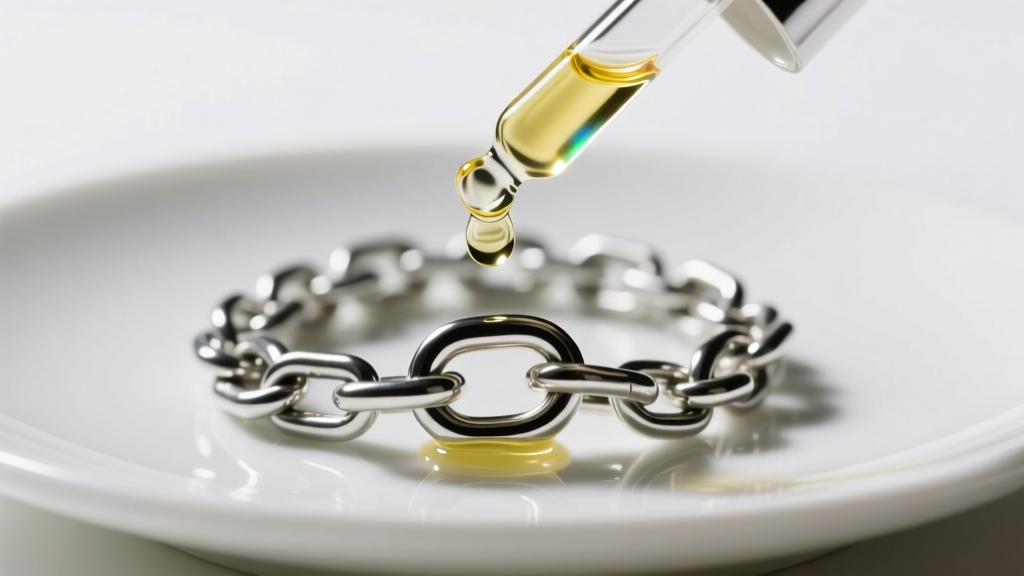
Expert Tip: For gold and silver chains under 1.5mm, start with baby powder. The fine particles act like microscopic ball bearings, rolling between the links and breaking the surface tension without leaving a sticky residue that attracts grit.
Step-by-Step Micro-Knot Extraction Protocol
Abandon standard sewing needles. The eye of a sewing needle has a raised ridge that will catch on micro-soldered jump rings, potentially snapping a fragile 24-gauge link. Instead, source entomology pins (size #1 or #2) or specialized jewelry knot-picking tools, which feature a perfectly smooth, tapered titanium or stainless steel shaft ending in a 0.15mm point.
The Extraction Environment
- Surface Preparation: Place the chain on a hard, non-porous surface like a glass pane or smooth acrylic. Fabric surfaces have microscopic fibers that grab onto open links and hinder movement.
- Illumination: Use a 5000K daylight LED desk lamp. Warm light (2700K) washes out the contrast needed to see the overlapping boundaries of fine wire links.
- Optics: While a standard 10x triplet loupe is excellent for inspecting diamond clarity, it lacks the depth of field required for knot manipulation. Use a 3x to 5x magnifying visor or a digital USB microscope. This allows you to keep both hands free while maintaining a stereoscopic view of the knot's overlapping geometry.
- Powder Application: Generously dust the knot with baby powder. Gently tap the surface next to the chain to vibrate the powder into the link crevices.
- Core Loosening: Insert two entomology pins into the exact center of the knot. Push the pins away from each other to expand the core. Never pull the ends of the chain; this acts as a drawstring and tightens the knot.
- Peripheral Teasing: Once the core has a millimeter of slack, identify the outermost link that is looping over the others. Use a single pin to lift that link and gently slide it off the pile.
Troubleshooting Stubborn Herringbone and Snake Chains
Flat chains require an entirely different troubleshooting approach. A kinked herringbone chain is not tangled; it is mechanically compromised. The links have been forced past their yield point.
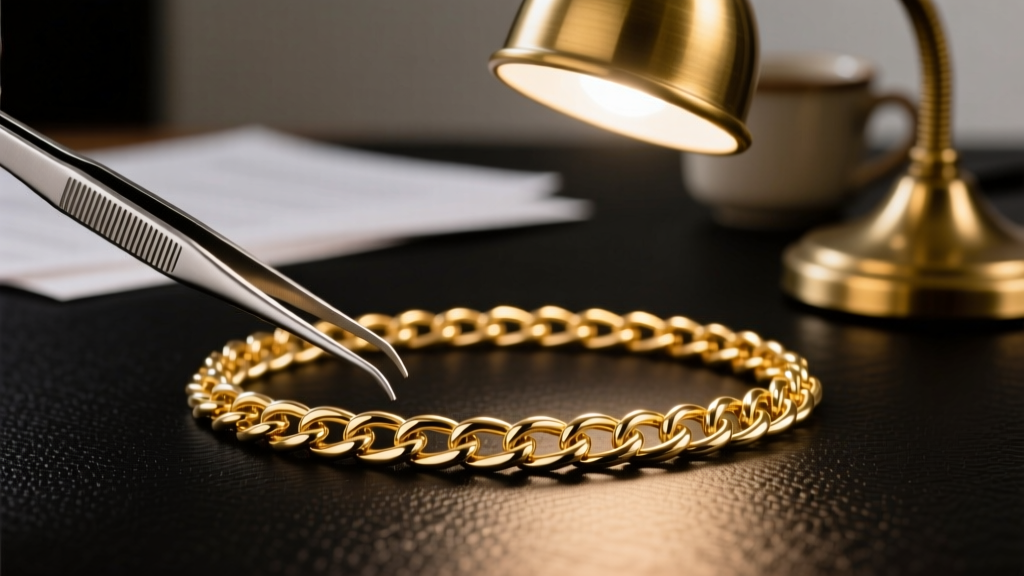
To repair a kink without snapping the chain, you must use a burnishing technique. Lay the chain perfectly flat on a steel block. Using the smooth, rounded back of a stainless steel spoon or an agate burnisher, apply moderate downward pressure and roll the tool back and forth over the kinked area. This forces the displaced links back into their horizontal alignment. According to master jewelers affiliated with Jewelers of America, attempting to bend a kinked herringbone chain backward with your fingers will almost always result in a clean snap due to metal fatigue.
Recognizing Metal Fatigue: When to Stop Pulling
Metals undergo work-hardening when subjected to repeated bending or stress. As you manipulate a knot, the crystal lattice structure of the gold or silver accumulates dislocations, making the metal increasingly brittle. If you notice the wire of the link becoming stiff, or if you see micro-fractures appearing on the surface of the metal under magnification, stop immediately. At this stage, the link is structurally compromised. Continuing to detangle it will cause a break. Take the piece to a professional jeweler who can use a laser welder to safely open, untangle, and re-fuse the weakened link without applying heat to the surrounding area. Professional laser welding for a single micro-link typically ranges from $35 to $85, depending on the karat and complexity.
Post-Detangling Cleanup: Removing Lubricant Residue
If you used mineral oil, the chain must be degreased to prevent it from becoming a magnet for skin oils and environmental dust. Prepare a lukewarm bath of distilled water and two drops of phosphate-free dish soap. Submerge the chain and gently agitate it. Use a baby toothbrush with ultra-soft bristles to lightly sweep the links. Rinse with distilled water (tap water contains chlorine and hard minerals that can spot sterling silver) and dry with a lint-free microfiber cloth. Avoid ultrasonic cleaners for knot-weakened chains, as the high-frequency cavitation can shake loose already stressed solder joints.
Preventative Storage Architecture
Once you have successfully learned how to detangle a necklace chain, preventing future knots is paramount. Implement these storage protocols:
- The Straw Method: Thread one end of the chain through a plastic or silicone drinking straw and fasten the clasp. The rigid straw prevents the chain from folding in on itself during travel.
- Clasp Locking: Always store chains with the clasp securely fastened through the end ring. An open clasp acts as a grappling hook inside a jewelry box.
- Individual Polybags: Store each chain in its own anti-tarnish ziplock bag. Squeeze the air out before sealing to restrict the chain's movement and eliminate the kinetic energy required for knots to form.


