Diamond K Necklace Gift Guide: 2026 Occasion Matching
Discover the ultimate 2026 diamond K necklace gift guide. Learn how to match carat weights, chain types, and settings to specific milestones and budgets.

The Art of Gifting the Diamond K Necklace
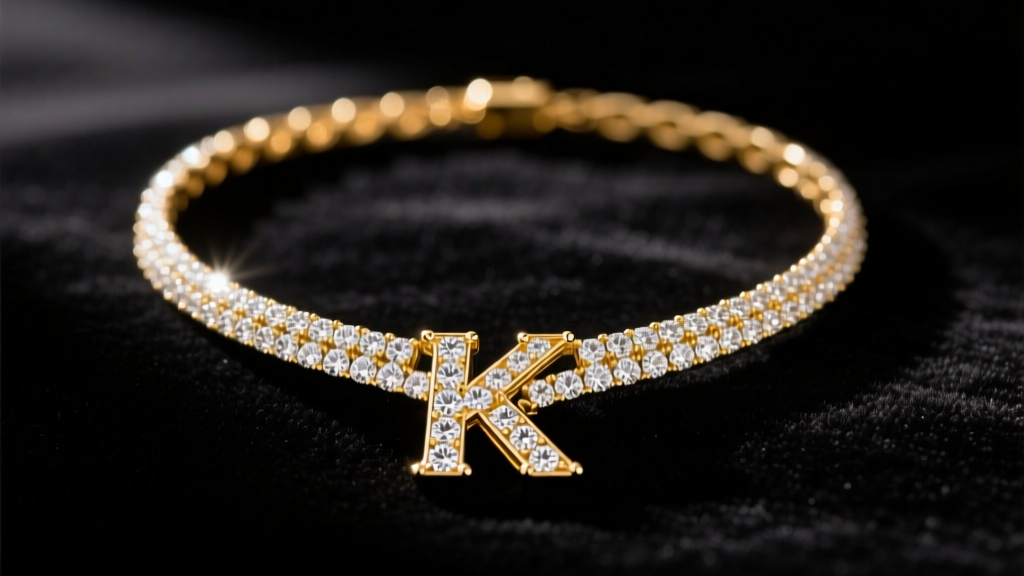
Gifting an initial pendant is a timeless gesture, but selecting the perfect diamond K necklace requires a nuanced understanding of jewelry engineering, diamond grading, and personal styling. Unlike simpler letters such as 'O' or 'I', the letter K presents a unique structural and aesthetic profile. Its intersecting diagonal arms and sharp vertices demand precision in both CAD (Computer-Aided Design) modeling and stone setting. Whether you are shopping for a Katherine, a Kelly, or commemorating a meaningful word that starts with K, this 2026 guide provides the exact specifications, material grades, and occasion-matching frameworks needed to make an informed, expert-level purchase.
Engineering the Letter K: Structural Integrity in Jewelry Design
Before evaluating diamond quality, one must understand the physical anatomy of the pendant. The letter K is inherently top-heavy and features a critical stress point: the vertex where the upper and lower diagonal arms meet the vertical stem. In mass-produced, low-quality castings, this joint is often left thin to save on gold weight, making it highly susceptible to micro-fractures and bending over time.
When evaluating a high-end diamond K necklace, look for jewelers who utilize a reinforced metal armature beneath the pave setting. This means the gold or platinum core at the vertex is slightly thicker, providing a stable foundation for the prongs. Furthermore, the diagonal arms should feature a subtle 'micro-bezel' or 'shared-prong' setting that protects the edges of the melee diamonds from catching on silk or knitwear. According to manufacturing standards upheld by the Jewelers of America, proper structural weighting is essential for asymmetrical pendants to ensure they hang flush against the collarbone without constantly flipping upside down.
Occasion Matching Matrix: Which Specifications Fit the Milestone?
A diamond initial necklace is a versatile gift, but the metal karat, carat weight, and chain style should align with the significance of the occasion. Use the matrix below to match your gifting scenario with the appropriate jewelry specifications.
| Occasion | Metal Recommendation | Diamond CTW & Type | Chain Style & Length | Estimated Budget (2026) |
|---|---|---|---|---|
| Sweet 16 / 18th Birthday | 14k Rose or Yellow Gold | 0.15 CTW Lab-Grown Melee | 1.0mm Cable Chain (16') | $350 - $550 |
| College Graduation | 18k White Gold | 0.25 CTW Natural Melee (G-H) | 1.2mm Box Chain (18') | $800 - $1,200 |
| Milestone Anniversary | Platinum (950) | 0.50 CTW Natural (VS2) | 1.5mm Rolo Chain (16' + 2' ext) | $2,200 - $3,500 |
| Push Present / New Mother | 18k Yellow Gold | 0.30 CTW Lab-Grown (VVS) | 1.3mm Wheat Chain (17') | $900 - $1,400 |
Decoding Melee Diamonds: Full-Cut vs. Single-Cut
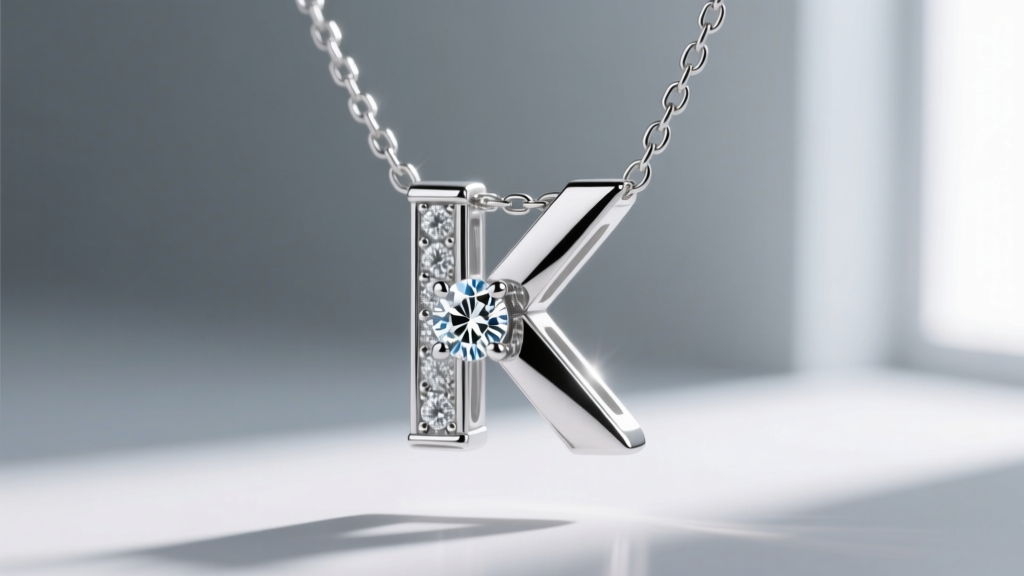
The brilliance of a diamond K necklace relies entirely on 'melee' diamonds—small stones typically ranging from 0.005 to 0.18 carats each. Not all melee diamonds are created equal, and this distinction drastically impacts the pendant's fire and scintillation. The Gemological Institute of America (GIA) notes that melee diamonds generally fall into two categories: single-cut and full-cut.
- Single-Cut Melee (17 or 18 facets): Often used in budget-friendly or vintage-style pieces. Because they have fewer facets, they appear glassy and lack the intense sparkle required to make the sharp angles of the letter K pop.
- Full-Cut Melee (57 or 58 facets): These are miniature versions of standard round brilliant diamonds. For a K pendant, full-cut melee is non-negotiable. The diagonal arms of the K catch light from oblique angles; full-cut stones ensure that the letter sparkles dynamically as the wearer moves, rather than only when hit by direct, overhead light.
Expert Tip: Always request that the jeweler confirm the use of 'full-cut melee' in writing. For natural diamonds, insist on a minimum color grade of G-H and clarity of SI1 to ensure no visible dark carbon inclusions disrupt the continuous flow of the letter's outline.
Chain Mechanics and Bail Physics
The most common failure point in initial necklaces is not the pendant itself, but the chain and bail combination. The letter K is asymmetrical. The right side (the arms) carries more visual and physical weight than the left side (the stem). If suspended on a flimsy chain, the pendant will perpetually slide to one side or flip backward.
Selecting the Right Chain Gauge
Avoid delicate 0.8mm or 0.9mm chains for K pendants. Instead, opt for a 1.2mm to 1.5mm gauge. The box chain and the rolo chain are superior choices because their interlocking geometric links provide high tensile strength and resist kinking, which is vital when supporting an off-center pendant.
The Hidden Bail Advantage
Consider a 'hidden bail' or 'euro-shank' design where the chain threads directly through a hollowed-out channel at the top of the K's vertical stem. This lowers the center of gravity, forcing the pendant to sit perfectly flat against the sternum. Standard loop bails tend to push the top of the K outward, creating an awkward, protruding silhouette.

2026 Pricing Reality: Lab-Grown vs. Natural
The market shift toward lab-grown diamonds has fundamentally altered the pricing landscape for personalized jewelry. Understanding this allows you to maximize the visual impact of your gift without overpaying.
| Specification | Natural Diamond K Pendant | Lab-Grown Diamond K Pendant |
|---|---|---|
| 0.20 CTW (14k Gold) | $750 - $950 | $350 - $450 |
| 0.50 CTW (18k Gold) | $1,800 - $2,400 | $650 - $850 |
| Resale / Heirloom Value | Moderate retention | Primarily sentimental |
If the recipient values sustainability, technological innovation, and maximum carat weight for their budget, a lab-grown diamond K necklace is the definitive choice for 2026. If the gift is meant to serve as a traditional financial heirloom passed down through generations, natural diamonds still hold a psychological and market premium.
Layering and Neckline Pairing
The diamond K necklace is a staple of the modern 'curated neck stack.' To style it correctly, treat the K pendant as the 'anchor' piece.
'When layering an initial pendant, always place it in the middle of the stack. Pair it with a 14-inch plain herringbone choker above, and a 20-inch lariat or coin necklace below. This creates a cascading visual triangle that draws the eye directly to the diamond initial.' — Senior Stylist, Jewel Style Radar
For wardrobe pairing, the K necklace shines best against V-necklines, scoop necks, and open-collared silk blouses. Avoid wearing it over high-neck ribbed turtlenecks, as the friction from the heavy knit fabric can wear down the prongs holding the melee diamonds over time.
Care and Maintenance for Pave Settings
Pave settings, while breathtaking, are notorious for trapping lotions, perfumes, and dead skin cells, which quickly dull the diamonds' brilliance.
- Weekly Cleaning: Use a soft baby toothbrush and a drop of mild dish soap in warm water. Gently brush the underside of the K pendant, where the diamond pavilions are exposed. This is where 90% of light-blocking grime accumulates.
- Ultrasonic Warning: Never put a pave diamond K necklace in an ultrasonic cleaner. The high-frequency vibrations can easily shake loose the tiny melee stones, especially along the delicate diagonal arms of the K.
- Annual Checkup: Have a professional jeweler inspect the prongs under a loupe every 12 months to ensure the structural integrity of the K's vertices remains intact.
Final Gifting Checklist
Before finalizing your purchase, verify these four critical data points with your jeweler: full-cut melee diamonds, a reinforced vertex armature, a chain gauge no thinner than 1.2mm, and a secure, low-profile bail. By prioritizing these structural and gemological details, your diamond K necklace will transcend being a simple trend piece, becoming a durable, brilliant heirloom perfectly matched to the milestone it celebrates.


