How to Choose and Style a Diamond Necklace Halo Pendant
Master the art of the diamond necklace halo. Learn step-by-step how to choose ratios, metals, chains, and neckline pairings for maximum brilliance.

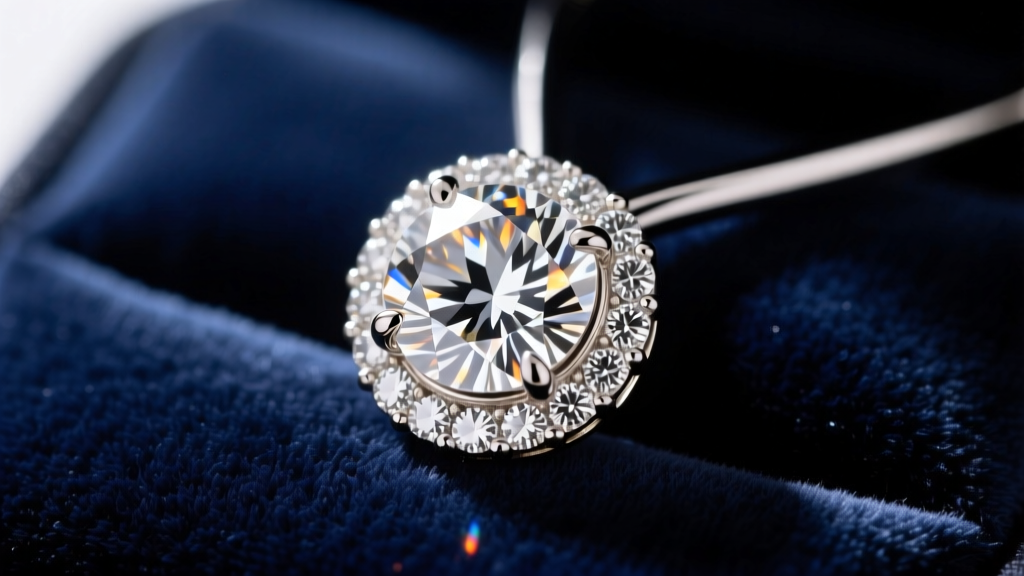
The diamond necklace halo is a masterclass in optical illusion and light performance. By encircling a center stone with a continuous rim of micro-pave melee diamonds, a halo pendant can increase the visual spread of your jewelry by up to 30% while amplifying brilliance. However, designing, sourcing, and styling a halo pendant requires a precise understanding of proportions, metallurgy, and chain mechanics. In this comprehensive step-by-step guide, we break down the exact specifications you need to build, buy, and wear a flawless diamond necklace halo in 2026.
The Anatomy of a Diamond Necklace Halo
Before selecting your stones, you must understand the structural components that dictate a halo pendant's durability and light return. According to the Gemological Institute of America (GIA), a diamond's cut quality is paramount, but in a halo setting, the melee stones and the gallery (basket) play equally vital roles.
- The Center Stone: Typically a round brilliant or cushion cut, ranging from 0.50ct to 1.50ct.
- The Halo Melee: Small diamonds (usually 0.01ct to 0.02ct each) set in a micro-pave or shared-prong configuration. For a seamless look, melee should match the center stone's color grade within one tier (e.g., an F-color center requires F or G-color melee).
- The Basket and Bail: The gallery wire that holds the stones, and the bail that connects the pendant to the chain. A well-engineered basket allows light to enter the pavilion of the center stone unobstructed.
Step 1: Calibrating Center Stone to Halo Ratios
The most common mistake buyers make is choosing a halo that is either too thick (making the center stone look like a button) or too thin (failing to create a cohesive spread). The ideal halo width depends entirely on your center stone's millimeter diameter. Below is a structural framework for achieving the perfect visual ratio.
| Center Carat | Avg Diameter | Ideal Halo Width | Total Visual Spread | Estimated Lab-Grown Price (2026) |
|---|---|---|---|---|
| 0.50ct | 5.1mm | 1.2mm - 1.5mm | 7.5mm - 8.1mm | $800 - $1,200 |
| 0.75ct | 5.8mm | 1.5mm - 1.8mm | 8.8mm - 9.4mm | $1,200 - $1,800 |
| 1.00ct | 6.5mm | 1.8mm - 2.0mm | 10.1mm - 10.5mm | $1,600 - $2,400 |
| 1.50ct | 7.4mm | 2.0mm - 2.2mm | 11.4mm - 11.8mm | $2,500 - $3,800 |
Pro-Tip: Ensure there is a microscopic gap (0.1mm to 0.2mm) between the center stone's girdle and the halo's inner edge. This prevents the stones from rubbing and chipping against one another while creating a 'floating' effect that enhances brilliance.
Step 2: Selecting the Metal and Bail Engineering
The metal you choose impacts both the aesthetic and the structural integrity of the micro-prongs holding your halo melee. The American Gem Society (AGS) notes that metal malleability is crucial for pave settings.
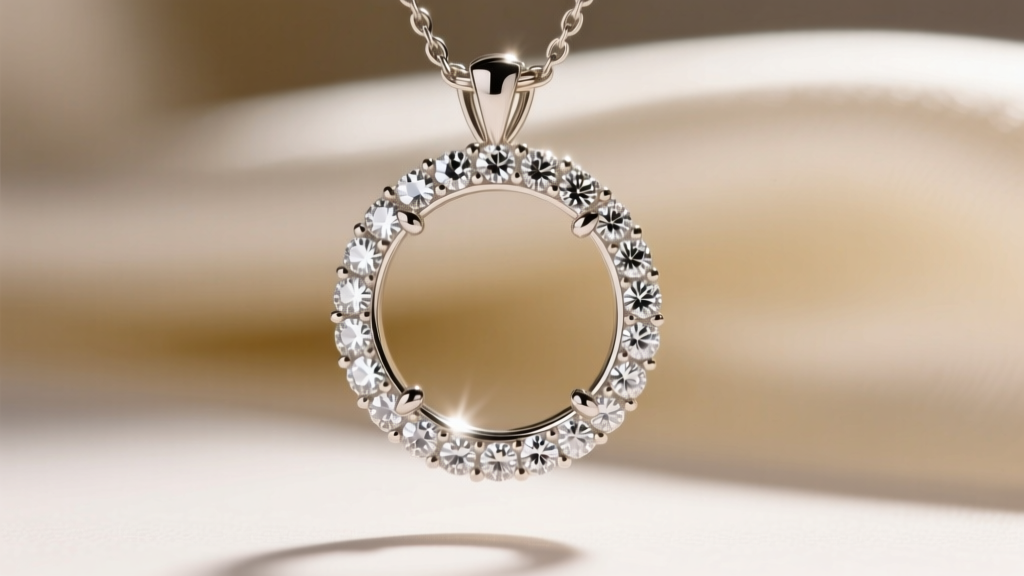
Platinum (950Pt) vs. 14k/18k Gold
Platinum is the undisputed champion for halo pendants. Its tensile strength and malleability mean that the tiny beads of metal securing the melee diamonds are less likely to snap or wear away over time. While 14k white gold is more affordable and offers a bright initial rhodium flash, it requires re-plating every 12 to 18 months. If the rhodium wears off near the bail, the yellowish undertone of the white gold can reflect into the bottom of your colorless diamonds, subtly altering their perceived color.
Bail Mechanics
For a halo pendant, avoid standard loop bails that sit high above the basket, as they create an awkward visual disconnect. Instead, opt for a hidden bail (where the chain threads directly through a horizontal channel behind the center stone) or a tapered V-bail that integrates seamlessly into the top prongs of the halo.
Step 3: Chain Selection and Weight Distribution
A diamond necklace halo pendant is significantly heavier than a standard solitaire. A 1.00ct halo pendant in platinum can weigh between 3.5 and 5 grams. Pairing this with a delicate 0.5mm chain is a recipe for a snapped necklace.
- Box Chains (0.9mm - 1.2mm): The optimal choice. Their interlocking square links distribute weight evenly, resist kinking, and provide a modern, reflective backdrop that complements the halo.
- Rope Chains (1.0mm - 1.5mm): Excellent for vintage-inspired halos, offering high durability and a twisted texture that mimics the brilliance of the melee stones.
- Cable Chains: Generally too weak for pendants exceeding 2 grams unless soldered with reinforced jump rings.
Always ensure the clasp is a heavy-duty lobster claw rather than a spring ring, which can easily deform under the pendulum motion of a heavy halo basket.
Step 4: Neckline Pairing and Length Mapping
Styling a diamond necklace halo requires mapping the pendant's drop length to your wardrobe's most common necklines. The goal is to frame the face without the pendant getting lost in fabric or competing with collars.
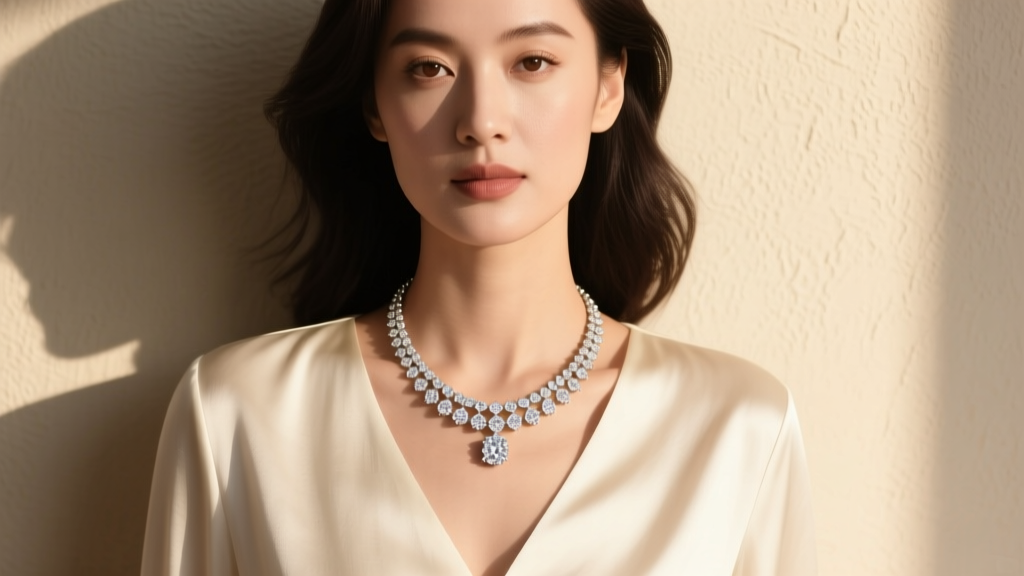
The Styling Matrix
- V-Neck & Wrap Dresses: Use an 18-inch chain. The pendant should rest exactly in the apex of the V, mirroring the geometric lines of the garment. A round brilliant halo works best here.
- Crew Necks & Turtlenecks: Opt for a 20 to 22-inch chain so the halo sits below the collarbone on the fabric. Choose a halo with a high-profile basket so it doesn't lay completely flat against the chest, which can mute its sparkle.
- Sweetheart & Off-the-Shoulder: A 16-inch choker-length chain keeps the pendant hovering just above the neckline, drawing the eye upward. Cushion-cut halos pair beautifully with the romantic curves of these necklines.
- Button-Down Shirts: Wear the pendant inside the shirt, resting against the skin, with the top two buttons undone for an effortless, layered look.
Step 5: Maintenance and Cleaning Protocols
Halo pendants are notorious for trapping skin oils, lotions, and environmental dust in the micro-pave gallery, which quickly dulls the melee stones. However, you must be incredibly careful with how you clean them.
WARNING: Never place a micro-pave diamond necklace halo in an ultrasonic cleaner. The high-frequency acoustic cavitation can easily shake the tiny melee diamonds loose from their micro-prongs, resulting in lost stones.
According to the GIA Diamond Care Guide, the safest and most effective method for home cleaning is a solution of warm water and a few drops of mild, ammonia-free dish soap. Let the pendant soak for 15 minutes, then gently agitate the underside of the basket with a soft-bristled baby toothbrush. Rinse with distilled water to prevent hard water spots, and dry with a lint-free microfiber cloth. Finally, have a professional jeweler inspect the halo prongs under 10x magnification every 12 months to ensure the melee stones remain secure.
Final Thoughts on Sourcing
As of 2026, the lab-grown diamond market has revolutionized the halo pendant. Because melee stones are priced by the carat-total-weight (ctw) rather than individual rarity, lab-grown melee allows jewelers to use higher-clarity (VVS) and higher-color (D-E) stones in the halo without exponential price increases. This ensures the halo never looks milky or gray, maintaining a crisp, icy contrast that elevates the entire piece. By following these precise structural and stylistic steps, your diamond necklace halo will remain a brilliant, versatile staple in your collection for decades.


