Diamond Paw Print Necklace: Gemologist Setting & Durability Guide
Expert gemologist guide to buying a diamond paw print necklace. Compare melee grades, metal alloys, prong settings, and chain pairing for lasting wear.

The Anatomy of a Paw Print Pendant
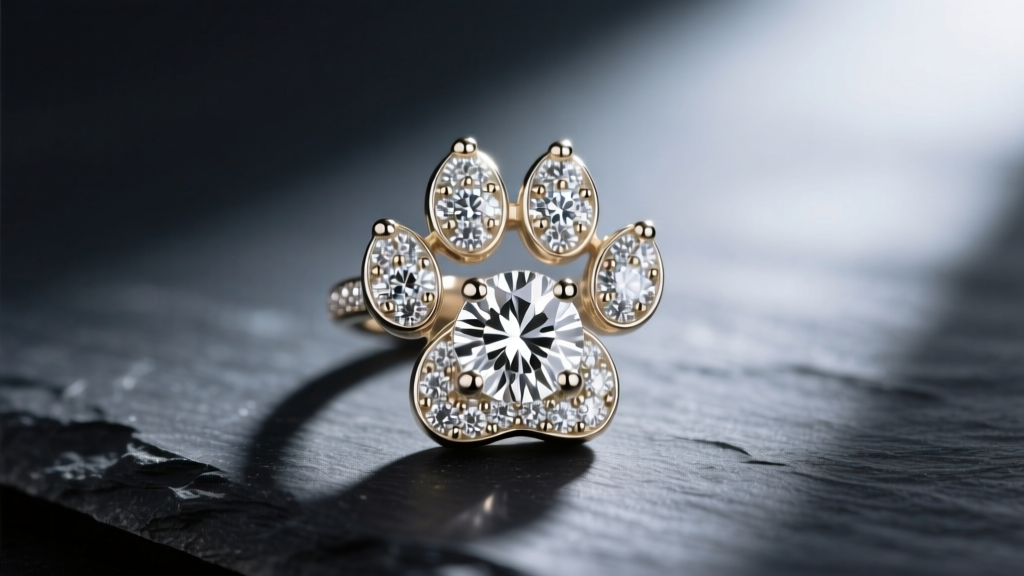
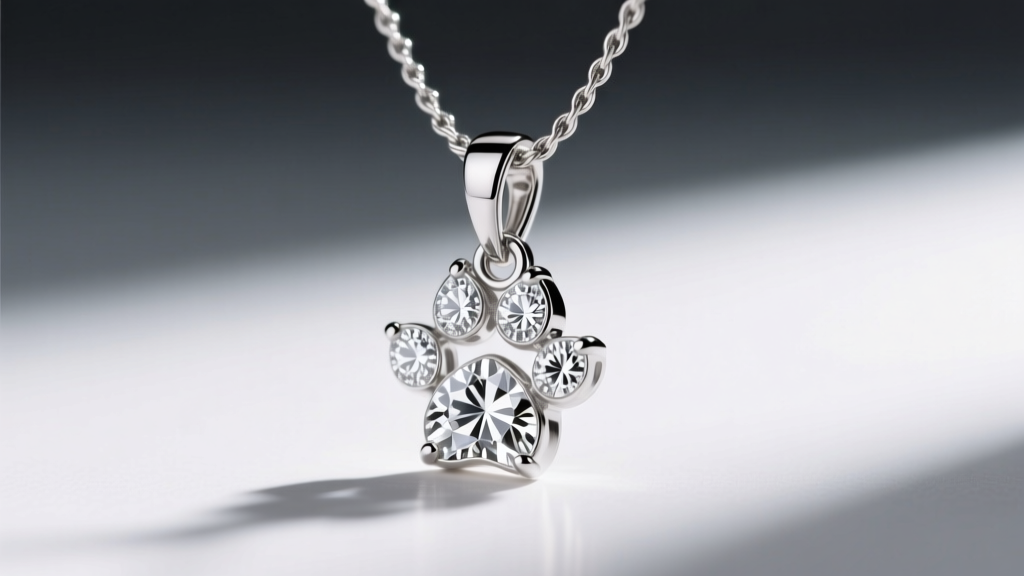
When evaluating a diamond paw print necklace, most consumers focus solely on the total carat weight (ctw). However, from a gemological and manufacturing perspective, the structural anatomy of the pendant dictates its longevity. A standard paw print design consists of four distinct toe pads and one primary metacarpal pad. The toe pads typically utilize 1.2mm to 1.5mm round brilliant melee diamonds (approximately 0.008 to 0.015 carats each), while the main pad may feature a single 3.0mm to 4.0mm center stone or a clustered micro-pavé arrangement.
The protruding nature of the toe pads makes them highly susceptible to lateral impact. Unlike a flush-set solitaire, the multi-stone geometry of a paw print requires precise metal distribution to secure the stones without obscuring their light return. Understanding how these stones are set, graded, and supported by the underlying alloy is critical for selecting a piece that will survive daily wear.
Diamond Quality Metrics for Melee Stones
The diamonds used in the toe pads of a paw print pendant fall into the "melee" category—defined by the GIA as stones weighing less than 0.15 carats. Because these stones are so small, traditional grading reports are rarely provided. Instead, jewelers sort melee by sieve size and commercial quality tiers.
Cut Quality Over Color and Clarity
In stones measuring 1.5mm or less, the human eye cannot easily resolve individual inclusions (clarity) or subtle color tints. Therefore, paying a premium for VVS clarity or D-F color melee is a poor allocation of budget. The critical metric is cut precision. Poorly cut melee diamonds suffer from "light leakage," appearing as flat, glassy windows rather than sparkling gems. When inspecting a diamond paw print necklace, look for stones that exhibit crisp, symmetrical scintillation under diffuse lighting. If the toe pads look milky or dull, the manufacturer likely used single-cut melee (which only have 17 or 18 facets) instead of full-cut round brilliants (57 or 58 facets).
Metal Alloys, Prong Failure, and Setting Techniques
The setting technique used to secure the melee diamonds heavily influences the pendant's failure rate. The two most common methods for paw prints are micro-pavé and shared prong.
- Micro-Pavé: Tiny beads of metal are pushed over the diamond's girdle. This offers a smooth surface that resists snagging on clothing and pet hair, making it the superior choice for daily wear.
- Shared Prong: Minimal metal is used between adjacent stones to maximize light exposure. However, the exposed prongs on the curved toe pads act as microscopic hooks, frequently catching on fabrics and eventually bending away from the stone.
Alloy Selection and Prong Durability
The metal alloy must be matched to the setting style. According to metallurgical standards outlined by the GIA, platinum's density and malleability make it the ideal metal for micro-prongs, as it work-hardens upon impact rather than snapping. Conversely, 14k white gold is harder but more brittle; if a micro-prong catches, it is more likely to shear off entirely.
| Metal Alloy | Hardness (Vickers) | Prong Durability | Maintenance Requirement |
|---|---|---|---|
| Platinum 950 (5% Ru) | 135 HV | Excellent (Bends, holds stones) | Polishing (Develops patina) |
| 14k White Gold (Ni/Pd) | 125-140 HV | Moderate (Prone to shearing) | Rhodium replating every 1-2 years |
| 18k Yellow Gold | 120 HV | Low (Soft, prongs wear quickly) | Frequent prong re-tipping |
Bail Engineering and Chain Pairing
The bail—the loop connecting the pendant to the chain—is a frequent point of structural failure in novelty pendants. Paw print pendants often feature asymmetrical weight distribution, causing the pendant to tilt. To counteract this, expert manufacturers use a "hidden bail" or a tapered V-bail soldered directly behind the main pad's center of gravity.
Pairing the pendant with the correct chain is equally vital. Avoid snake chains entirely; their interlocking plates trap pet hair and kink irreversibly when bent. Instead, opt for a 1.0mm to 1.2mm cable chain or a box chain. These styles provide adequate tensile strength to support a 3-gram pendant while allowing the bail to slide freely, preventing the "cheese-wire" effect where a thin chain slowly saws through the interior of the bail loop over time.
Pricing Tiers and Value Assessment
When shopping for a diamond paw print necklace, pricing should correlate directly with the metal weight and the melee carat total weight (ctw). Below is a realistic pricing framework for 2026 based on standard retail markups and material costs:
- Entry Tier ($350 - $600): 10k or 14k gold, 0.10 to 0.15 ctw. Stones are often single-cut or lower-grade commercial melee. Settings are usually cast-in-place (stones set during the casting process), which results in poor light return and higher porosity in the metal.
- Mid Tier ($650 - $1,200): 14k white or yellow gold, 0.25 to 0.40 ctw. Full-cut melee diamonds (SI clarity, G-H color). Hand-set micro-pavé or prong settings. This is the sweet spot for durability and brilliance.
- Premium Tier ($1,500 - $3,000+): Platinum 950, 0.50 to 1.00+ ctw. Premium cut melee, precision hand-engraved milgrain detailing, and custom-tapered bails. Often includes a larger center stone in the main pad.
Expert Maintenance and Ultrasonic Warnings
Gemologist Warning: Never clean a micro-pavé diamond paw print necklace in an ultrasonic cleaner. The high-frequency vibrations (typically 20-40 kHz) can easily rattle loose the microscopic metal beads holding the 1.2mm toe pad diamonds, resulting in sudden stone loss.
To maintain the brilliance of your pendant without compromising the settings, use a soft-bristled baby toothbrush and a solution of warm water with a single drop of mild, ammonia-free dish soap. Gently brush the underside of the main pad where skin oils and lotions accumulate, blocking light from entering the pavilion of the diamonds. Finally, have a professional jeweler inspect the toe pad prongs under 10x magnification every 12 months to check for metal fatigue and lateral stone movement.


