The Ultimate Necklace Measurement Guide: Lengths, Fits & Layering
Master the perfect fit with our expert necklace measurement guide. Learn exact lengths, layering techniques, and neckline pairings for any pendant.

The Anatomy of Standard Lengths: Metrics and Tolerances
When purchasing fine jewelry, relying on generic size labels often leads to fit failures. As of 2026, precision manufacturing has tightened tolerances, but understanding the exact metrics of chain lengths remains critical for both jewelers and consumers. According to the Jewelers of America, standard necklace lengths are categorized by their functional placement on the décolletage, but a '16-inch' chain actually measures 16.25 inches when the clasp hardware is included. This quarter-inch tolerance is vital when calculating pendant drops.
| Standard Name | Nominal Length | Exact Metric | Anatomical Placement | Max Pendant Weight |
|---|---|---|---|---|
| Collar | 12 - 14 inches | 30.5 - 35.5 cm | Wraps tightly above the collarbone | 5 grams |
| Choker | 15 - 16 inches | 38.1 - 40.6 cm | Rests on the lower neck / upper clavicle | 10 grams |
| Princess | 17 - 19 inches | 43.2 - 48.3 cm | Drapes over the collarbone, upper chest | 20 grams |
| Matinee | 20 - 24 inches | 50.8 - 61.0 cm | Falls at the upper bust / sternum | 35 grams |
| Opera | 28 - 36 inches | 71.1 - 91.4 cm | Rests below the bust line | 50+ grams |
Neck Circumference and the Drop Formula
The most common mistake in jewelry sizing is assuming a chain length dictates a universal visual drop. In reality, the visual drop is entirely dependent on the wearer's neck circumference and the slope of their shoulders. A 16-inch choker on a model with a 12-inch neck will yield a drastically different silhouette than on a client with a 15-inch neck.

Calculating the Visual Drop
To achieve mathematical precision in custom jewelry design, master jewelers use the Drop Formula. This calculation determines exactly how far below the base of the neck the chain will hang at its center point. The formula is:
Visual Drop = (Chain Length - Neck Circumference) / 2
For example, if a client has a 14-inch neck circumference and requests an 18-inch princess chain, the calculation is (18 - 14) / 2 = 2 inches. The chain will drop exactly two inches below the clavicle base. If that same client prefers a 1.5-inch drop, you must size the chain to 17 inches. This technical approach eliminates guesswork and ensures pendants sit precisely in the intended anatomical hollow.
Chain Gauge, Weight, and Drape Physics
Length is only one axis of the necklace measurement guide; the chain gauge (thickness) fundamentally alters how the metal drapes. The Gemological Institute of America (GIA) notes that metal alloys behave differently under tension. A 14k gold chain will drape softer than a platinum chain of the exact same gauge due to platinum's higher density and stiffness.
- Delicate Gauge (0.6mm - 0.9mm): Highly flexible but prone to micro-kinking. Requires pendants under 5 grams to prevent permanent structural stretching of the links.
- Standard Gauge (1.2mm - 1.8mm): The optimal balance of tensile strength and fluid drape. Supports pendants up to 15 grams without distorting the chain's geometry.
- Heavy Gauge (2.5mm - 4.0mm+): Stiff drape, often requiring wider link patterns like Cuban or Curb chains to maintain flexibility. Acts as a statement piece even without a pendant.
Layering Mechanics: The Delta Rule and Hardware
Layering necklaces is an exercise in spatial geometry and friction management. When multiple chains occupy the same plane, they generate kinetic friction, leading to severe tangling—especially with cable and rope chains. To prevent this, experts adhere to the 'Delta Rule'.

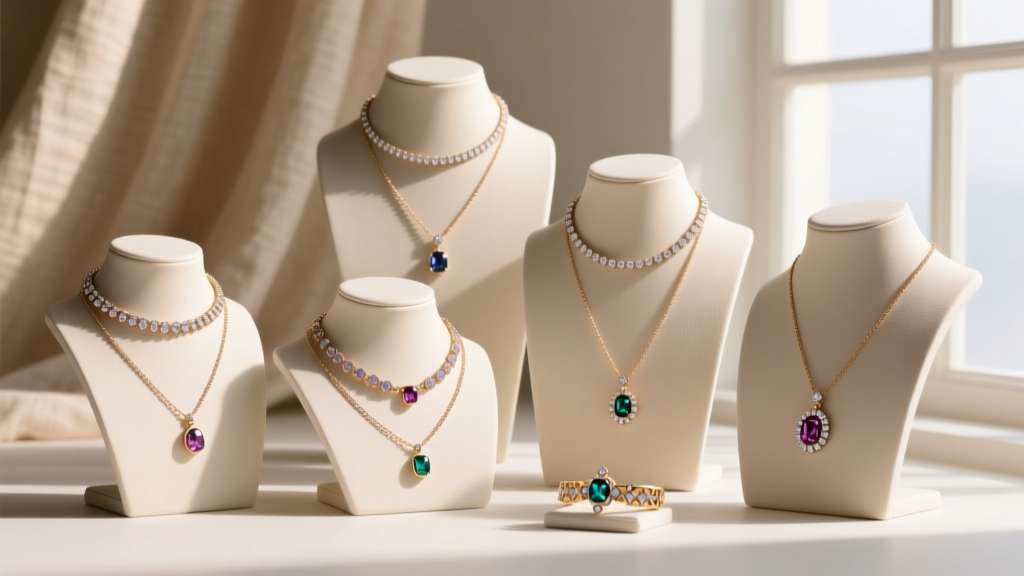
The Delta Rule mandates a minimum length differential (delta) of 1.5 to 2.0 inches between layered chains. A 14-inch choker paired with a 16-inch princess chain and an 18-inch matinee chain creates distinct, non-overlapping parabolic arcs. Furthermore, the chain profiles must vary; pairing a 1.0mm cable chain with a 1.5mm box chain prevents the links from interlocking. Finally, ensure all lobster clasps face backward (at the nape of the neck) and are matched in weight to avoid asymmetric pulling.
Geometric Alignment with Necklines
A technically perfect necklace measurement must also account for the garment's neckline. The terminal point of the pendant or the lowest arc of the chain should either sit exactly 0.5 inches below the fabric line or be concealed entirely beneath it. Clashing the chain's arc with the garment's hem creates visual dissonance.
'The necklace should act as an extension of the neckline, not a competitor. If the collar is V-shaped, the chain must mimic that acute angle. If the neckline is a boatneck, opt for a collar or choker that runs parallel to the clavicle.' — Master Bench Jeweler Guidelines, 2026.
Troubleshooting Common Fit Failures
Even with precise measurements, physical dynamics can cause fit failures. Here is how to troubleshoot the most frequent technical issues encountered on the bench:
- The Sliding Clasp (Center of Gravity Failure): If a lightweight chain carries a heavy pendant, the center of gravity shifts forward, pulling the clasp to the front of the neck. Solution: Solder a small, dense counterweight (like a gold tag) directly opposite the clasp, or use a silicone necklace stopper.
- The Choke Effect (Thermal Expansion): A chain fitted perfectly at room temperature may feel restrictive in high heat or during physical activity due to natural neck swelling and thermal expansion. Solution: Always add a 0.25-inch to 0.5-inch allowance for 'active wear' chains, or integrate a 1-inch extender chain.
- Pendant Flip (Torque Imbalance): Pendants with offset bail loops will constantly flip backward. Solution: Replace the standard bail with a weighted, soldered tube bail or a European-style slider bail to distribute the mass evenly across the chain links.
By treating necklace sizing as a precise science rather than an arbitrary fashion choice, you ensure structural longevity, optimal drape, and flawless aesthetic integration.