Expert Guide to Fine-Line Necklace Tattoo Designs & Ink
Explore the technical anatomy of necklace tattoo designs. Learn about needle groupings, ink dilution, and how permanent ink mimics fine jewelry.

The Intersection of Fine Jewelry and Body Art
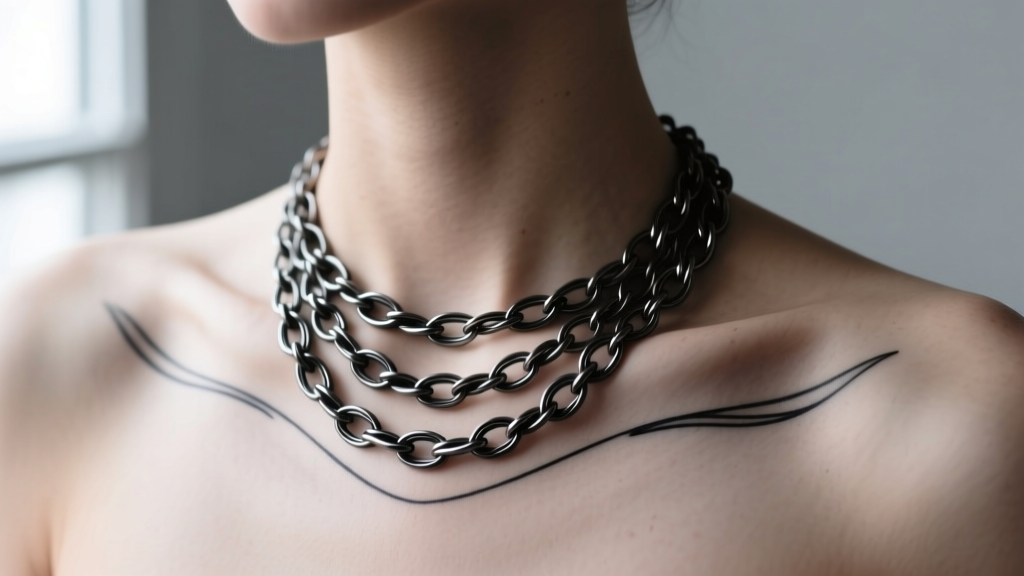
As we navigate the style landscape of 2026, the boundary between traditional fine jewelry and body modification continues to blur. While soldered permanent bracelets and anklets have dominated the market for years, necklace tattoo designs have emerged as the ultimate zero-maintenance alternative for the décolletage. Unlike physical chains that can tarnish, snap, or trigger contact dermatitis, a meticulously executed tattooed chain offers a permanent, weightless aesthetic. However, translating the reflective, three-dimensional nature of precious metals into two-dimensional dermal ink requires an advanced understanding of tattoo physics, needle configurations, and anatomical placement.
For jewelry enthusiasts and body art collectors alike, understanding the technical execution of these designs is crucial. A poorly executed chain tattoo will quickly blur into an unrecognizable smudge, while a masterfully applied design will mimic the delicate links of a 14k gold or sterling silver cable chain for decades. This guide dives deep into the technical specifications, ink dilution ratios, and dermal migration factors that dictate the success of permanent necklace art.
Needle Configurations for Specific Chain Styles
The illusion of metallic jewelry relies entirely on line weight and negative space. Standard tattoo needles are far too thick to replicate the micro-links of modern jewelry. Master tattooists specializing in fine-line necklace tattoo designs rely on specialized micro-cartridges to achieve link diameters as small as 1.5 millimeters.
| Chain Style | Needle Configuration | Line Weight | Blowout Risk | Best Anatomical Placement |
|---|---|---|---|---|
| Micro Cable | 1RL (0.25mm) | Ultra-Fine | High | Nape, Upper Sternum |
| Snake Chain | 3RL (0.35mm) | Fine | Medium | Clavicle, Collarbone |
| Box Chain | 3RL to 5RL | Medium | Low | Lower Sternum, Ribcage |
| Rope Chain | 1RL (Stippling) | Textured | Very High | Thick Dermal Areas |
The 1RL (Round Liner) cartridge, specifically the 0.25mm bugpin variant, is the gold standard for micro cable chains. Because the needle deposits a microscopic amount of pigment, the artist must maintain a flawless hand speed and voltage ratio (typically running rotary machines at 6.5v to 7.2v). If the hand moves too slowly, the ink pools and causes a blowout; if it moves too quickly, the ink fails to penetrate the dermis, resulting in patchy, broken links that heal poorly.
Ink Dilution and the Illusion of Metallic Luster
Black ink does not naturally possess the reflective qualities of white gold, platinum, or oxidized silver. To create the illusion of metallic luster in necklace tattoo designs, artists must manipulate ink viscosity and utilize negative space to simulate light reflection.
The Gray Wash Technique for Highlights
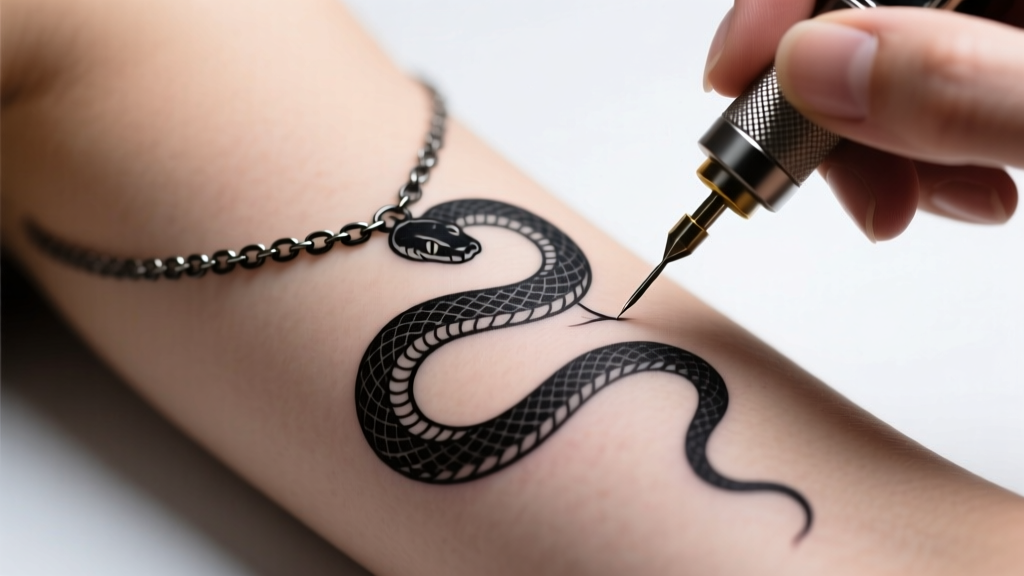
To mimic the shine of a polished metal link, artists use a technique called gray washing. By diluting a high-quality, carbon-based black ink (such as Dynamic Black or Kuro Sumi) with distilled water or witch hazel in a 3:1 or 4:1 ratio, the artist creates a translucent gray wash. This wash is applied to the 'shadow' side of the tattooed link, leaving the adjacent skin completely bare. The contrast between the bare skin (acting as the highlight) and the gray wash (acting as the shadow) tricks the eye into perceiving a cylindrical, metallic object.
Stippling for Textured Metals
For designs mimicking matte or hammered finishes, dotwork (stippling) is employed using a 1RL needle. By varying the density of the dots, the artist can create gradients that resemble the brushed texture of titanium or tarnished antique silver. This method is highly forgiving regarding dermal migration, as the negative space between the dots allows the skin to absorb minor ink spread over time without losing the overall design integrity.
Anatomical Placement and Dermal Migration
The anatomy of the neck and chest presents unique challenges for fine-line jewelry tattoos. The skin in these areas varies drastically in thickness, elasticity, and macrophage activity, all of which influence how a tattooed chain will age.
- The Clavicle (Collarbone): The skin over the clavicle is exceptionally thin, with the dermis measuring barely 1.0mm to 1.5mm in depth. Because the bone sits directly beneath the skin, there is minimal subcutaneous fat to absorb excess ink. This makes the clavicle a high-risk zone for blowouts, where ink spills into the hypodermis and creates a bruised, blurred appearance. Artists must use a shallow needle depth (1.2mm) and a light hand pressure here.
- The Sternum: The sternum offers a slightly thicker dermal layer and a beautiful, symmetrical canvas for draped pendant designs. However, the constant expansion and contraction of the ribcage during breathing can cause micro-trauma during the healing process, occasionally leading to ink fallout in ultra-fine lines.
- The Nape (Back of Neck): The nape features a thicker, more resilient dermis, making it the ideal location for intricate, heavy-link chains or geometric box chains. The skin here is less prone to UV degradation compared to the chest, significantly extending the lifespan of the crisp linework.
According to dermatological insights from the American Academy of Dermatology, the body's immune system constantly attempts to break down tattoo pigment. Macrophages encapsulate the ink particles, and over time, UV exposure and cellular turnover cause these particles to shift slightly. In fine-line necklace tattoo designs, even a 0.5mm shift can cause individual chain links to merge into a solid black line.

Pendant Integration and 3D Shading
A chain is only half the equation; the pendant serves as the focal point of the jewelry piece. When integrating a pendant into necklace tattoo designs, artists transition from strict linework to dimensional shading. Whip shading—a technique where the needle is flicked out of the skin to create a soft gradient—is essential for rendering the facets of a gemstone or the beveled edges of a metallic charm.
For example, to replicate a brilliant-cut diamond pendant, the artist will use pure black for the deepest internal reflections, a 2:1 gray wash for the mid-tones, and leave sharp, angular patches of bare skin to represent light hitting the crown of the stone. This high-contrast approach ensures the pendant pops visually against the delicate, low-contrast linework of the surrounding chain.
Layering Real Jewelry Over Permanent Ink
One of the most compelling aspects of necklace tattoo designs is their versatility in mixed-media styling. A tattooed choker or base chain can serve as a permanent foundational layer, allowing the wearer to swap out physical pendants or layer heavier gold and silver chains over the ink without worrying about tangling or skin irritation.
When layering physical jewelry over a tattoo, consider the friction between the metal and the skin. A physical 18k gold snake chain resting directly over a tattooed cable chain creates a stunning juxtaposition of textures. However, ensure that the physical jewelry does not have sharp backing or heavy clasps that could cause micro-abrasions on the tattooed skin, which, over years of wear, could lead to localized scarring and ink distortion.
Longevity, Aftercare, and Touch-Up Protocols
The lifespan of a fine-line necklace tattoo is heavily dependent on the initial healing phase and long-term UV protection. Because the lines are so thin, any scabbing that is picked or prematurely pulled off will extract the pigment, leaving permanent gaps in the chain links.
Expert Healing Protocol:
- Days 1-3: Cleanse gently with a sterile, fragrance-free antibacterial soap. Apply a micro-thin layer of a specialized tattoo balm (avoiding petroleum-based products that can suffocate the dermis and cause ink rejection).
- Days 4-14: The 'peeling' phase. The skin will shed its epidermal layer. It is critical not to scratch or exfoliate the area, as the ink is still settling into the basal layer.
- Days 15-30: The 'silver skin' phase. The tattoo will appear dull and slightly cloudy as a new layer of epidermis forms over the dermis. This is temporary; the crispness will return once the skin fully regenerates.
As noted by skin care experts at Healthline, UV radiation is the primary enemy of tattoo longevity, breaking down carbon-based ink particles and accelerating macrophage dispersion. For necklace tattoos exposed to the sun, a daily application of SPF 50+ mineral sunscreen is non-negotiable to prevent the fine links from blurring into a solid shadow.
Expert Tip: Schedule a touch-up session 8 to 12 weeks after the initial application. Fine-line work almost always requires a second pass to reinforce any links that experienced minor ink fallout during the peeling phase, ensuring the chain looks continuous and structurally sound for years to come.
Ultimately, necklace tattoo designs represent a masterclass in optical illusion and dermal precision. By respecting the limitations of the skin and leveraging advanced needle configurations, collectors can achieve a permanent, weightless jewelry aesthetic that defies the traditional boundaries of adornment.


