Troubleshooting Your Circular Gold Necklace: Fixes for Tangling
Is your circular gold necklace tangling or breaking? Discover expert troubleshooting tips to fix clasp failures, prevent warping, and restore jewelry.

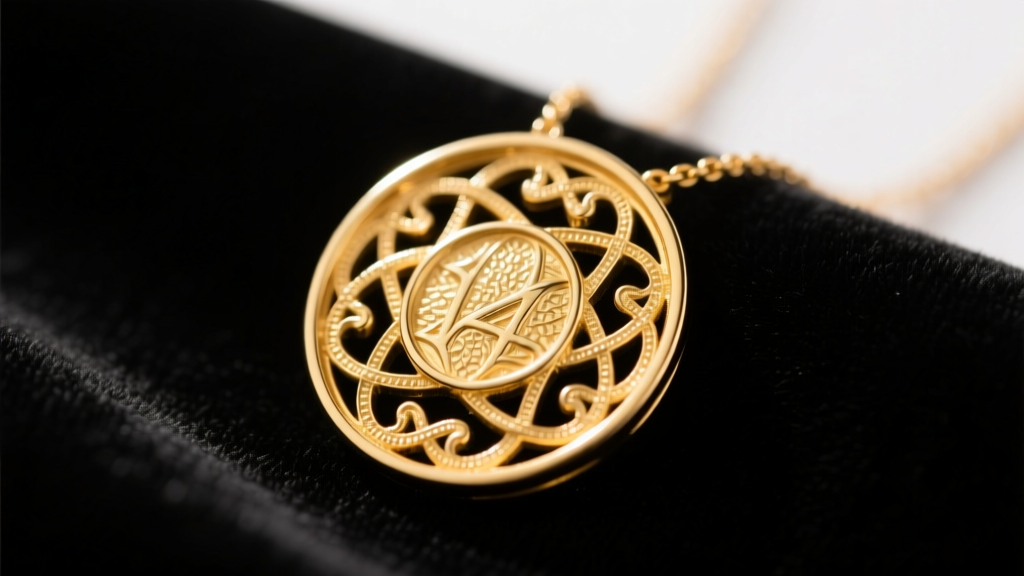
The Unique Physics of Circular Gold Necklaces
When troubleshooting jewelry failures, most guides focus on standard link chains. However, a circular gold necklace—whether it is a continuous rigid hoop, a circular medallion pendant on a fixed loop, or a seamless torc-style collar—operates under an entirely different set of physical rules. The geometry of a perfect circle distributes tension evenly across its circumference, but it also creates unique vulnerabilities regarding center of gravity, metal fatigue, and spatial tangling.
Unlike flexible link chains that drape and fold, circular necklaces hold their shape. This rigidity means they do not collapse neatly when stored, leading to complex geometric knots. Furthermore, the continuous curve places constant, low-grade stress on the clasp mechanism and the solder points connecting the clasp to the circle. Understanding these structural nuances is the first step in diagnosing why your necklace is failing and how to implement permanent, professional-grade solutions.
Troubleshooting Clasp Migration (The Spinner Effect)
The most common complaint among wearers of circular gold necklaces is the 'spinner effect'—where the clasp continually migrates from the nape of the neck to the front, resting awkwardly against the collarbone or pendant. This is not a defect in the gold; it is a physics problem related to the center of gravity.
In a perfectly balanced circle, the heaviest point will always seek the lowest gravitational position. If your clasp (especially a solid 14k or 18k gold lobster claw) is heavier than the chain links or the opposite side of the circular pendant, gravity will pull it to the front of your chest. Conversely, if the pendant is significantly heavier, the clasp will slide to the back, but the necklace will still rotate if the weight distribution is asymmetrical.
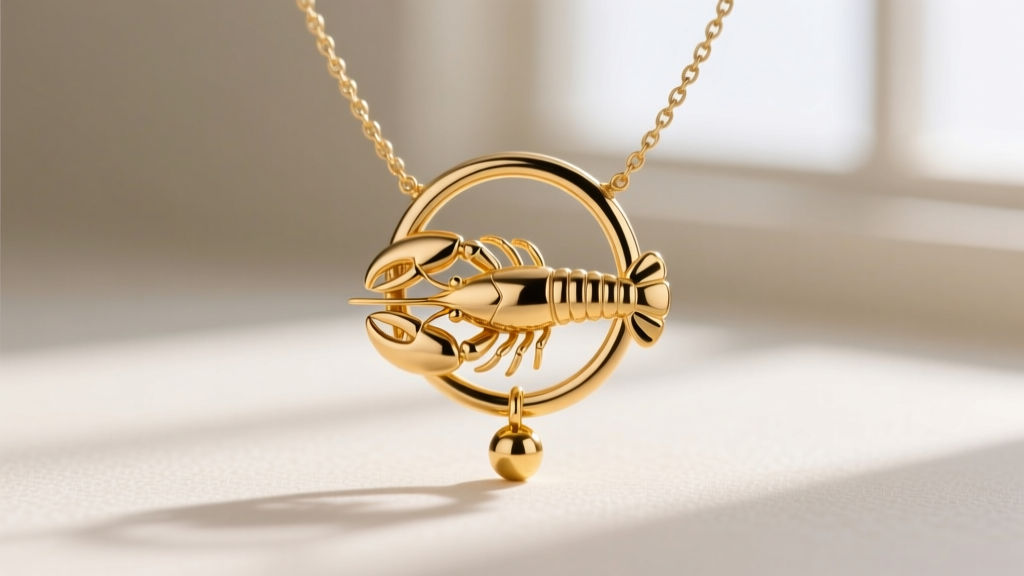
The Counterweight Solution
To stop the rotation, you must balance the mass of the necklace. Jewelers solve this by adding a micro-counterweight. If the clasp is too heavy, a tiny gold bead (usually 2mm to 3mm in diameter) can be soldered or crimped onto the chain exactly opposite the clasp. If the pendant is too heavy, a small counterweight is added to the chain segment directly behind the clasp. This equalizes the gravitational pull, keeping the clasp anchored at the nape of the neck.
Upgrading the Clasp Mechanism
Standard spring ring clasps are notoriously lightweight and prone to slipping on circular profiles. Upgrading to a toggle clasp or a magnetic neodymium clasp with a wider surface area creates friction against the skin and clothing, naturally resisting rotation. According to the Jewelers of America, ensuring your clasp hardware is proportionate to the overall weight of the piece is critical for long-term wearability and security.
Diagnosing and Fixing Structural Warping
Because circular necklaces lack the flexible joints of a standard chain, any external pressure—such as sleeping in the necklace, leaning against a hard surface, or catching it on a garment—can distort the perfect circle into an oval or teardrop shape. The severity of this warping depends heavily on the karat of the gold.
| Gold Karat | Approx. Vickers Hardness (HV) | Warping Risk | Troubleshooting Approach |
|---|---|---|---|
| 24k (Pure) | ~60 HV | Extreme | Requires frequent professional annealing and reshaping; avoid daily wear. |
| 22k | ~90 HV | High | Can be bent back by hand, but high risk of metal fatigue and cracking. |
| 18k | ~125 HV | Moderate | Requires a mandrel and rawhide mallet for safe, precise reshaping. |
| 14k | ~135+ HV | Low | Highly resistant to warping; if bent, requires significant leverage to fix. |
The Gemological Institute of America (GIA) notes that the alloy metals mixed with pure gold (such as copper, silver, and zinc in 14k gold) drastically increase the metal's tensile strength and hardness. If you frequently warp your necklaces, switching from 18k to 14k gold is the most effective preventive measure.
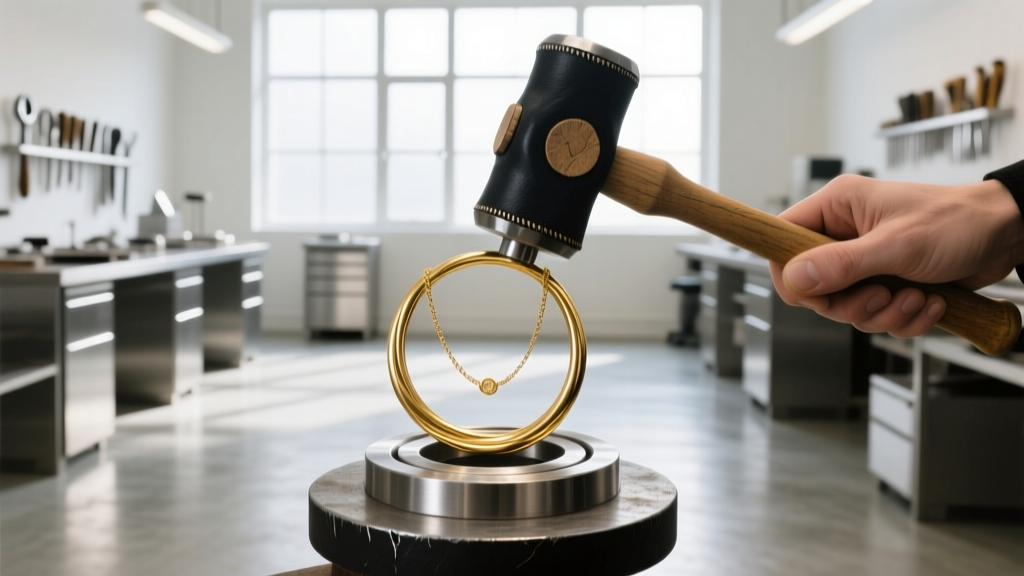
The Mandrel Reshaping Protocol
Never attempt to bend a warped circular gold necklace back into shape using your bare hands or standard metal pliers. Hand-bending creates 'kinks'—sharp angles that weaken the crystalline structure of the gold, leading to eventual snapping. Instead, use the professional mandrel method:
- Secure the Mandrel: Place a stepped steel ring mandrel vertically on a stable workbench.
- Seat the Necklace: Slide the circular necklace down the mandrel until it rests snugly at the point where the circle is perfectly round.
- Apply Soft Force: Using a rawhide or nylon-jaw mallet, gently tap the protruding, warped areas of the gold. The soft mallet head forces the gold into the steel curve without marring, scratching, or stretching the metal.
- Check Tension: Rotate the necklace on the mandrel to ensure the entire circumference sits flush against the steel.
Solving the Circular Tangle Geometry
Why do circular necklaces tangle in ways that seem mathematically impossible? When placed in a jewelry box, a rigid or semi-rigid circle acts as a geometric trap. If a second necklace or a loose earring passes through the center of the circle and the box is jostled, the items become locked in a 'topological knot.' Unlike a flexible chain that can slip back through its own loops, a rigid circular frame maintains its open center, actively catching other items.
The Isolation Rule
The only foolproof troubleshooting method for circular tangling is strict isolation. Never store a circular gold necklace loose in a drawer. It must be hung on a dedicated necklace bust or a wall-mounted hook where gravity keeps the circle perfectly vertical. If traveling, use a hard-shell jewelry roll with individual, snap-button felt straps that immobilize the clasp and the exact opposite side of the circle, preventing any rotational movement inside the pouch.
Work Hardening and Clasp Spring Failures
A hidden issue specific to circular gold necklaces is 'work hardening' at the solder joints. Because the circular shape does not absorb shock by folding like a chain, any sudden tug on the necklace transfers 100% of the kinetic energy directly to the clasp's jump rings and the tiny spring inside a lobster claw.
Over time, this repeated micro-trauma causes the internal steel spring (or the gold tension lever) to lose its elasticity. If your clasp feels 'mushy' or fails to snap shut with a crisp click, the internal mechanism has suffered metal fatigue. Do not attempt to oil or pry open a failing clasp; the internal components are micro-machined and cannot be repaired. The correct troubleshooting step is to have a jeweler snip off the fatigued clasp and laser-weld a fresh, heavy-duty lobster claw or parrot clasp onto the existing circular frame.
Preventive Maintenance Checklist
To maintain the structural integrity and aesthetic perfection of your circular gold necklace, adopt this bi-annual maintenance routine:
- Ultrasonic Caution: Never place hollow or tubular circular gold hoops in an ultrasonic cleaner. The high-frequency vibrations can cause micro-fractures at the solder joints where the hollow tube meets the solid clasp loop.
- Friction Testing: Run a piece of silk thread along the entire circumference of the circle. If the thread snags, you have a micro-burr or a warped link that will eventually catch on your clothing and pull the necklace out of its circular alignment.
- Chemical Avoidance: Chlorine in swimming pools reacts aggressively with the copper alloys in 14k and 18k gold, leading to 'stress corrosion cracking.' This is especially fatal to circular necklaces under constant tension.
A circular gold necklace is a masterclass in continuous tension. By respecting its geometry, balancing its weight, and utilizing proper reshaping tools, you can ensure the piece remains a flawless, unbroken loop for generations.


