Necklace Turtle Troubleshooting: Fix Flipping & Broken Bails
Is your necklace turtle constantly flipping or breaking its chain? Learn expert troubleshooting for bail wear, weight distribution, and enamel repair.

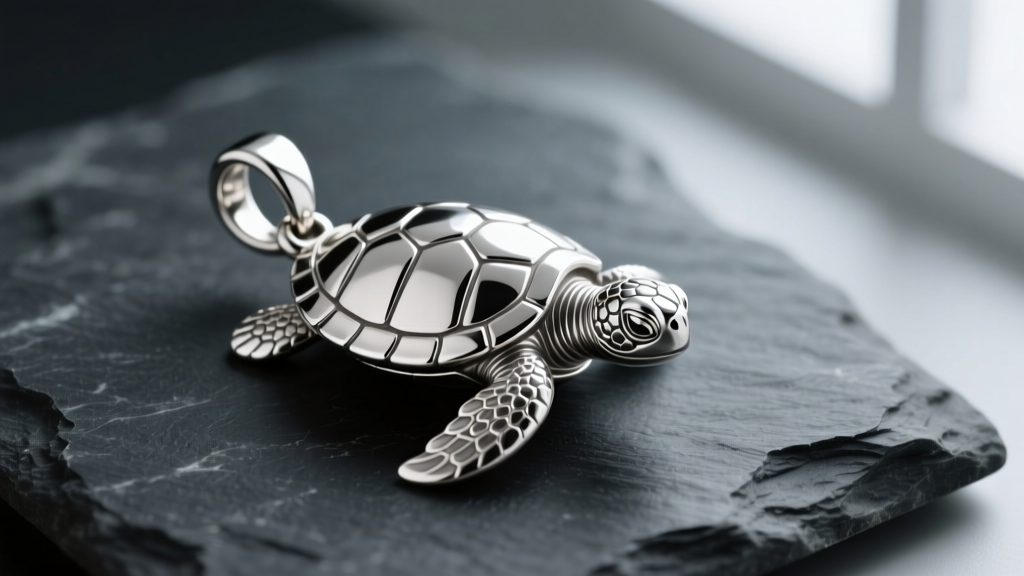
Turtle pendants are beloved for their symbolism of longevity, steady progress, and oceanic wanderlust. However, from a bench jeweler’s perspective, the necklace turtle is a notorious mechanical troublemaker. Because of their unique anatomical shape—wide flippers, domed carapaces, and uneven weight distribution—turtle pendants suffer from a specific set of structural and material failures that standard geometric pendants simply do not face.
If your favorite turtle pendant is constantly flipping upside down, sawing through its chain, or losing the gemstones embedded in its shell scutes, you are not alone. This comprehensive troubleshooting guide dives deep into the physics, metallurgy, and material science required to fix and prevent the most common necklace turtle failures.
The Gravity Problem: Why Your Necklace Turtle Keeps Flipping
The most frequent complaint regarding turtle pendants is their tendency to flip forward, showing the flat belly rather than the detailed shell. This is a physics issue rooted in the center of mass versus the bail placement.
Sea turtle designs, with their elongated front flippers, are inherently bottom-heavy. Box turtles, with their highly domed shells, are often top-heavy or front-heavy depending on the angle of the head. When a standard cylindrical loop bail is soldered to the exact top-center of the carapace, the pendant hangs from a single pivot point. If the center of gravity sits even two millimeters below or in front of that pivot, gravity will force the pendant to rotate forward.
Solution: Repositioning the Bail and Adding Counterweights
To fix a flipping necklace turtle, you must alter the pendulum physics. A bench jeweler can remove the standard loop bail and solder a hidden bail or a V-bail slightly lower on the shell, closer to the actual center of mass. Alternatively, if you do not want to alter the pendant itself, you can change the chain dynamics. Adding a discrete, heavy tungsten or sterling silver counterweight bead on the chain directly behind the pendant's neck area will pull the top backward, forcing the shell to lay flat against the sternum.
Bail Friction and Chain Snap: The Hidden Wear Point
Turtles are rarely lightweight. A solid 925 sterling silver sea turtle measuring 25mm across can easily weigh between 8 and 14 grams. When worn daily, this heavy mass acts as a kinetic pendulum. The constant swinging creates immense friction at the single point where the chain passes through the bail.
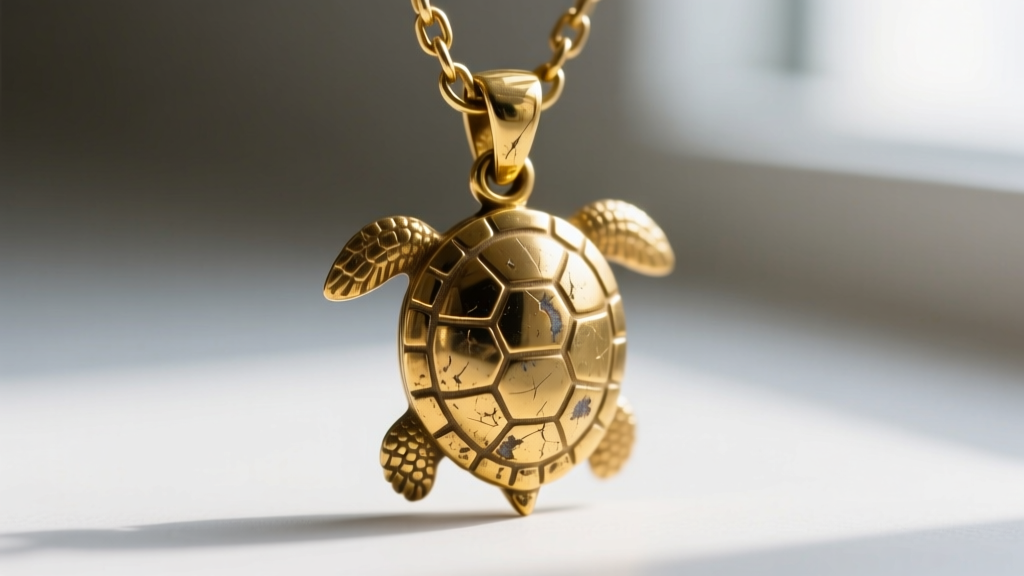
If your necklace turtle is paired with a standard 0.9mm cable chain, the bail will act like a jeweler's saw. Over 6 to 12 months, the bail will saw completely through the chain link, or the chain will wear a groove entirely through the soft silver bail, resulting in a lost pendant. According to metal fatigue studies referenced by the GIA Gem Encyclopedia, repetitive kinetic friction on soft alloys like 925 silver or 14k yellow gold drastically accelerates metal loss.
The Chain-to-Pendant Weight Ratio Chart
To prevent catastrophic chain failure, you must match your chain's gauge and weave to the exact weight of your turtle pendant. Avoid standard cable chains entirely; instead, opt for Wheat (Spiga) or Rope chains, which distribute friction across multiple interlocking links.
| Pendant Weight | Minimum Chain Thickness | Recommended Chain Weave | Wire Gauge Equivalent |
|---|---|---|---|
| Under 3g (Hollow/Thin) | 0.9mm - 1.1mm | Cable or Curb | 20 - 18 Gauge |
| 3g - 8g (Standard Solid) | 1.2mm - 1.5mm | Wheat or Box | 16 - 14 Gauge |
| 8g - 15g (Heavy/Large) | 1.8mm - 2.5mm | Rope or Figaro | 12 - 10 Gauge |
| 15g+ (Oversized/Solid Gold) | 3.0mm+ | Cuban Link or Leather | 8 Gauge or thicker |
Pro-Tip: If you must use a thinner chain for aesthetic reasons, have a jeweler install a hardened steel or platinum jump ring inside the silver bail. This sacrificial ring will take the brunt of the friction, saving both your gold chain and your silver pendant from being sawed in half.
Enamel Chipping and Resin Yellowing on the Shell
Many high-end necklace turtles feature colored shells to mimic the vibrant patterns of a hawksbill or green sea turtle. The troubleshooting method depends entirely on the material used to color the shell scutes.
Cold Enamel (Epoxy Resin) vs. Vitreous Enamel (Glass)
Cold Enamel: Often found in mid-range ($50–$150) turtle pendants, cold enamel is essentially a hardened epoxy resin. The primary problem here is UV degradation and chemical reaction. Prolonged exposure to sunlight, combined with the acidic pH of human sweat, will cause white or light-blue resins to yellow and become brittle. Never put a cold-enamel turtle in an ultrasonic cleaner; the high-frequency vibrations will shatter the resin bond, causing it to flake out of the metal cells.
Vitreous Enamel: Found in luxury and artisan pieces ($300+), vitreous enamel is powdered glass fired at over 1400°F. It will never yellow and is impervious to skin acids. However, it has a low Vickers hardness rating regarding impact resistance. Dropping a vitreous enamel turtle on a tile floor will result in immediate, catastrophic chipping. If your vitreous enamel chips, it cannot be glued; it must be sent to a specialist enamelist to be fired in a kiln again.
Loose Scute Gemstones: Prong vs. Bezel Settings
Designers frequently place diamonds, sapphires, or cubic zirconia on the hexagonal scutes of the turtle's shell. Because the shell is a curved, three-dimensional surface, these stones are usually set with standard prongs to maximize light return.

The problem? The domed shape of the turtle shell means the prongs sit at various outward angles. When you pull a sweater over your head or wipe your neck with a towel, the fabric catches these protruding prongs, pulling them away from the gemstone's girdle. According to industry repair data cited by Rio Grande jewelry suppliers, prong tipping is one of the most common bench repairs for zoomorphic pendants.
How to Secure Your Scute Stones
- Routine Maintenance: Every six months, use a 10x jeweler's loupe to inspect the prongs on the shell. If you see a gap between the metal and the stone, stop wearing it immediately.
- Prong Tipping: A jeweler can add a small bead of hard 14k white gold or platinum to the worn prongs. Avoid using soft 24k or 18k yellow gold for tipping, as it will wear down just as quickly.
- The Bezel Upgrade: If you are constantly losing stones, ask a custom jeweler to mill out the scute settings and replace the prongs with flush or bezel settings. While you will lose a fraction of the gemstone's visible surface area, a bezel setting is virtually snag-proof and will secure the stones for a lifetime.
Final Thoughts on Turtle Pendant Maintenance
A necklace turtle is more than just a charming accessory; it is a complex piece of micro-engineering that requires specific care. By understanding the physics of its center of gravity, matching your chain gauge to its kinetic weight, and respecting the chemical limitations of its enamel shell, you can ensure your pendant survives the elements. Treat your turtle with the mechanical respect it deserves, and it will easily become a lifelong staple in your jewelry rotation.


