Troubleshooting Your Pitbull Dog Necklace: Fixes for Flipping & Breakage
Is your pitbull dog necklace constantly flipping or breaking? Discover expert troubleshooting tips for pendant bails, chain gauges, and metal grades.

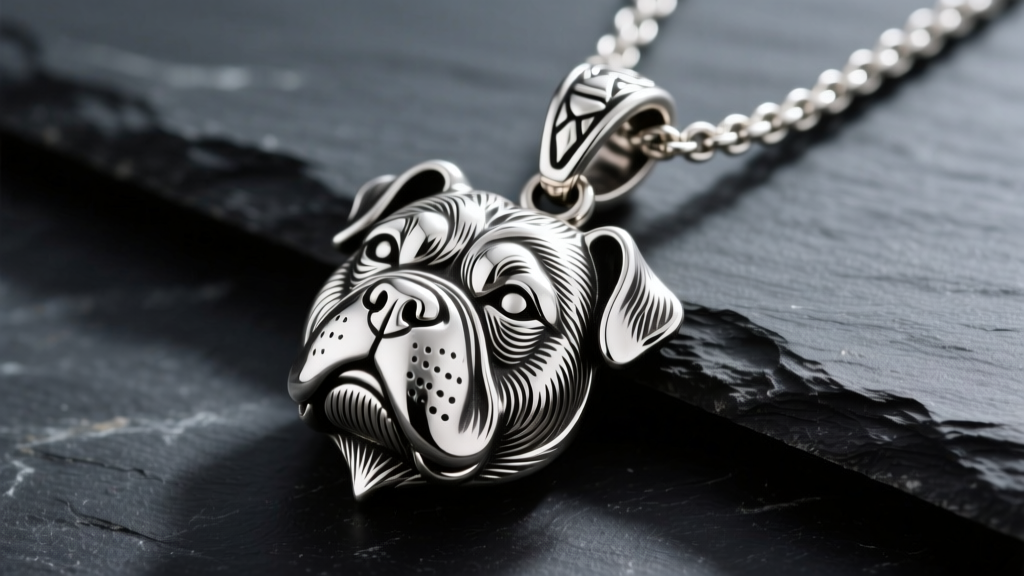
Owning a piece of breed-specific jewelry is a profound way to celebrate your bond with your canine companion. However, when it comes to a pitbull dog necklace, owners frequently encounter a unique set of structural and mechanical frustrations. Unlike symmetrical geometric pendants or lightweight gemstone drops, a pitbull profile pendant is inherently asymmetrical, dense, and top-heavy. This distinct anatomy creates specific points of failure in everyday wear.
If your favorite pendant is constantly flipping upside down, snapping chains, or leaving a green residue on your skin, the issue isn't just bad luck—it is a matter of jewelry physics and metallurgy. In this comprehensive troubleshooting guide, we will break down the exact mechanical failures common to heavy, breed-specific pendants and provide actionable, expert-level solutions to fix them.
The Physics of the 'Upside-Down Pendant' Flip
The most common complaint among pitbull owners is that the pendant refuses to sit correctly. A sitting or standing pitbull profile has a drastically off-center center of gravity due to the broad chest and heavy head. When suspended from a standard loop bail on a rounded chain, the pendant acts as a pendulum. It will naturally rotate until its heaviest point rests at the absolute bottom, which often results in the dog's face pointing sideways or completely upside down.
Solution 1: Upgrading to a Hidden or Fixed Bail
Standard glue-on flat pad bails or simple wire loops offer too much rotational freedom. To solve the flipping issue, you must restrict the pendant's movement.
- Hidden Bails: A jeweler can solder a hidden tube bail directly into the top of the pendant. This lowers the suspension point and forces the pendant to lay flush against the chest.
- Fixed Enhancers: If you cannot alter the pendant, use a fixed pendant enhancer with a tight internal silicone grip. This creates friction against the chain, preventing the pendant from sliding into the lowest gravitational dip of the necklace.
Solution 2: Chain Friction Pairing
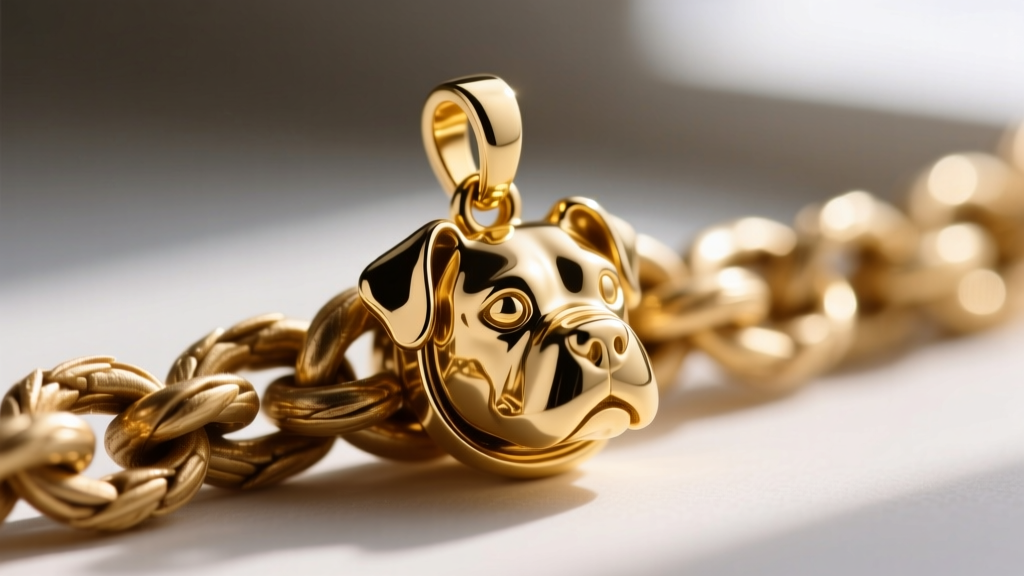
The type of chain you use dictates how freely the bail can slide. Rounded chains like snake or box chains act like ball bearings, encouraging the pendant to flip. According to jewelry fabrication standards outlined by Rio Grande, textured chains provide the necessary friction to hold heavy, asymmetrical pendants in place.
| Chain Style | Surface Friction | Flipping Risk | Best Pairing For |
|---|---|---|---|
| Box Chain | Low | High | Lightweight, symmetrical pendants |
| Wheat Chain | High | Low | Heavy, asymmetrical pitbull profiles |
| Rope Chain | Medium-High | Medium | Medium-weight cast pendants |
| Snake Chain | Very Low | Very High | Pendants with fixed, non-moving bails |
Troubleshooting Chain Snaps and Clasp Failures
Pitbull pendants are notoriously dense. A solid 925 sterling silver pitbull head measuring just 25mm x 30mm can easily weigh between 18 and 28 grams. While this feels light in your hand, the dynamic tensile load it places on a chain when you bend over, jog, or catch the pendant on a sweater is immense. A sudden jerk can generate up to 15 pounds of momentary shear force on the weakest link.
The Gauge Size Mandate
Most fashion jewelry chains range from 1.0mm to 1.5mm in thickness. A 1.2mm cable chain has a breaking point of roughly 4 to 6 pounds of tension. When pairing a chain with a heavy pitbull dog necklace, you must scale up the wire gauge. Never use a chain thinner than 2.5mm for a solid metal breed pendant. Opt for a 3.0mm Wheat or Rope chain, which distributes the tensile stress across multiple interlocking links rather than a single weak solder point.
Upgrading the Clasp Mechanism
The clasp is almost always the first point of failure. Spring ring clasps rely on a microscopic internal spring that routinely fails under dynamic loads. Furthermore, the tiny jump ring connecting the spring ring to the chain is often left unsoldered in mass-produced jewelry, creating a gap that the heavy pendant will easily pry open.
"Always inspect the jump rings on a heavy pendant necklace. If the gap in the metal ring is visible to the naked eye, a 20-gram pendant will eventually pull it open. Demand soldered, closed jump rings or upgrade to a forged lobster clasp with a reinforced swivel." — Master Bench Jeweler
For ultimate security, replace the standard lobster clasp with a box clasp featuring a figure-8 safety latch. This mechanical lock physically prevents the clasp from disengaging even if the primary trigger is accidentally depressed.
Preventing Tarnish, Corrosion, and Skin Irritation
The third major issue plaguing owners of novelty pet jewelry is the dreaded 'green neck' and rapid tarnishing. Many mass-market breed-specific necklaces are stamped with misleading terms like 'Tibetan Silver' or 'Alpaca.' These are not silver at all; they are base metal alloys composed primarily of copper, zinc, and occasionally nickel or lead.
Decoding Metal Grades for Dog Jewelry
According to metallurgical guidelines from the Gemological Institute of America (GIA), prolonged skin contact with copper-heavy alloys in the presence of sweat and body oils causes a rapid oxidation reaction, resulting in green skin and contact dermatitis. To troubleshoot this, you must verify the exact metal grade of your pitbull dog necklace.
- 925 Sterling Silver: The ideal standard. It contains 92.5% pure silver and 7.5% copper. It will tarnish over time, especially if exposed to dog grooming products or sulfur, but it is easily polished and generally hypoallergenic.
- 316L Surgical Stainless Steel: Highly resistant to tarnish and incredibly strong. It is an excellent, budget-friendly alternative for heavy pendants, though local jewelers cannot easily resize or solder steel chains if they break.
- Gold Vermeil (Not Gold Plated): Vermeil requires a thick layer of gold (minimum 2.5 microns) over a sterling silver base. Standard 'gold plated' jewelry uses a brass base with a microscopic gold flash that will wear off in weeks, exposing the reactive brass underneath.
Expert Maintenance and Cleaning Protocols
Because you are a dog owner, your necklace is exposed to environmental factors that standard jewelry is not. Dog shampoos, flea treatments, and natural pet dander contain sulfur compounds and harsh surfactants that accelerate the oxidation of sterling silver. If you pet your dog and then adjust your necklace, you are actively transferring these tarnishing agents to the metal.
The 3-Step Troubleshooting Cleaning Routine
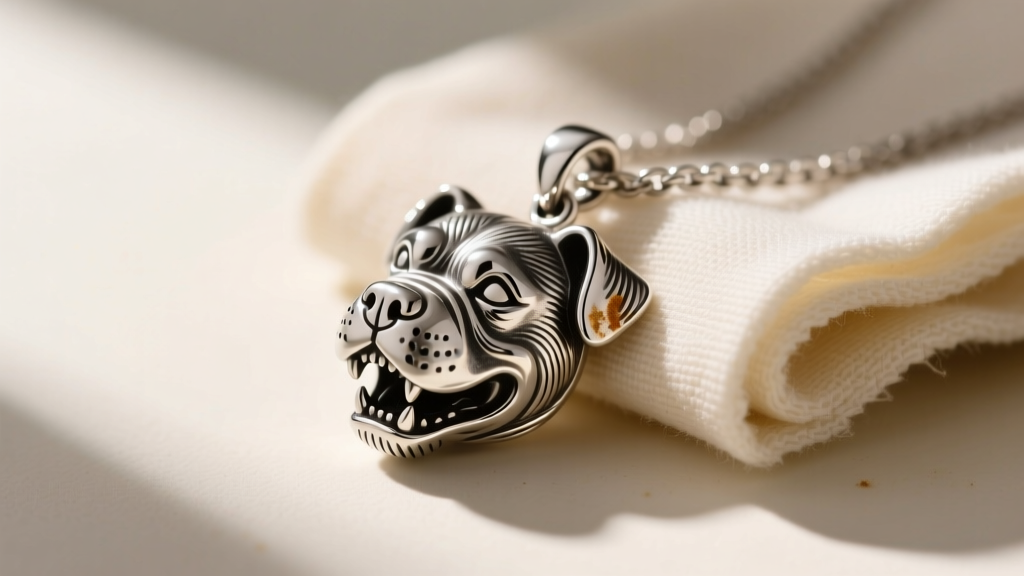
- Degrease First: Before polishing, wash the pendant in warm water with a single drop of phosphate-free dish soap. Use an extra-soft baby toothbrush to gently clear out the deep crevices of the cast fur texture where skin oils and dog dander accumulate.
- Chemical-Free Polishing: Avoid liquid silver dips. These harsh acids strip the factory patina from the engraved details, leaving the pitbull's fur texture looking flat and overly bright. Instead, use a treated micro-abrasive jeweler's cloth to gently buff only the high points of the metal.
- Ultrasonic Caution: Never put an oxidized (antiqued) pitbull pendant in an ultrasonic cleaner. The high-frequency vibrations will shake the intentional black oxidation right out of the fur grooves, ruining the contrast and depth of the design.
By understanding the unique center of gravity, respecting tensile strength limits, and demanding proper metal purity, you can transform your problematic pitbull dog necklace into a durable, lifelong heirloom that sits perfectly and safely against your chest.


