Every Floral Necklace Name: Material Properties Guide
Discover the ideal metal alloys and gemstone pairings for every floral necklace name, from rose gold lotus pendants to platinum daisy chains.

The Metallurgy Behind the Bloom
When you search for a specific floral necklace name—whether it is a 'Victorian Rose,' an 'Egyptian Lotus,' or a 'Minimalist Daisy'—you are not just choosing a botanical motif; you are selecting a specific set of metallurgical requirements. The architecture of a flower dictates how a jeweler must manipulate metal. High-relief petals require malleable alloys that can be deeply carved without fracturing, while delicate filigree stems demand metals with high tensile strength and ductility.
As we navigate the 2026 jewelry market, the intersection of botanical symbolism and material science has never been more refined. Sustainable lab-grown diamonds and recycled precious metals are now the baseline for high-end floral pendants. However, the fundamental physics of jewelry making remains unchanged. According to data from the World Gold Council, the specific alloy mix of a gold chain or pendant drastically alters its Vickers hardness (HV), which in turn determines whether a floral design will hold its intricate edges over decades of daily wear or slowly erode into a smooth, unrecognizable blob.
This guide decodes the most popular floral necklace name categories, matching each botanical design with its ideal metal grade, casting method, and gemstone pairing to ensure your necklace is as resilient as it is beautiful.
Decoding the Most Popular Floral Necklace Name Categories
The Rose: High-Relief & Malleability
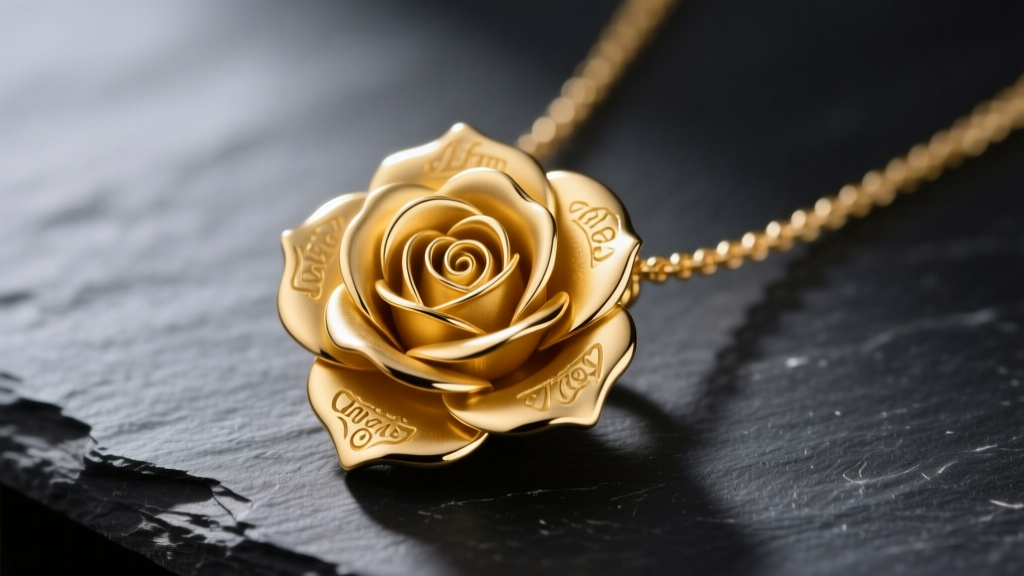
The 'Rose' is arguably the most common floral necklace name in global jewelry markets. A true rose pendant relies on high-relief layering to mimic the overlapping, velvety texture of petals. This requires a metal that is highly malleable and capable of holding a matte or brushed finish without reflecting too much light, which would ruin the organic illusion.
Ideal Material: 18k Yellow Gold or 18k Rose Gold. The 75% pure gold content provides the necessary softness (approximately 125-140 HV) for deep carving and lost-wax investment casting. The copper content in 18k rose gold not only provides a warm, romantic hue but also increases the alloy's durability slightly compared to pure 24k gold, preventing the thin petal edges from bending during accidental impacts.
Design Note: Avoid 14k white gold for highly textured rose pendants unless it is rhodium-plated, as the polishing process required to maintain the white gold's luster will eventually wear down the microscopic ridges that give the rose its realistic texture.
The Lotus: Intricate Filigree & Tensile Strength
The 'Lotus' floral necklace name is synonymous with spiritual purity and intricate, symmetrical geometry. Lotus pendants often feature openwork filigree, wire-wrapping, or micro-pave settings that require the metal to be drawn into extremely thin wires or sheets without snapping.
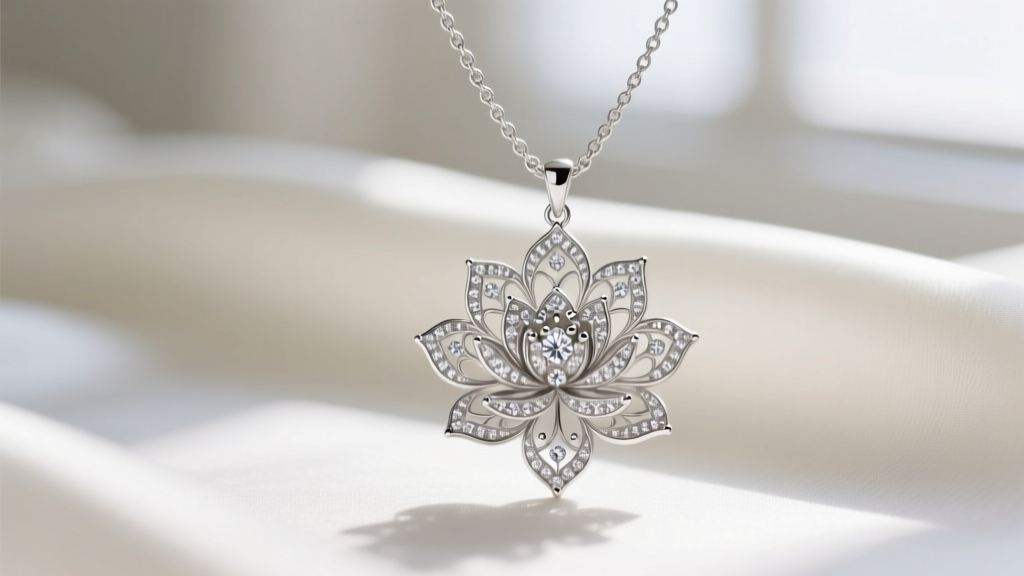
Ideal Material: 950 Platinum alloyed with Ruthenium. Platinum is exceptionally ductile, meaning it can be drawn into wires thinner than a human hair for filigree work. While its Vickers hardness (around 135 HV) is similar to 18k gold, platinum's unique property is that it displaces rather than loses metal when scratched. This makes it the ultimate choice for securing the tiny micro-pave diamonds often used to represent dew drops on lotus petals. In 2026, recycled 950 platinum has become the industry standard for these heirloom-quality botanical pieces.
The Daisy: Enamel & Stamping Durability
The 'Daisy' or 'Chamomile' floral necklace name usually points toward flat, die-struck designs, often featuring cold enamel or anodized finishes to capture the flower's bright, cheerful contrast. Because daisies are relatively flat and geometric, they do not require the deep casting malleability of a rose.
Ideal Material: Grade 5 Titanium (Ti-6Al-4V) or Sterling Silver Vermeil. Titanium is incredibly hard (upwards of 334 HV) and lightweight, making it perfect for larger, flat daisy pendants that won't drag down a delicate chain. Furthermore, titanium can be anodized using electrical voltage to produce vibrant, permanent colors without the use of toxic dyes or fragile enamels that might chip over time.
Material Comparison Chart for Floral Pendants
To help you choose the right metal for your specific floral necklace name, refer to the metallurgical breakdown below. Pricing reflects estimated 2026 raw material and basic fabrication costs per gram for cast botanical components.
| Floral Motif | Ideal Metal Alloy | Vickers Hardness (HV) | Best Casting Method | 2026 Est. Price/Gram |
|---|---|---|---|---|
| Rose (High Relief) | 18k Yellow Gold (75% Au) | 125 - 140 HV | Lost-Wax Investment | $65 - $85 |
| Lotus (Filigree) | 950 Platinum (Ru alloy) | 135 - 150 HV | Hand-Fabricated / CAD | $35 - $50 |
| Daisy (Stamped) | Grade 5 Titanium | 334+ HV | Die-Striking / CNC | $4 - $12 |
| Orchid (Asymmetrical) | 14k Rose Gold | 150 - 170 HV | 3D Resin Cast | $45 - $60 |
Gemstone Pairings Based on Floral Symbolism
A floral necklace name often implies a specific color palette and gemstone cut. However, pairing the wrong gemstone hardness with a textured metal setting can lead to catastrophic damage. The GIA Gem Encyclopedia emphasizes that the Mohs scale of mineral hardness must dictate how a stone is set within a botanical motif.
The Lily and the Morganite
The 'Lily' floral necklace name evokes elegance and soft, sweeping curves. This design is perfectly complemented by a 6mm to 8mm faceted Morganite (Mohs 7.5-8). Morganite's peach-pink hue mimics the natural blush of a Stargazer lily. Because lily pendants often feature sweeping, prong-like metal petals that wrap around the stone, the gem must be hard enough to resist scratching from the metal setting during the polishing process.
The Violet and the Amethyst
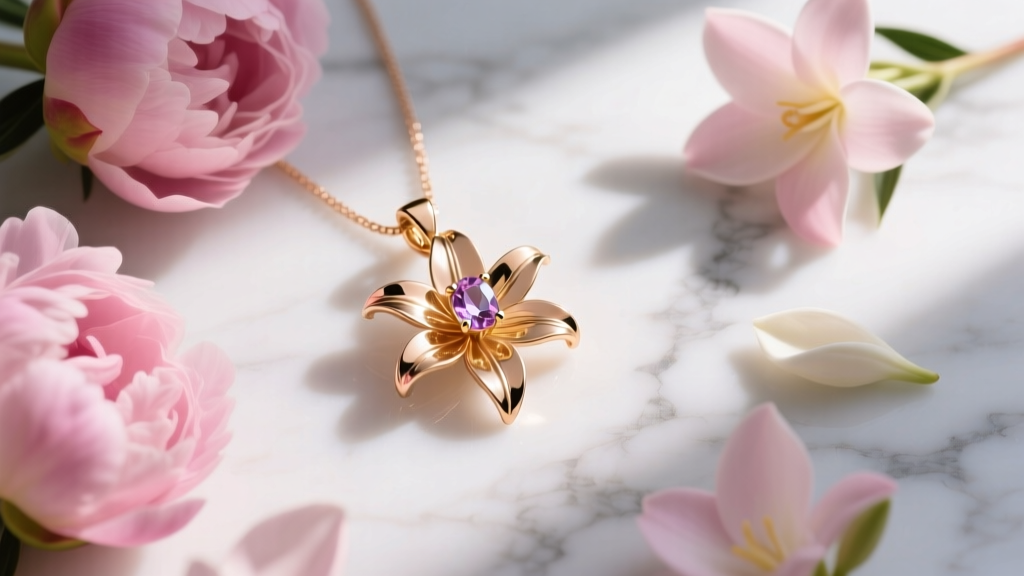
For a 'Violet' or 'Pansy' necklace, deep purple Amethyst (Mohs 7) is the traditional choice. However, violets are often carved in intaglio or cameo styles. When setting an amethyst cabochon into a violet bezel, jewelers must ensure the metal is fully annealed before pushing it over the stone. If the metal is work-hardened, the pressure required to set it can cleave the amethyst along its natural crystalline planes.
Expert Tip: Never pair a soft, porous gemstone like Turquoise (Mohs 5-6) or Pearl (Mohs 2.5-4.5) with a high-relief floral pendant that features sharp, unpolished metal edges. The daily friction between the metal and the stone will act like sandpaper, destroying the gem's luster within months.
Care and Tarnish Prevention for Botanical Jewelry
Floral jewelry is notoriously difficult to clean. The deep crevices of a rose pendant or the tight wire-wrapping of a lotus filigree trap skin oils, lotions, and environmental dust. This buildup not only dulls the metal but can accelerate localized galvanic corrosion if the piece is made of mixed alloys.
The Ultrasonic Warning: While ultrasonic cleaners operating at 40kHz are excellent for removing dirt from plain metal chains, they are highly dangerous for many floral pendants. If your floral necklace name design includes fracture-filled emeralds, dyed jade, or opals, the high-frequency vibrations will shatter the stones. Furthermore, ultrasonic waves can loosen the micro-pave diamonds often found in high-end lotus or orchid designs.
The Correct Protocol: For textured gold and platinum floral pendants, use a soft-bristled baby toothbrush and a solution of warm water with a few drops of phosphate-free dish soap. Gently agitate the bristles into the petal crevices. Rinse with distilled water to prevent hard water spots, and dry immediately with a microfiber cloth. For sterling silver botanical pieces, store them in an anti-tarnish cloth pouch with a piece of activated charcoal to absorb ambient sulfur compounds that cause blackening.
Understanding the material science behind your favorite floral necklace name ensures that your botanical jewelry remains a vibrant, lasting tribute to nature, rather than a fragile piece destined for the repair bench.


