Expert Guide to Buying an Antique Opal Necklace: Eras & Care
Discover how to authenticate an antique opal necklace. Explore Victorian to Art Deco eras, opal types, setting metallurgy, and expert preservation tips.

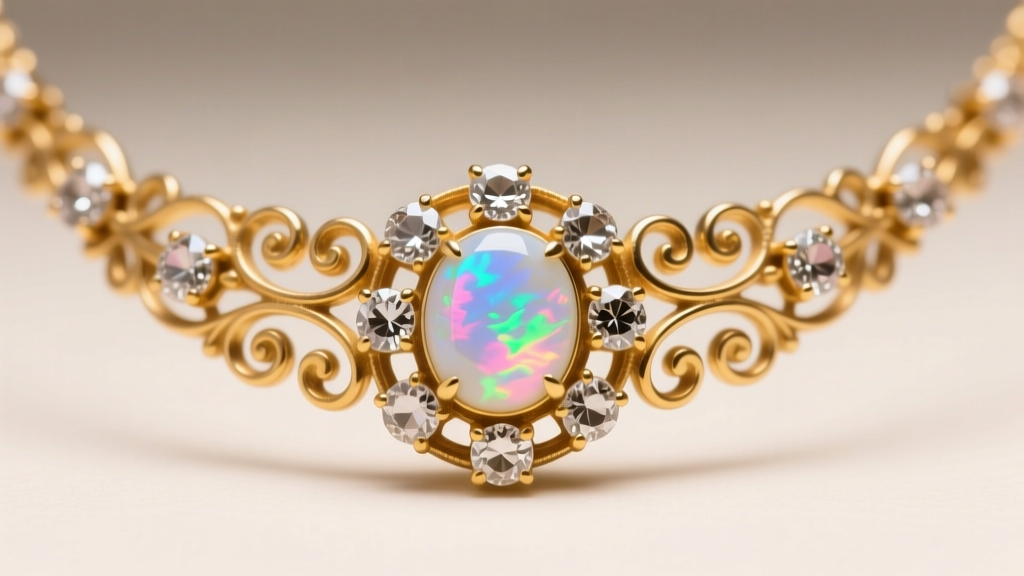
The pursuit of an authentic antique opal necklace requires far more than an appreciation for play-of-color; it demands a rigorous understanding of historical metallurgy, gemological composites, and era-specific construction techniques. Unlike modern mass-produced jewelry, antique pieces (defined as 100 years or older) carry inherent structural vulnerabilities and unique identifiers that separate genuine historical artifacts from later reproductions or frankenstein pieces. In this technical deep dive, we dissect the anatomy, authentication markers, and preservation protocols for antique opal necklaces spanning the Victorian, Edwardian, and Art Deco eras.
The Metallurgy and Mechanics of Antique Opal Settings
Opals rank between 5.5 and 6.5 on the Mohs hardness scale, making them exceptionally susceptible to abrasion and impact. Historical jewelers understood this, yet their setting techniques were often dictated by the aesthetic trends of their time rather than pure gemological safety. When evaluating an antique opal necklace, the metal composition and setting style provide critical clues regarding its age and structural integrity.
- Victorian Yellow Gold (15k and 18k): Before the UK Hallmarking Act standardized 14k and 18k in 1932, British jewelers heavily utilized 15k gold. A 15k stamp (often accompanied by a crown and the number 15) is a strong indicator of mid-to-late 19th-century British origin. Prong settings from this era often feature thick, rounded claws, but centuries of wear can reduce these to paper-thin strips that no longer secure the cabochon.
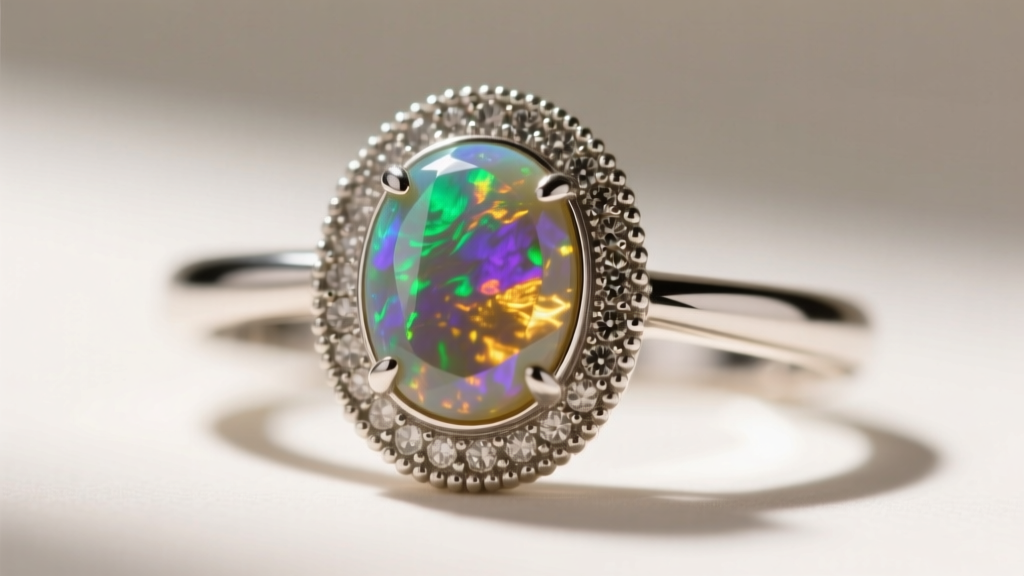
- Edwardian Platinum and Millegrain: The advent of the oxyhydrogen torch in the early 1900s allowed jewelers to work with platinum. Edwardian opal necklaces frequently feature platinum bezels or prongs adorned with millegrain (tiny beaded edges). Because platinum is highly durable, original Edwardian prongs often survive intact, but the delicate openwork galleries beneath the opal can easily crush if subjected to modern ultrasonic cleaning.
- Bezel vs. Prong Failure Modes: While bezel settings offer superior protection for the fragile edges of an opal, antique prong settings are more common for high-domed cabochons. The primary failure mode in antique prong settings is 'claw fatigue,' where repeated micro-impacts cause the metal to snap. Always inspect the underside of the gallery; if the metal is worn thin or shows evidence of laser welding (a modern repair), the piece requires immediate professional retipping.
Chronological Guide to Antique Opal Necklaces (1837–1935)
Victorian Era (1837–1901)
Queen Victoria’s patronage of Scottish jewelry and her general fondness for sentimental motifs popularized opals in the mid-19th century. Victorian antique opal necklaces often feature white or crystal opals set in 15k yellow gold, frequently accented with rose-cut diamonds or turquoise. A critical authentication marker for high-end Victorian pieces is the presence of closed-back, foil-backed settings. While this enhances the opal's fire, it poses a massive preservation risk: if moisture breaches the backing, the silver foil will oxidize and turn black, destroying the stone's optical performance.
Edwardian & Art Nouveau (1901–1915)
The Edwardian era shifted focus to ethereal, lace-like designs. Opals were integrated into garland-style lavalieres and delicate platinum chains. During the overlapping Art Nouveau period, opals became the centerpiece of organic, asymmetrical designs, often carved into plique-à-jour enamel motifs or set alongside demantoid garnets. Authentication hinges on examining the chain links; Edwardian chains feature hand-soldered, perfectly circular jump rings, whereas later reproductions will show machine-stamped, uniform links with visible seam lines.
Art Deco (1920–1935)
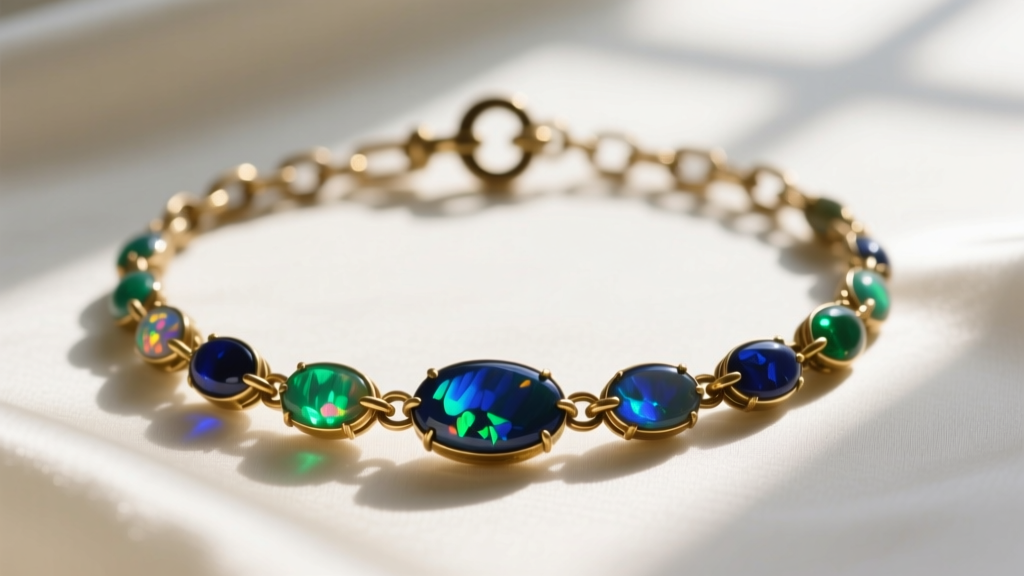
The discovery of the Lightning Ridge black opal fields in Australia coincided with the Art Deco movement's demand for high-contrast geometry. Art Deco antique opal necklaces frequently pair dark, vibrant black opals with stark black onyx, rock crystal, and calibré-cut sapphires in platinum or white gold settings. Look for step-cut geometric halos and early channel settings, which were pioneered during this era to create seamless lines of color.
Solid vs. Composite: Identifying Historical Opal Types
Not every opal in an antique necklace is a solid, single piece of gem material. To maximize yield and enhance color, historical lapidaries frequently utilized composite stones. Identifying these is crucial for accurate valuation and proper care, as submerging a composite opal in water can dissolve the adhesive layers.
| Opal Type | Historical Era of Popularity | Identification Marker | Primary Vulnerability |
|---|---|---|---|
| Solid White/Crystal | Victorian (1837-1901) | Uniform color play from all angles; natural inclusions visible under 10x loupe. | Crazing (cracking) due to extreme dehydration or rapid temperature shifts. |
| Solid Black | Art Deco (1920-1935) | Naturally dark body tone (N1-N4); rough, unpolished back or natural sandstone inclusions. | Chipping at the girdle if prongs apply uneven pressure during setting. |
| Doublet | Late Victorian to Edwardian | Perfectly flat, straight color line when viewed in profile; black glass or potch backing glued to thin opal veneer. | Delamination if exposed to hot water, steam, or harsh chemical cleaners. |
| Triplet | Mid-20th Century (Rare in true antiques) | Domed clear quartz or glass cap glued over a thin opal slice and a dark backing; visible glue lines at the dome edge. | Cap abrasion and glue clouding over decades of wear. |
| Boulder Opal | Edwardian & Art Nouveau | Irregular shape with natural brown ironstone matrix left on the back and sides of the stone. | Ironstone matrix can rust or stain if exposed to prolonged moisture or acidic environments. |
Chain Anatomy and Clasp Authentication
The chain and clasp of an antique opal necklace are often more revealing than the pendant itself. Reproducers frequently pair genuine antique pendants with modern chains to pass them off as entirely original pieces. According to historical jewelry archives at the Victoria and Albert Museum, analyzing the clasp mechanism is a primary method for dating necklaces.
- The C-Clasp (Pre-1900): Early Victorian and Edwardian brooches and pendants utilized a simple 'C' shaped catch without a locking mechanism. If an antique opal necklace features a C-clasp, it should show significant wear inside the curve of the 'C' from decades of the pin stem rubbing against it.
- The Tube Clasp (1900–1920): A transitional mechanism where the pin stem pushes into a narrow metal tube. These are notoriously difficult to operate and were largely abandoned by the 1920s.
- Early Lobster and Bolt Rings (1930s+): If an opal pendant purportedly from the Victorian era is attached to a chain with a modern, stamped lobster clasp or a perfectly machine-spring bolt ring with a seamless solder joint, the chain is a later replacement. True antique bolt rings (often called spring rings) feature a visible solder seam and a small, flat push-lever rather than a rounded pull-tab.
Preservation and Failure Prevention
Opals are non-crystalline silica containing between 3% and 21% water. This water content makes them highly reactive to their environment. The most catastrophic failure mode for an antique opal necklace is 'crazing'—a network of fine surface cracks caused by rapid moisture loss or thermal shock.
"Never subject an antique opal to ultrasonic or steam cleaning. The high-frequency vibrations can shatter internal stress points in the silica structure, while the heat can instantly evaporate the stone's internal water content, leading to irreversible crazing." — Gemological Institute of America (GIA) Opal Care Guidelines
To properly preserve an antique opal necklace, adhere to the following protocols:
- Avoid Hydrophane Shock: Some antique white opals are 'hydrophane,' meaning they are highly porous and will temporarily lose their play-of-color and turn transparent if submerged in water or exposed to heavy oils and lotions. Always remove the necklace before bathing or applying cosmetics.
- Climate Control: Store the necklace in a sealed, airtight polyethylene bag with a slightly damp (not wet) cotton ball to maintain a stable humidity level of around 40-50%. Do not store opals in safety deposit boxes or safes for extended periods, as the dehumidifiers in these environments will draw moisture out of the stone.
- Prong Maintenance: Have a master jeweler inspect the prongs every 24 months. Because opals cannot withstand the heat of a traditional jeweler's torch, any retipping or prong tightening must be done using a laser welder or by completely removing the stone from the setting first.
Acquiring an antique opal necklace is an exercise in historical stewardship. By meticulously examining the metallurgy, decoding the clasp mechanics, and understanding the gemological nuances of the stone, collectors can confidently navigate the market and preserve these iridescent artifacts for the next century.


