The Anatomy of a Gold Flower Pendant Necklace: An Expert Guide
Explore the technical anatomy of a gold flower pendant necklace. Learn about karat alloys, casting methods, petal gauges, and chain pairing.
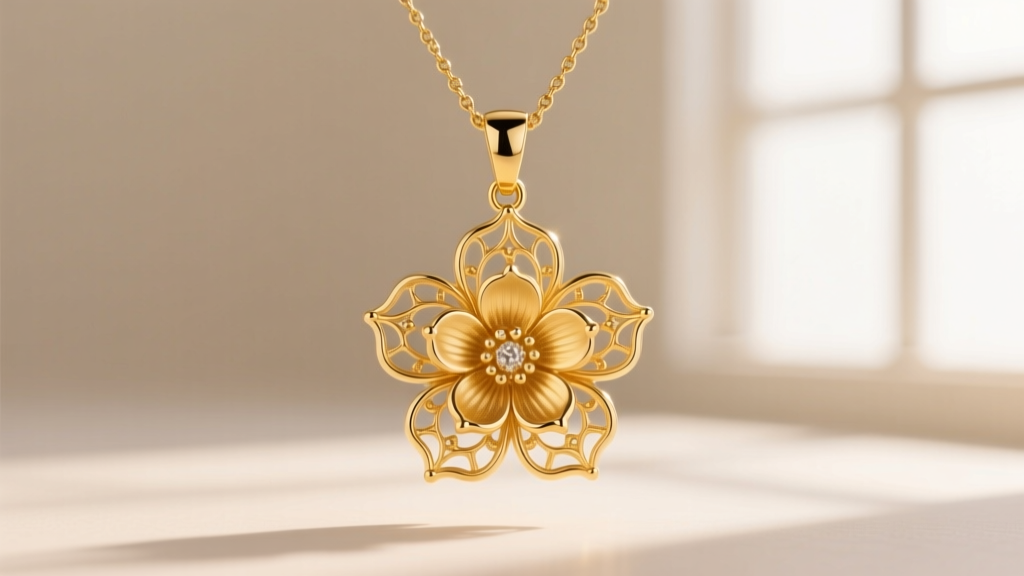
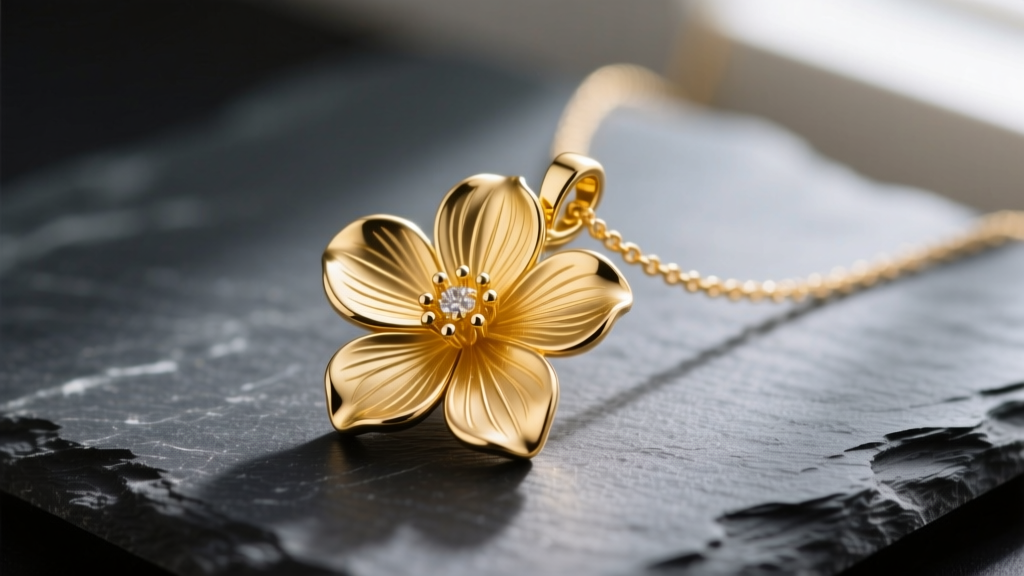
When evaluating a gold flower pendant necklace, most consumers focus solely on the aesthetic appeal of the botanical design. However, as jewelry appraisers and master goldsmiths know, the longevity, drape, and structural integrity of floral jewelry rely on a complex interplay of metallurgy, casting physics, and mechanical tolerances. This expert deep dive deconstructs the technical anatomy of floral pendants, providing you with the precise specifications needed to assess quality, avoid structural failure, and make informed acquisitions in 2026 and beyond.
The Metallurgy of Floral Gold: Karat Alloys and Petal Durability
The delicate nature of flower petals requires a gold alloy that balances malleability for intricate detailing with sufficient tensile strength to resist bending. Pure 24K gold (Vickers hardness of ~25 HV) is entirely unsuitable for organic, multi-petal structures due to its extreme softness. According to the Gemological Institute of America (GIA), alloying gold with copper, silver, and zinc fundamentally alters its crystalline lattice, dictating how thin a petal can be cast before it becomes structurally compromised.
14K vs. 18K vs. 22K: A Structural Comparison
| Karat | Gold Purity | Vickers Hardness (HV) | Minimum Safe Petal Gauge | Best Floral Application |
|---|---|---|---|---|
| 14K | 58.3% | 120 - 150 HV | 0.3mm - 0.5mm | Highly detailed, thin-layered roses with micro-pavé centers. |
| 18K | 75.0% | 90 - 120 HV | 0.6mm - 0.8mm | Premium botanical pendants requiring rich color and moderate durability. |
| 22K | 91.6% | 50 - 70 HV | 1.2mm+ | Chunky, hammered floral motifs; unsuitable for delicate veining. |
For a standard gold flower pendant necklace featuring overlapping petals with deep veining, 14K or 18K gold is mandatory. The higher copper content in 14K yellow or rose gold increases the alloy's yield strength, allowing master casters to achieve petal thicknesses as low as 0.4mm without risking deformation during everyday wear.
Manufacturing Techniques: Lost-Wax Casting vs. Die Stamping
The manufacturing method dictates the pendant's dimensional accuracy and internal density. The vast majority of 3D floral pendants are produced via lost-wax casting. A 3D-printed or hand-carved wax model is encased in investment plaster, burned out at 1350°F, and replaced with molten gold via centrifugal or vacuum force.
Identifying Failure Modes in Cast Petals
- Gas Porosity: If the investment flask is not properly degassed, microscopic air bubbles become trapped in the gold. In thin floral petals, porosity creates weak points that can snap under minor tensile stress.
- Shrinkage Cavities: As gold cools, it contracts. Poorly designed sprue networks (the channels feeding gold into the mold) can result in localized sink marks on the back of thick flower centers.
- Work Hardening (Stamping): Conversely, flat floral designs (like daisies or sunflowers) are often die-stamped. Stamping compresses the gold grains, increasing hardness but reducing flexibility. Stamped petals will crack if bent, whereas cast petals will simply warp.
Chain Mechanics: Matching the Bail and Link Gauge
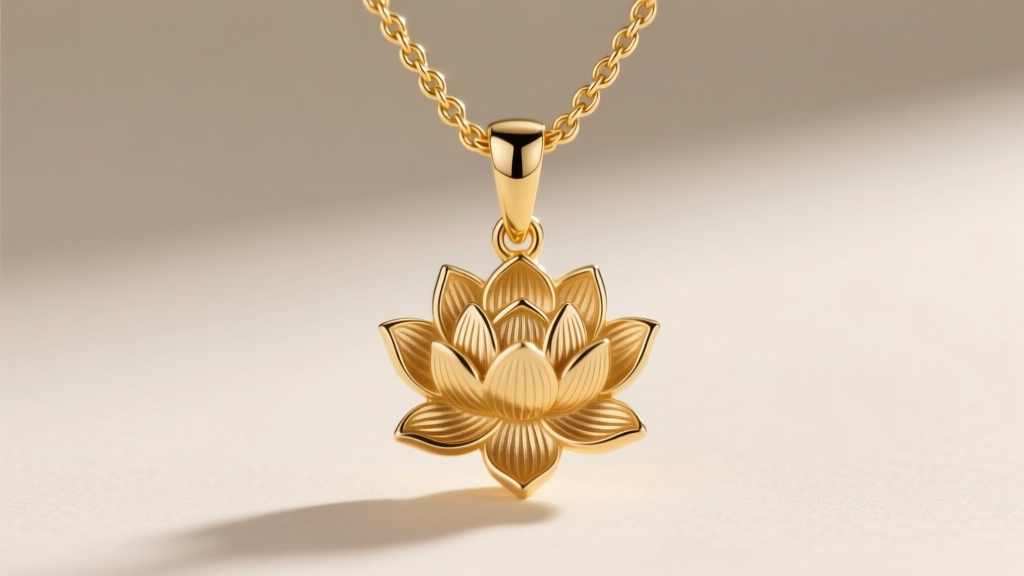
A frequent point of failure in a gold flower pendant necklace is the junction between the pendant bail and the chain. The bail aperture must be engineered to accommodate the chain's diagonal width while minimizing friction-induced wear. According to manufacturing standards highlighted by the Santa Fe Symposium on jewelry technology, the internal diameter of a soldered bail should be at least 1.5 times the maximum diagonal measurement of the chain links.
"A heavy 25mm gold lotus pendant requires a chain with a minimum breaking strength of 15 lbs. Pairing it with a delicate 0.9mm cable chain will inevitably result in tensile failure at the clasp or severe friction wear inside the bail loop."
Bail Aperture and Chain Thickness Tolerances
For pendants weighing under 5 grams, a 1.0mm to 1.5mm box or cable chain is optimal. The bail hole should measure no less than 2.0mm x 1.5mm. For statement floral pieces exceeding 15 grams, a 2.5mm to 3.5mm rope or Figaro chain is required. Furthermore, the bail itself must be cast or fabricated with a minimum wall thickness of 0.8mm; otherwise, the friction from the gold chain will eventually saw through the bail loop over a period of 3 to 5 years.
Botanical Accuracy and Enamel Integration
High-end floral pendants often incorporate enameling to replicate the vibrant colors of nature. The technical execution of this enamel work separates mass-produced jewelry from heirloom-quality pieces.
- Vitreous Enamel: Fused glass powder fired at approximately 1400°F (760°C). It is highly durable, UV-resistant, and will not fade. Often used in champlevé techniques where the gold flower center is carved out to hold the glass.
- Cold Enamel (Epoxy Resin): A two-part polymer cured at room temperature. While cheaper and capable of brighter, more translucent colors, cold enamel is susceptible to yellowing from UV exposure and can degrade when exposed to harsh chemicals or ultrasonic cleaners.
- Plique-à-jour: A master-level technique where translucent enamel is suspended in the gold petal framework without a metal backing, resembling stained glass. This requires exceptional structural rigidity in the gold lattice to prevent the enamel from cracking upon impact.
Expert Maintenance: Ultrasonic Risks and Prong Fatigue
Maintaining a gold flower pendant necklace requires an understanding of its specific vulnerabilities. While ultrasonic cleaners are excellent for removing sebum and lotion buildup from plain gold chains, they pose a severe risk to floral pendants featuring micro-pavé diamond centers or vitreous enamel.
The high-frequency cavitation bubbles generated by ultrasonic waves can easily shake loose the tiny prongs securing 1mm melee diamonds in a flower's stamen. Furthermore, if the pendant features cold enamel or fractured inclusions in any center gemstones, the ultrasonic vibrations will exacerbate the fractures or cause the resin to delaminate from the gold substrate. For routine cleaning of intricate floral gold jewelry, experts recommend a soft-bristled brush, lukewarm water, and a mild, ammonia-free dish detergent, followed by drying with a microfiber cloth to prevent water spotting in the deep crevices of the cast petals.
By understanding the metallurgical properties, casting tolerances, and mechanical requirements of floral jewelry, collectors and enthusiasts can confidently evaluate the true craftsmanship behind any gold flower pendant necklace.