Ultimate Care Guide for Your Gold Necklace Infinity Pendant
Learn expert cleaning and maintenance tips to keep your gold necklace infinity pendant tarnish-free, shiny, and structurally sound for years.


The infinity symbol is one of the most enduring motifs in jewelry, representing boundless love, eternity, and empowerment. However, the continuous, overlapping loops of a gold necklace infinity pendant create unique structural challenges when it comes to daily wear and maintenance. The tight crevices where the figure-eight crosses over itself are notorious traps for dead skin cells, cosmetic residues, and environmental pollutants. Over time, this buildup not only dulls the brilliance of the gold but can also accelerate localized tarnishing of the alloy metals.
Whether your piece is crafted from 10k, 14k, or 18k gold, maintaining its luster requires more than a quick wipe with a tissue. In this comprehensive guide, we break down the metallurgy of gold alloys, provide a step-by-step cleaning protocol, and outline the specific hazards that can permanently damage your infinity pendant.
The Anatomy of an Infinity Pendant: Why It Needs Special Care
To understand how to care for your jewelry, you must first understand its composition. Pure 24-karat gold is highly resistant to tarnish and corrosion. However, it is far too soft to hold the rigid, overlapping structure of an infinity symbol without bending or warping during daily wear. Therefore, jewelers alloy gold with metals like copper, silver, zinc, and nickel to increase durability.
- 18k Gold (75% pure): Rich in color but contains 25% alloy metals. It is more prone to surface scratching and requires gentle handling.
- 14k Gold (58.5% pure): The industry standard for durability. The higher alloy content makes it resilient, but the copper and silver are highly susceptible to oxidation when exposed to sulfur and chlorine.
- 10k Gold (41.7% pure): Extremely durable but contains more alloy than gold, making it the most prone to dullness and tarnish if not cleaned regularly.
The crossover point of the infinity loop is a microscopic shelf. When you apply lotions, perfumes, or hairspray, these products settle into this junction. As the water and alcohol evaporate, they leave behind a sticky film that attracts dust and grit, acting like sandpaper against the gold every time the pendant moves against your skin.
Daily Wear vs. Deep Cleaning: A Maintenance Schedule
Not every gold necklace infinity pendant requires the same level of maintenance. Your lifestyle dictates how often you need to intervene. Below is a data-driven maintenance schedule based on wear frequency and environmental exposure.
| Wear Profile | Environment & Habits | Quick Clean Frequency | Deep Clean Frequency |
|---|---|---|---|
| Occasional | Worn for events; stored safely; no chemical exposure. | After every 3rd wear | Every 6 months |
| Daily (Office) | Worn daily indoors; occasional perfume/lotion contact. | Weekly | Every 3 months |
| Active / High-Exposure | Worn 24/7; gym, swimming, heavy skincare routines. | Every 2-3 days | Monthly |
Step-by-Step Cleaning Guide for Gold Infinity Necklaces
According to the Gemological Institute of America (GIA), the safest and most effective way to clean gold jewelry at home is using a mild, phosphate-free liquid dish soap and warm water. Avoid harsh commercial jewelry dips, which often contain thiourea—a chemical that can cause micro-pitting in gold alloys over time.
What You Need
- Mild, phosphate-free dish soap (e.g., original blue Dawn)
- Distilled or filtered warm water (hard tap water can leave mineral spots)
- A brand-new, extra-soft baby toothbrush
- An untreated microfiber polishing cloth
- A lint-free cotton swab
The Soak and Swish Method
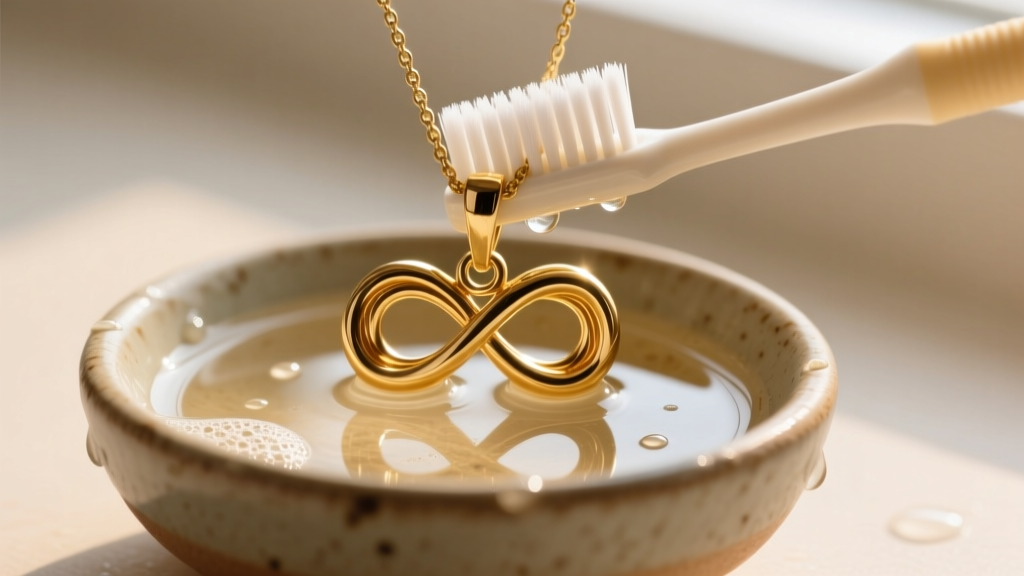
- Prepare the Bath: Fill a small ceramic or glass bowl with warm water and add three drops of dish soap. Avoid using plastic bowls, as they can harbor microscopic scratches that trap grit.
- Soak: Submerge your gold necklace infinity pendant in the solution for 10 to 15 minutes. This loosens the sebum and cosmetic buildup trapped in the figure-eight crossover.
- Agitate: Gently swish the necklace through the water. Do not pull the chain aggressively.
- Target the Crevices: Take the baby toothbrush and lightly brush the overlapping junction of the infinity symbol. Use the cotton swab to reach the tightest angles where the metal loops intersect.
- Rinse: Rinse the pendant under a gentle stream of lukewarm distilled water. Ensure the drain is securely plugged!
Drying and Polishing
Pat the necklace dry with a soft paper towel, then use your untreated microfiber cloth to buff the surface. Crucial Warning: Do not use abrasive jeweler's cloths (like Sunshine cloths) for weekly cleaning. These cloths are impregnated with mild abrasives that remove a microscopic layer of gold each time. Reserve abrasive cloths for once or twice a year to remove stubborn surface scratches.
Hazards to Avoid: Chemicals and Ultrasonic Cleaners
While gold itself is a noble metal, the alloys mixed into your 14k or 18k infinity pendant are highly reactive. Understanding these chemical vulnerabilities is critical to preventing irreversible damage.
Expert Warning: Exposure to chlorine causes a metallurgical reaction known as 'stress corrosion cracking.' The chlorine attacks the copper and zinc alloys within the gold, permanently weakening the molecular structure. This often results in the infinity loop snapping at the solder point or the crossover junction.
The Ultrasonic Cleaner Dilemma
Ultrasonic cleaners use high-frequency sound waves to create microscopic cavitation bubbles that blast dirt away. If your gold necklace infinity pendant is a solid, plain metal casting, an ultrasonic cleaner is generally safe. However, if your infinity symbol features micro-pavé diamonds, tension settings, or gemstones glued into place (like turquoise or opals), the vibrations will loosen the settings and shatter fragile stones. When in doubt, stick to the manual soak-and-swish method.

Storing Your Infinity Necklace to Prevent Tangles and Scratches
The continuous loops of an infinity pendant make it a magnet for chain tangles. When a delicate gold chain (such as a 0.9mm cable or box chain) knots itself around the infinity loops, the friction can cause severe wear to the chain links.
To prevent this, never toss your necklace into a communal jewelry box. The Jewelers of America recommends storing fine jewelry in individual, anti-tarnish fabric pouches. For optimal care:
- Clasp It First: Always fasten the clasp before storing. This creates a closed circuit that drastically reduces the chance of the chain threading through the infinity loops.
- Use Anti-Tarnish Strips: Place a 3M anti-tarnish strip inside your jewelry box or pouch. These strips absorb airborne sulfur compounds before they can react with the copper in your gold alloy.
- Hanging Storage: If you prefer to display your necklaces, use a velvet-lined stand with individual pegs. Ensure the infinity pendant hangs freely without touching other metal pieces, as gold easily scratches when rubbed against harder metals or even other gold pieces.
White Gold Infinity Pendants: The Rhodium Factor
If your gold necklace infinity pendant is crafted from white gold, it requires an additional layer of maintenance. White gold is naturally a pale, slightly yellowish-grey alloy. To achieve the brilliant, mirror-like silver finish, it is plated with a microscopic layer of rhodium, a platinum-group metal.
Over time, friction from your skin and clothing will wear away the rhodium plating, particularly on the back of the infinity loop and the bail (the loop that connects the pendant to the chain). When you notice a yellowish tint bleeding through, it is time to visit a professional jeweler for a rhodium re-dip. Attempting to aggressively polish white gold at home will only strip the remaining rhodium faster.
When to See a Professional Jeweler
While home maintenance keeps your pendant looking brilliant, structural integrity requires professional oversight. You should take your gold necklace infinity pendant to a certified bench jeweler once a year for a comprehensive inspection. The jeweler will check the solder point where the bail meets the infinity loop—a common failure point due to the pendulum-like swinging motion of the necklace. They will also inspect the chain links for thinning and professionally steam-clean the piece to restore factory-level brilliance.
Conclusion
A gold necklace infinity pendant is more than just a beautiful accessory; it is a symbolic investment that requires mindful stewardship. By understanding the specific vulnerabilities of gold alloys, avoiding harsh environmental chemicals, and committing to a gentle, consistent cleaning routine, you can ensure that your infinity symbol remains as timeless and unbroken as the meaning it represents. Treat your jewelry with respect, and it will retain its brilliance for generations to come.


