Gold Necklace Layering: Metal Properties & Durability Guide
Master gold necklace layering with our metallurgy guide. Compare karat hardness, chain friction, gauge sizes, and galvanic risks for durable stacks.

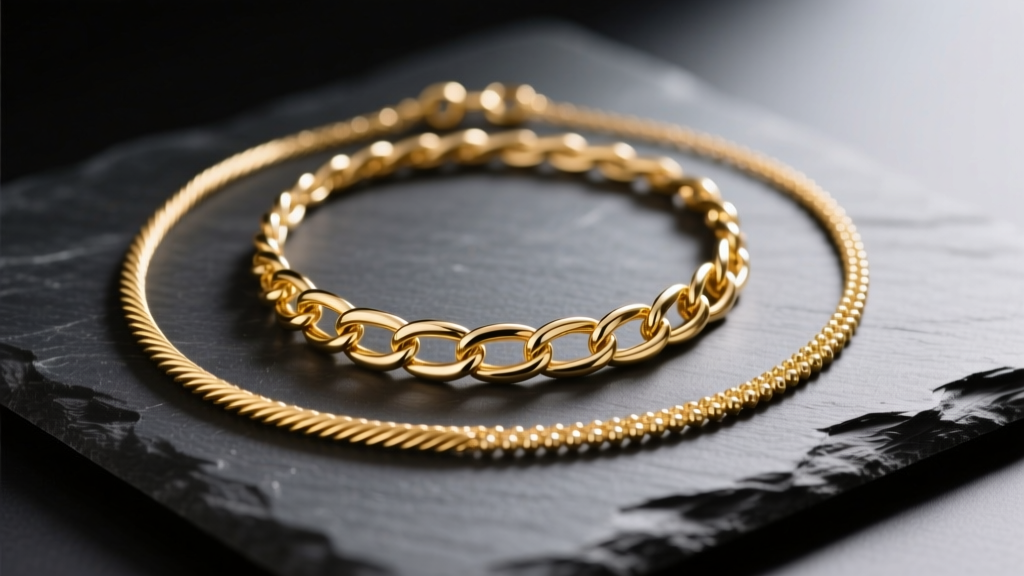
The Physics and Metallurgy of Gold Necklace Layering
Gold necklace layering is often treated purely as an aesthetic exercise, but from a jeweler's perspective, it is a complex interplay of metallurgy, friction, and tensile mechanics. When you stack multiple chains, you are creating a dynamic environment where metals constantly abrade one another. Understanding the material properties of your gold alloys, chain link geometries, and gauge thicknesses is the difference between a curated stack that lasts a lifetime and a tangled, degraded mess that requires constant repair. In this guide, we break down the exact material science behind successful gold necklace layering.
Karat Hardness: The Vickers Scale in Layered Stacks
Not all gold is created equal. The purity of gold, measured in karats, directly dictates its hardness and, consequently, how it will behave when rubbed against another chain. According to the Gemological Institute of America (GIA), pure 24k gold is far too soft for everyday jewelry, which is why it is alloyed with metals like copper, silver, and zinc. However, the resulting hardness varies wildly across karats.
10K and 14K Gold: The Abrasive Workhorses
14K gold (58.5% pure gold) typically registers between 135 and 150 on the Vickers Hardness (HV) scale. Because of its higher alloy content, it is highly resistant to deformation. When you layer a 14K gold chain against a softer metal, the 14K chain effectively acts as a micro-file. It is the ideal base layer for any stack due to its structural integrity and resistance to stretching under the weight of pendants.
18K and 22K Gold: Luxury and Liability
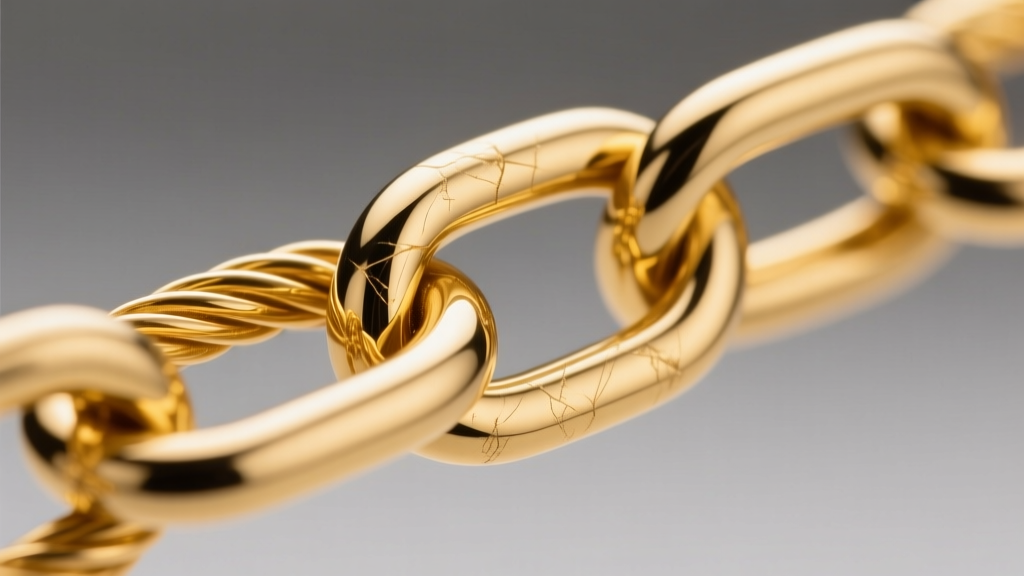
18K gold (75% pure gold) drops to roughly 110-125 HV, while 22K gold plummets to around 70 HV. If you layer an 18K or 22K chain with a 14K chain, the harder 14K links will gradually wear away the surface of the higher-karat gold. Over months of daily wear, this friction results in visible micro-scratches, loss of polish, and eventual thinning of the links. If you must layer mixed karats, always place the higher-karat (softer) chain on the outside of the stack where it moves freely, rather than trapped against a harder base chain.
Chain Geometry and Friction Coefficients
The physical shape of the chain link dictates its surface area contact and friction coefficient. According to manufacturing standards outlined by Rio Grande Jewelry Supply, different weaves interact uniquely when stacked. Choosing the wrong combination guarantees tangling and accelerated wear.
| Chain Style | Surface Friction | Tangling Risk | Best Layering Position |
|---|---|---|---|
| Cable / Rolo | Low | Low | Base or Middle Layer |
| Box | Medium | High (Catches hair/fabric) | Outer Layer (Pendant holder) |
| Rope | Very High | Medium | Solo or Outer Layer Only |
| Curb / Figaro | Low | Very Low (Lays flat) | Base Layer |
| Snake | High | High (Kinks easily) | Not recommended for stacking |
Pro Tip: Never layer two rope chains together. The twisted grooves of the rope weave act like gears, catching onto one another and causing severe localized friction that can snap the links under tension.
Galvanic Corrosion in Mixed-Metal Stacks
A common mistake in gold necklace layering is mixing solid gold with gold-filled, gold vermeil, or sterling silver chains. When dissimilar metals rest against each other on the skin, they form a galvanic cell. Human sweat acts as an electrolyte (saltwater), facilitating the transfer of electrons between the metals.
"Galvanic corrosion occurs when two dissimilar metals are in electrical contact in the presence of an electrolyte. The less noble metal (the anode) will corrode at an accelerated rate."
If you layer a gold vermeil chain (sterling silver base plated with gold) against a solid 14K gold chain, the friction will eventually wear through the thin gold plating (usually 0.5 to 2.5 microns). Once the silver core is exposed, the solid gold chain will act as the cathode, and the silver core will rapidly oxidize and degrade, leaving black marks on your skin and destroying the vermeil chain. Always layer solid gold with solid gold to maintain electrochemical equilibrium.

Strategic Gauge Sizing and Length Graduation
Material durability in a layered stack relies heavily on wire gauge (thickness) and precise length graduation. If chains are too close in length, they twist around each other, multiplying the friction points. If the gauges are mismatched incorrectly, a thick chain will crush a delicate one.
The 2-Inch Rule and Gauge Hierarchy
- The Base Layer (16 inches): Use a sturdy 18-gauge (1.02mm) or 16-gauge (1.29mm) curb or cable chain. This anchors the stack and distributes the weight across the cervical spine.
- The Middle Layer (18 inches): Step down to a 20-gauge (0.81mm) chain. A simple rolo or wheat chain works best here to provide visual contrast without adding excessive bulk.
- The Outer/Pendant Layer (20 to 22 inches): Use a delicate 22-gauge (0.64mm) or 24-gauge (0.51mm) chain. Because it hangs lowest, it experiences the most swinging momentum. Ensure the clasp is a high-quality lobster claw rather than a spring ring, as the dynamic tension of a swinging pendant can easily pull a weak spring ring open.
Maintenance: The Dangers of Ultrasonic Cleaning
When it comes time to clean your layered gold necklaces, the instinct is often to drop the entire tangled stack into an ultrasonic cleaner. Do not do this. Ultrasonic cleaners use high-frequency sound waves to create cavitation bubbles in a liquid solvent. If multiple chains are submerged together, the violent microscopic implosions will cause the chains to thrash and weave into one another, creating microscopic welds and severe tangles that require a jeweler's saw to cut apart.
Instead, unclasp all layers. Clean each karat and chain style individually using a soft-bristled brush and a mild, phosphate-free dish soap. Rinse with distilled water to avoid hard water mineral deposits, and dry completely with a microfiber cloth before reassembling your stack. By respecting the material properties and mechanical realities of your jewelry, your gold necklace layering will remain pristine, untangled, and structurally sound for years to come. For more data on global gold standards and alloy compositions, refer to the World Gold Council.


