Gold Plectrum Necklace Metals: Karat & Material Guide
Discover the best alloys for a gold plectrum necklace. We compare 14k vs 18k gold hardness, playable materials, and casting techniques for pick pendants.

The Metallurgical Challenge of Flat Pendants
A gold plectrum necklace is more than just a nod to musical passion; it represents a unique structural challenge in jewelry manufacturing. Unlike spherical or tubular pendants, a guitar pick shape is broad, flat, and features sharp, tapered edges. When jewelers use traditional lost-wax casting to create flat gold pendants, the metal cools unevenly. This often results in "sink marks" or shrinkage porosity in the center of the pick, where the metal is thickest. To combat this, high-end manufacturers either cast the plectrum in specialized vacuum-assisted kilns or utilize CNC (Computer Numerical Control) milling to carve the pick from a solid sheet of gold alloy. This ensures a perfectly flat surface, crisp beveled edges, and structural integrity that won't warp when pressed against the chest.
Choosing the right material for a gold plectrum necklace requires balancing aesthetic warmth with metallurgical durability. Because flat pendants experience high surface-area friction against clothing and skin, the alloy's hardness and scratch resistance are paramount. According to the Gemological Institute of America (GIA), the addition of alloying metals like copper, silver, and zinc not only dictates the color of the gold but fundamentally alters its tensile strength and Vickers Hardness (HV).
Solid Gold Karats: Hardness, Alloys, and Wearability
When shopping for a solid gold plectrum pendant, you will primarily encounter 18k, 14k, and 10k options. Pure 24k gold is virtually never used for plectrum pendants due to its extreme malleability; a 24k pick pendant would dent if simply squeezed between two fingers. Below is a metallurgical breakdown of the standard karats used in 2026 for musical jewelry.
| Karat | Gold Purity | Vickers Hardness (HV) | Primary Alloy Mix | Best Use Case |
|---|---|---|---|---|
| 24K | 99.9% | 25 - 30 HV | None (Pure Gold) | Strictly display/collector items |
| 18K | 75.0% | 120 - 135 HV | Copper, Silver, Zinc | High-end luxury, rich yellow hue |
| 14K | 58.3% | 140 - 160 HV | Copper, Silver, Nickel/Zinc | Daily wear, optimal scratch resistance |
| 10K | 41.7% | 160 - 180 HV | Copper, Zinc, Nickel | Budget-friendly, highest durability |
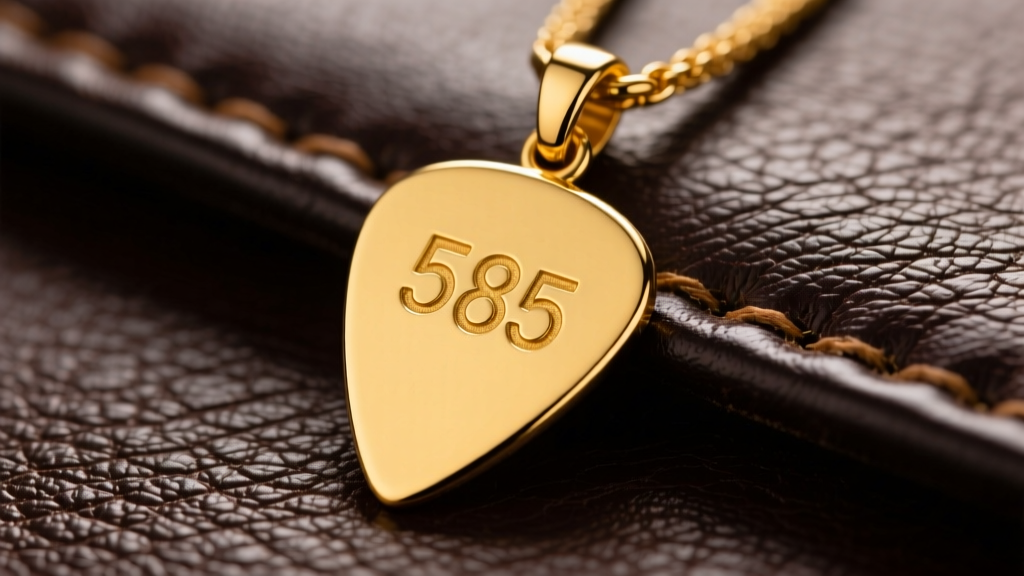
For a gold plectrum necklace intended for daily wear, 14k gold is the metallurgical sweet spot. It offers a Vickers Hardness nearly 30% higher than 18k gold, meaning it will resist the micro-scratches that inevitably occur when a flat pendant swings against zippers, buttons, and guitar straps. Furthermore, the Federal Trade Commission (FTC) Jewelry Guides mandate strict stamping requirements, so always look for the "585" or "14K" hallmark stamped discreetly on the top edge or bail of the plectrum to verify authenticity.
The "Playable" Myth: Why Solid Gold Fails as an Actual Pick
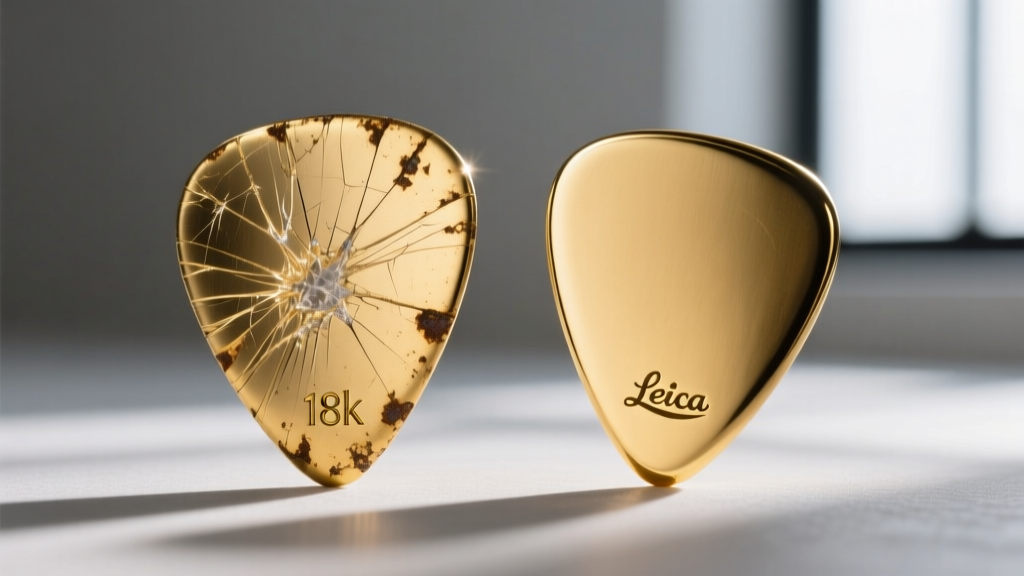
A common question from musicians is whether a solid gold plectrum necklace can be unclasped and used to actually strum an acoustic or electric guitar. From a materials science perspective, the answer is a definitive no. Standard guitar picks range from 0.46mm (thin) to 1.20mm (heavy) in thickness. If a jeweler were to mill a 14k gold pick at 0.80mm thick, the moment it struck a steel or nickel-wound guitar string, the gold would deform, bend, and gouge. Gold lacks the necessary Young's modulus (stiffness) to withstand the sheer force of strumming.
To create a structurally sound gold plectrum pendant that won't bend when bumped against a table, jewelers must cast them at a minimum thickness of 1.5mm to 2.5mm. This added thickness makes them far too rigid and heavy for playing guitar, resulting in a harsh, metallic scraping sound and potential damage to your instrument's strings and finish. If you want a "playable" plectrum necklace, you must look at alternative materials with gold accents, such as Tungsten Carbide (which boasts a staggering 1500+ HV) or aerospace-grade Titanium, often featuring a rose or yellow gold inlay in the center.
The High-Friction Problem: Plating vs. Solid Alloys
Because of the premium cost of solid gold, the market is flooded with gold-plated brass or gold vermeil (gold over sterling silver) plectrum necklaces. However, the geometry of a guitar pick makes it uniquely unsuited for plating. A plectrum pendant rests flat against the sternum, creating a broad surface area of continuous friction against the skin and clothing. Furthermore, musicians wearing these pendants often unconsciously rub the flat surface of the pick with their thumb while listening to music or thinking—a common nervous habit.
This repetitive, high-friction contact will strip standard 0.5-micron gold plating in a matter of weeks, exposing the base brass or copper underneath, which can then oxidize and turn the skin green. If you are on a strict budget and cannot afford solid 10k or 14k gold, opt for Gold-Filled (GF) alternatives. Gold-filled plectrums feature a mechanically bonded layer of gold that is 50 to 100 times thicker than standard plating, offering years of wear before the flat surface shows signs of brass exposure.
Bail Engineering and Chain Mechanics
The flat, top-heavy nature of a plectrum pendant creates a unique center of gravity. If hung on a standard, lightweight chain with a basic jump-ring bail, the pick will constantly flip upside down or slide laterally, failing to lay flat against the chest. To solve this, expert jewelers employ specific bail mechanics:
- The Slide Bail: A wide, flattened tube that allows the pick to sit flush and prevents lateral spinning.
- The Counterweighted Bail: A slightly heavier, thicker gold loop at the top of the pick that acts as a pendulum weight, forcing the pointed end of the plectrum to always face downward.
- Hidden Back Bails: A loop soldered horizontally on the back of the pick, allowing the chain to pass directly through the body of the pendant for a seamless, minimalist look.
For chains, avoid delicate cable or curb chains. A solid 5-gram gold plectrum requires a chain with high tensile strength, such as a 2.0mm to 3.0mm Box chain, Rope chain, or Wheat chain, which can support the pendant's weight without kinking.
2026 Pricing Benchmarks for Gold Plectrum Pendants
With gold prices remaining elevated in 2026, understanding the pricing structure of a gold plectrum necklace helps buyers avoid overpaying for underweight items. A standard, wearable plectrum pendant (approximately 30mm x 25mm) should weigh between 3.5 grams and 6 grams to maintain structural rigidity.
- 10K Solid Gold (4g - 6g): $180 - $280
- 14K Solid Gold (4g - 6g): $280 - $450
- 18K Solid Gold (5g - 7g): $450 - $750
- Gold-Filled / Heavy Vermeil: $45 - $90
When evaluating a gold plectrum necklace, always ask the jeweler for the exact gram weight. Because the shape is deceptively large but can easily be cast too thin to save on material costs, weight is the ultimate indicator of quality, durability, and fair market value.