Gold V Necklace Troubleshooting: Fix Flipping and Tangling
Learn how to fix common gold V necklace problems. Expert troubleshooting for flipping pendants, sliding chains, tangling, and metal wear.


The minimalist gold v necklace is a staple in modern jewelry wardrobes, prized for its elongating effect and geometric elegance. However, the very physics that make the V-shape visually striking also make it mechanically prone to specific failures. From relentless pendant flipping to asymmetric sliding and chain tangling at the vertex, these issues can turn a beautiful piece into a daily frustration.
As jewelry styling experts, we frequently diagnose structural and material failures in geometric pendants. This comprehensive troubleshooting guide addresses the root mechanical causes behind gold V necklace failures and provides actionable, professional-grade solutions to restore your piece to perfect working order.
The Anatomy of a Gold V Necklace and Why It Fails
Unlike circular or teardrop pendants, a V-shaped pendant features an off-center mass distribution and a sharp vertex that acts as a natural pivot point. When suspended from a flexible chain, gravity pulls the heaviest part of the pendant downward. If the bail (the loop connecting the pendant to the chain) is not perfectly aligned with the pendant's center of gravity, the necklace will continuously rotate.
Furthermore, the structural integrity of the V-vertex is a common failure point. According to the Gemological Institute of America (GIA), pure gold is highly malleable. Therefore, jewelry is alloyed with metals like copper, silver, and zinc. A delicate 18k gold v necklace (75% pure gold) is significantly softer than a 14k alternative (58.5% pure gold). Repeated stress at the sharp V-bend can cause micro-fractures or permanent warping in higher-karat pieces, altering how the pendant hangs.
Troubleshooting Issue #1: The Pendant Won't Stay Centered
One of the most common complaints is the pendant sliding off-center, resting awkwardly near the collarbone instead of the sternum. This is rarely a defect in the gold itself; it is a mismatch between the chain's friction coefficient and the bail's inner diameter.
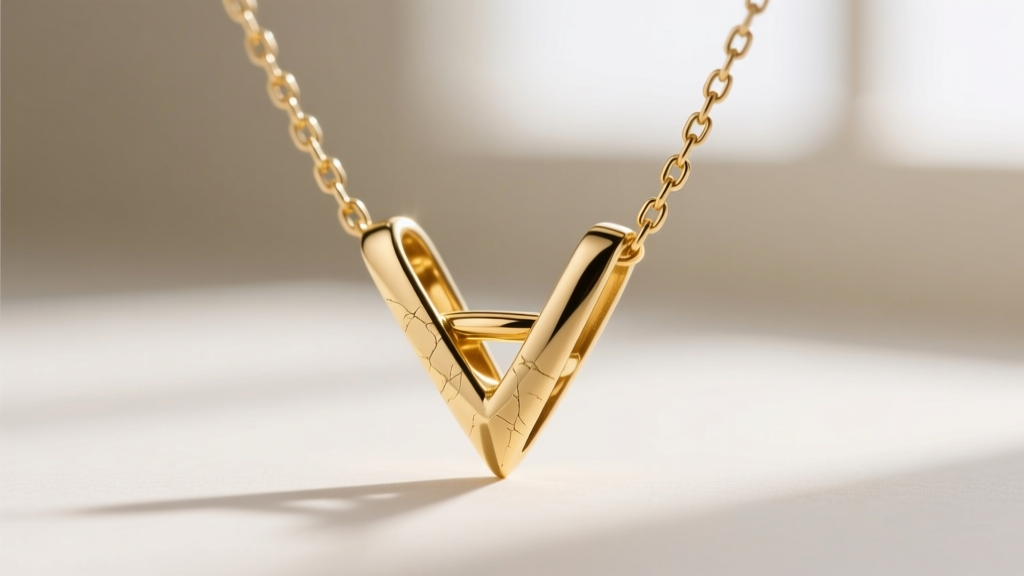
Diagnosing the Bail-to-Chain Ratio
For a gold v necklace to self-center, the pendant must have enough lateral freedom to slide along the chain, but enough friction to stop at the natural dip of the neckline. The golden rule of jewelry mechanics is that the bail's inner diameter (ID) should be exactly 1.5 to 2 times the width of the chain.
- Chain too thick for the bail: The pendant gets stuck where the neck slopes, unable to slide down to the center.
- Chain too thin for the bail: The pendant slides too freely, migrating to one side with every body movement.
Actionable Fixes
If your chain is too thin, you do not necessarily need to buy a new one. You can install silicone necklace stops (small, transparent O-rings) on the chain exactly two inches on either side of the center back. These act as invisible bumpers, restricting the pendant's lateral travel zone. If the bail is too small, a professional jeweler can use a mandrel to gently stretch the bail or replace it with a custom-soldered 14k gold jump ring, which offers a smoother, wider track for the chain.
Troubleshooting Issue #2: The V-Drop Keeps Flipping Upside Down
There is nothing more annoying than looking down to find your V pendant displaying its blank back or, worse, hanging upside down. This plagues both fixed-bail V pendants and lariat-style V necklaces.
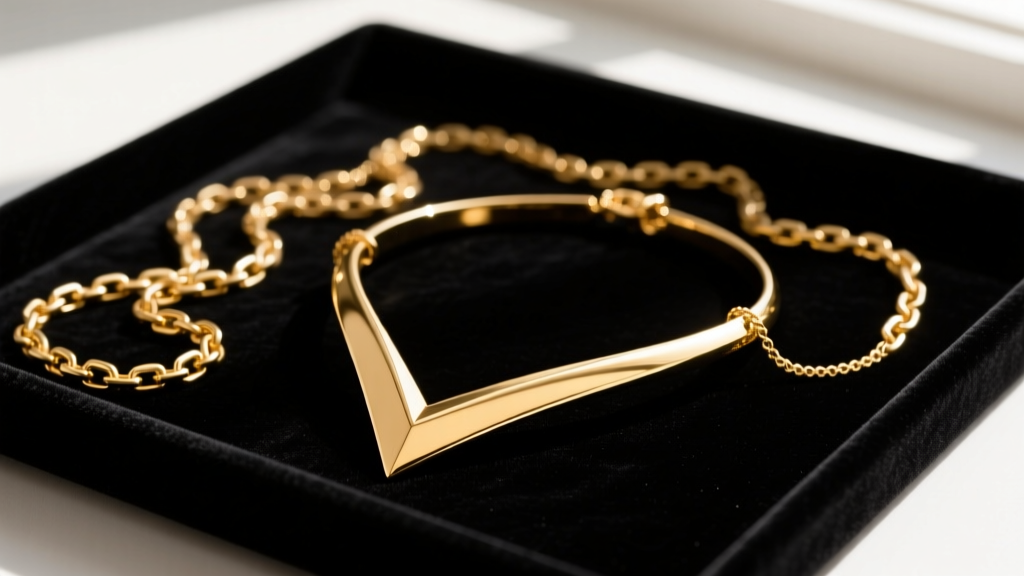
The Center of Mass Problem
Flipping occurs when the pendant's center of mass sits higher than the pivot point (the bail or the chain thread-hole). In minimalist 'direct-drill' V bars, where the chain threads directly through a hole at the top of the V, the top-heavy design guarantees it will flip backward against the skin.
Professional Counterweight Solutions
To permanently solve flipping, you must lower the center of gravity. A bench jeweler can perform a posterior counterweight modification. This involves laser-welding a tiny, 1.5mm 14k gold bead or a small hidden jump ring to the exact back-center of the pendant's top edge. This microscopic addition of weight pulls the back of the pendant down, forcing the front face to remain outward. For lariat V necklaces, ensure the drop chain is at least 20% heavier (in gram weight) than the collar chain to maintain downward tension.
Troubleshooting Issue #3: Chain Tangling and Knotting at the V-Point
The sharp angle of a V pendant creates a natural trap for chain links, particularly if you wear your gold v necklace in a layered configuration. The type of chain you pair with a V pendant dictates its tangling probability.
Chain Selection Matrix for V Pendants
Not all chains interact with geometric pendants equally. The Jewelers of America recommends matching chain flexibility to pendant geometry to prevent permanent kinking.
| Chain Type | Interaction with V Pendants | Tangling Risk | Best For |
|---|---|---|---|
| Box Chain (0.9mm) | Glides smoothly through standard bails; resists kinking at the V-vertex. | Low | Everyday wear, fixed-bail V pendants. |
| Snake Chain (1.5mm) | Highly rigid. Forces the V pendant to flip; prone to permanent bending at the V-neckline. | High | Avoid with V pendants entirely. |
| Cable Chain (1.0mm) | Classic look, but individual oval links can catch on direct-drill V holes. | Medium | Lightweight, delicate V charms. |
| Wheat Chain (1.2mm) | Braided links prevent folding; excellent weight distribution for heavy V drops. | Very Low | Heavy 18k gold V pendants, lariats. |
Untangling Tip: If your chain has knotted tightly at the V-bail, do not pull. Lay the necklace flat on a glass surface, apply a single drop of mineral oil or baby oil to the knot, and use two fine-tipped sewing needles to gently work the center link loose. The glass prevents the chain from snagging on fabric fibers.
Material Degradation: Identifying Wear at the V-Vertex
The vertex (the bottom point) of a gold V necklace is a high-stress zone. If your pendant is gold vermeil (a thick layer of gold over sterling silver) or gold-plated brass, the friction from resting against the sternum and catching on clothing will wear away the gold layer at the tip first.
Expert Insight: If you notice the V-point turning dull, gray, or causing a greenish tint on your skin, the base metal has been exposed. Stop wearing it immediately, as the exposed brass or copper will oxidize rapidly and degrade the structural integrity of the tip.
For long-term durability, especially for pieces worn daily against the skin, invest in solid 14k gold. The higher copper and zinc content in 14k gold provides the necessary tensile strength to prevent the sharp V-point from bending or snapping under minor physical stress, ensuring your necklace maintains its precise geometric angle for decades.
Quick Reference: Gold V Necklace Maintenance Matrix
| Problem | Root Cause | DIY Fix | Professional Jeweler Fix |
|---|---|---|---|
| Slides off-center | Low chain friction / wrong bail size | Add silicone O-ring stops | Replace bail with wider custom loop |
| Flips upside down | Top-heavy center of mass | None (requires metalwork) | Laser-weld posterior counterweight bead |
| Vertex bending | 18k gold too soft / impact damage | None | Reshape and apply structural solder backing |
| Tip discoloration | Plating wear exposing base metal | Clear nail polish (temporary) | Re-plate with heavy hard gold or rhodium |
By understanding the mechanical realities of geometric jewelry, you can transform a frustrating gold v necklace into a flawless, reliable centerpiece. Always prioritize the physics of the bail and chain pairing, and never hesitate to consult a master jeweler for micro-welding adjustments that elevate a mass-produced piece into custom-fitted perfection.


