How to Restring and Clean Your Labradorite Bead Necklace
Learn how to safely restring, clean, and store your labradorite bead necklace with our expert step-by-step guide to preserving its iridescent flash.

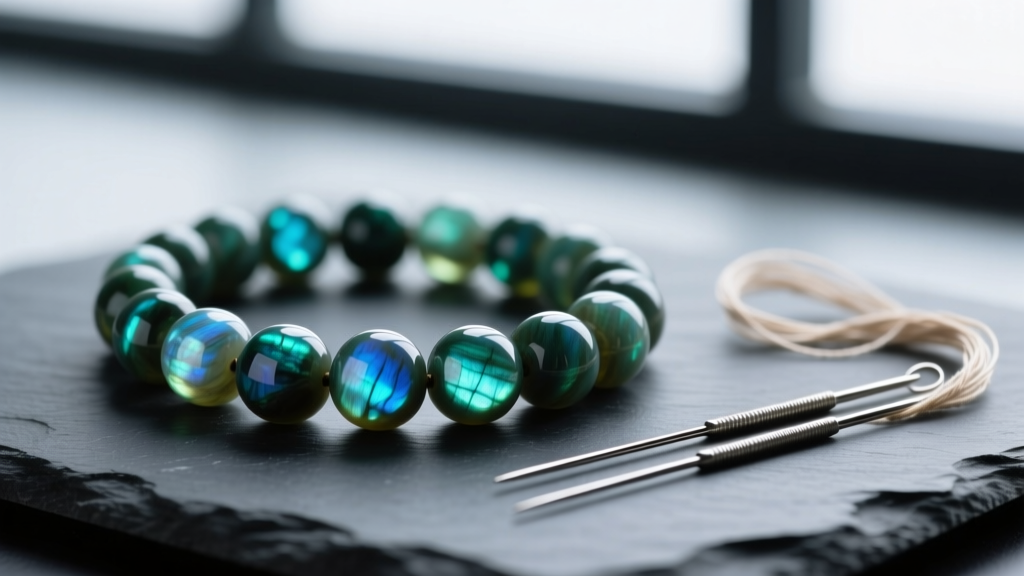
Labradorite’s signature labradorescence—a metallic schiller effect caused by light refracting through internal lamellar twinning planes—makes it one of the most captivating gemstones in modern jewelry. However, as we move through 2026, the jewelry community is increasingly prioritizing sustainable maintenance over replacement. Restringing and properly caring for your labradorite bead necklace ensures its longevity and preserves its optical phenomena. Because labradorite is a plagioclase feldspar with distinct structural vulnerabilities, standard jewelry maintenance routines can actually cause irreversible damage.
This comprehensive, step-by-step guide will walk you through the exact processes for restringing, cleaning, and storing your labradorite bead necklace, utilizing professional-grade techniques and modern material science.
Understanding Labradorite's Structural Vulnerabilities
Before picking up a beading needle, you must understand the mineralogy of your stones. According to the Gemological Institute of America (GIA), labradorite ranks between 6 and 6.5 on the Mohs hardness scale. While this makes it durable enough for everyday wear, it is significantly softer than quartz, topaz, or diamonds. If your necklace features spacer beads made of harder materials, they will gradually scratch the labradorite over time.
More critically, labradorite possesses perfect cleavage in one direction and good cleavage in another. This means that hard impacts or extreme temperature changes can cause the stone to fracture along its internal planes. Furthermore, Mindat.org's mineral database notes that the very twinning planes responsible for the stone's beautiful color flashes are also natural fault lines. Bead-on-bead friction without proper knotting will eventually wear down the polish around the drill holes, creating a chalky, dull appearance that ruins the necklace's aesthetic.
Step-by-Step Guide to Restringing Your Labradorite Bead Necklace
Most commercially produced labradorite bead necklaces are strung on cheap nylon monofilament that degrades, stretches, and eventually snaps. Restringing your necklace with high-quality materials and proper knotting techniques is essential.
Step 1: Prep and Measurement
Begin by carefully cutting the old stringing material over a soft towel to prevent any beads from bouncing away if they drop. Measure the bead diameter and the drill hole size. Standard 8mm labradorite beads typically feature drill holes ranging from 0.8mm to 1.2mm. You must select a stringing material and needle that can pass through a 0.8mm hole at least twice (for the finishing knot).
Step 2: Selecting the Stringing Material
Do not use rigid beading wire for labradorite. Wire prevents the necklace from draping naturally and causes the hard metal to grind against the inside of the stone's drill hole, eventually cracking the bead from the inside out. Instead, opt for Size FF or Size FFF natural silk thread, or a high-tenacity bonded nylon thread like Nymo D.
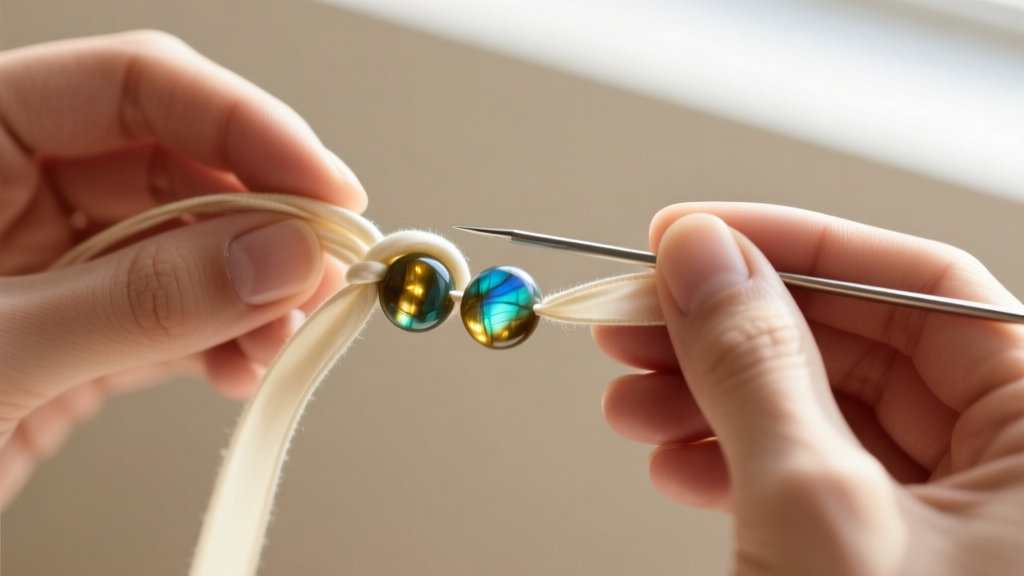
Step 3: The Knotting Technique
Knotting between every single bead is non-negotiable for labradorite. It prevents bead-on-bead abrasion and ensures that if the thread breaks, you only lose one stone rather than the entire strand.
- The Overhand Knot: Thread your needle, pass through the bead, and tie a standard overhand knot. Use a beading awl to push the knot tightly against the bead before pulling it taut.
- The French Wire Finish: When attaching the thread to the metal clasp, never loop thread directly through metal. The metal will act like a saw and cut the thread over time. Instead, use French wire (also known as bullion or gimp). Pass the thread through the French wire, then through the clasp ring, and knot it back onto the main thread. This creates a professional, durable barrier.
Stringing Material Comparison Chart
Choosing the right thread dictates the drape, durability, and safety of your labradorite bead necklace. Below is a technical comparison of the top stringing materials used by master jewelers in 2026.
| Material | Drape Quality | Knotability | Abrasion Resistance | Best For |
|---|---|---|---|---|
| Natural Silk (Griffin) | Excellent (Fluid) | Superior | Low (Degrades with moisture) | Lightweight beads (under 6mm), high-end heirloom pieces |
| Bonded Nylon (Nymo D) | Very Good | Good (Requires wax) | High | Standard 8mm labradorite beads, everyday wear |
| Thermally Fused Poly (WildFire) | Good (Slightly stiff) | Poor (Cannot knot easily) | Very High | Heavy, large-carat beads where knotting is skipped |
The Safe Cleaning Protocol for Labradorite
The most common mistake collectors make is using ultrasonic cleaners or steamers. The high-frequency vibrations in an ultrasonic bath will exploit labradorite's internal cleavage planes, causing micro-fractures that permanently cloud the stone's transparency and disrupt the schiller effect. Furthermore, harsh chemical dips will strip the natural oils and waxes often used to polish semi-precious beads.
The 2026 Approved Cleaning Method
- Prepare the Solution: Mix a few drops of pH-neutral, phosphate-free dish soap into a bowl of lukewarm distilled water. (Tap water contains minerals that can leave microscopic hard-water spots in the stone's natural fissures).
- Agitate Gently: Submerge the necklace for no more than three minutes. Use an extra-soft, baby-hair brush to gently sweep around the drill holes where skin oils and cosmetic residues accumulate.
- Rinse and Dry: Rinse thoroughly under a gentle stream of lukewarm distilled water. Lay the necklace flat on a microfiber towel. Do not hang it to dry, as the weight of the water can stretch the wet silk or nylon thread.
- Polish: Once completely dry, buff each bead individually with a clean, dry jeweler's cloth to restore maximum light refraction.
Proper Storage to Preserve the Schiller Effect
How you store your labradorite bead necklace when it is not being worn is just as critical as how you clean it. Because of its 6-6.5 Mohs hardness, tossing this necklace into a communal jewelry box with diamond, sapphire, or even quartz pieces will result in severe surface scratching.
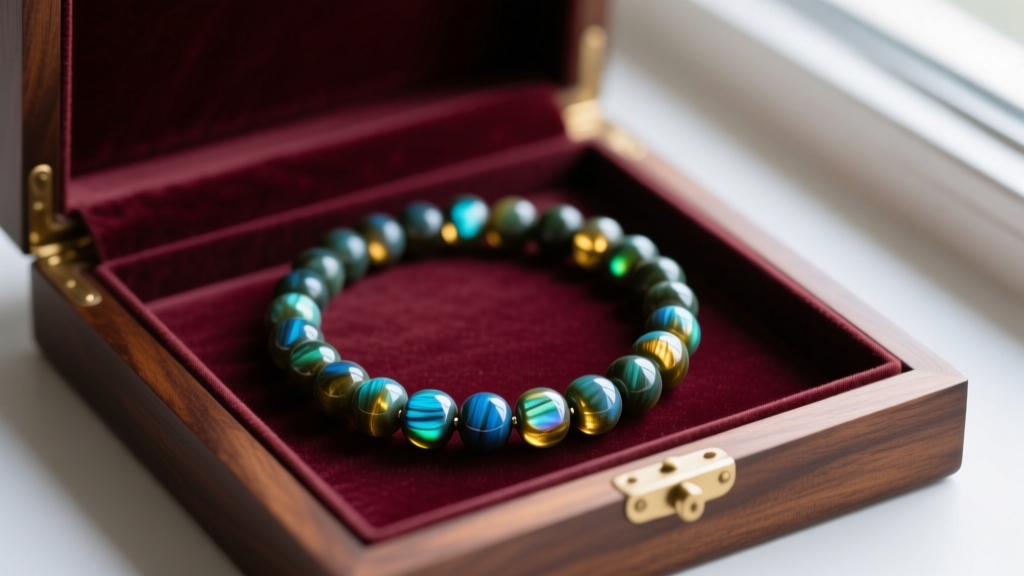
Environmental Controls
Labradorite is generally stable in light, but prolonged exposure to intense, direct UV radiation over several years can cause some treated or lower-grade feldspars to dry out and develop a web-like surface crazing. Store the necklace in a dark, temperature-controlled environment.
If your necklace features sterling silver spacer beads or a silver clasp, place a silica gel packet and an anti-tarnish strip inside the storage pouch. The tarnish on the silver won't damage the labradorite directly, but the chemical transfer can dull the polish of the beads immediately adjacent to the metal components. Always store the necklace coiled loosely in a soft flannel pouch or a dedicated, velvet-lined compartment to allow the thread to rest without being pulled taut.
Final Thoughts on Maintenance
A well-maintained labradorite bead necklace is an investment in wearable art. By taking the time to restring your beads with proper knotting techniques, avoiding ultrasonic cleaners, and storing the piece away from harder gemstones, you ensure that the stone's mesmerizing blue and green flashes remain vibrant for decades. Regular maintenance not only preserves the financial value of your jewelry but also honors the millions of years of geological pressure required to form these remarkable feldspar crystals.


