How to Style a Necklace Double Strand: Step-by-Step Layering Guide
Learn how to style a necklace double strand with our step-by-step guide. Master chain weights, length drops, and clasp hardware.


The Anatomy of a Perfect Necklace Double Strand
Achieving the perfect necklace double strand look is an exercise in structural engineering as much as it is in personal style. As we navigate the jewelry trends of 2026, the era of wearing two identical, store-bought layered sets is over. Today’s most sophisticated looks rely on high-contrast textures, deliberate weight distribution, and precision hardware. When executed correctly, a double strand setup frames the collarbone, adds dimensional depth to any outfit, and avoids the frustrating metal-on-metal tangling that plagues poorly planned layering.
However, combining two chains introduces physical friction. If the chains are too similar in texture, or if the length drop is miscalculated, the strands will twist, knot, and eventually cause micro-abrasions to the softer metal. This step-by-step guide will walk you through the exact mechanics of selecting, spacing, and securing a custom double strand necklace that drapes flawlessly and remains tangle-free.
Step 1: Selecting Chain Textures and Weights
The golden rule of double strand layering is contrast. If you use two cable chains of similar thickness, their links will interlock like gears, causing immediate tangling. You must pair a high-friction chain with a low-friction chain, and always anchor the heavier piece on the bottom.
According to jewelry manufacturing standards documented by Rio Grande, the top strand should ideally be between 1.0mm and 1.5mm in width, while the bottom strand should range from 2.0mm to 3.5mm. This weight disparity ensures gravity keeps the bottom chain taut, preventing it from riding up and crossing over the top strand.
| Top Strand (16"-18") | Bottom Strand (20"-24") | Tangle Risk | Best Aesthetic |
|---|---|---|---|
| 1.2mm Box Chain | 2.5mm Rope Chain | Very Low | Modern Minimalist |
| 1.5mm Cable Chain | 3.0mm Figaro Chain | Low | Classic Vintage |
| 2.0mm Snake Chain | 2.0mm Snake Chain | Extremely High | Avoid (Will Knot) |
| 1.0mm Bead Chain | 2.5mm Curb Chain | Low | Industrial Edge |
Step 2: Calculating the Length Drop (The 2-Inch Rule)
The most common mistake in layering is choosing chains with only a one-inch length difference (e.g., 16 inches and 17 inches). A one-inch drop forces the chains to sit on the exact same curvature of the clavicle, guaranteeing friction. To prevent this, you must employ the 2-Inch Rule.
By maintaining a minimum two-inch gap between the top and bottom strands, you allow each chain to rest on a different anatomical plane. The top strand rests at the base of the throat or upper collarbone, while the bottom strand drapes across the lower sternum. The Gemological Institute of America (GIA) notes that minimizing metal-on-metal contact is crucial for preserving the finish of softer alloys, particularly high-karat gold and oxidized silver, which can suffer from surface wear when subjected to continuous rubbing.
Expert Sizing Framework: For a standard crew neckline, pair a 16-inch top strand with an 18-inch bottom strand. For deeper V-necks or scoop necks, scale up to an 18-inch top and a 20-inch or 22-inch bottom to maintain the proportional 2-inch drop relative to the fabric line.

Step 3: Choosing and Attaching the Hardware
The hardware you use to join the strands at the nape of the neck dictates the longevity of your necklace double strand design. Throwing two chains onto a single standard jump ring and attaching a basic lobster clasp is a recipe for twisting. The chains will constantly compete for space on the single ring, causing the clasp to migrate to the front of your neck.
Tube Clasps vs. Slide Locks
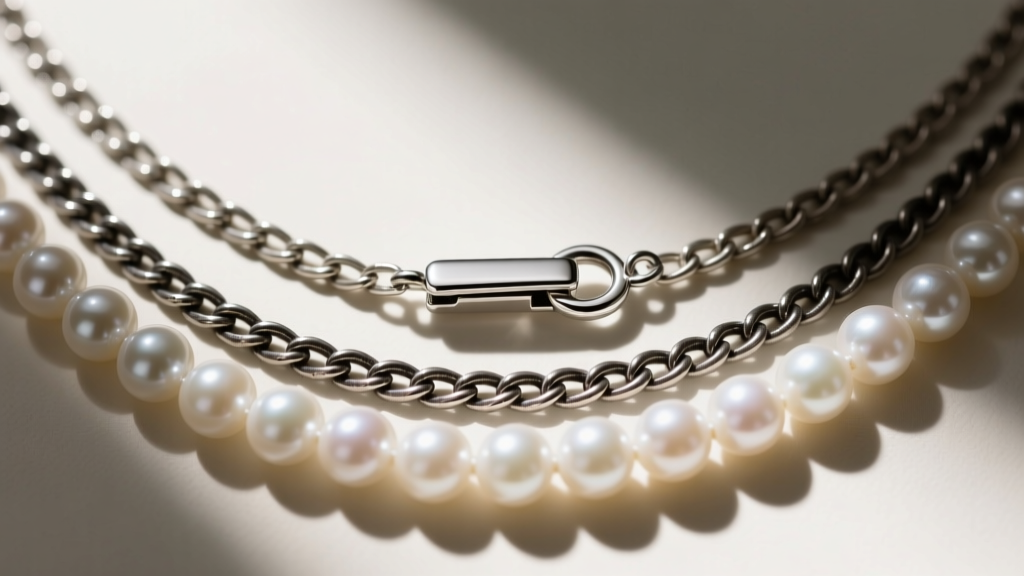
To solve the migration and twisting issue, you must use a dedicated multi-strand clasp. These clasps feature separate, isolated attachment points for each chain, keeping them parallel and untwisted.
- 2-Strand Tube Clasps: Ideal for delicate chains (under 2.0mm). They use a magnetic or friction-fit barrel design. Ensure the jump rings connecting your chains to the tube clasp are soldered or at least 18-gauge to prevent the wire from pulling apart under the dual-chain tension.
- Slide Lock Clasps: Best for heavier chains or pearl strands. These feature interlocking tubes that slide horizontally into one another and lock via internal silicone O-rings or metal tension snaps. They provide superior tensile strength for bottom strands exceeding 3.5mm in thickness.
When assembling your hardware, always use flush-cut jump rings. A standard 18-gauge or 16-gauge jump ring with a clean, flush cut will prevent the delicate links of a box or cable chain from slipping through the seam and snapping.
Step 4: Neckline Mapping and Final Styling
Once your hardware is secured and your length drop is verified, the final step is mapping the double strand to your wardrobe. The visual weight of two chains requires careful consideration of the garment’s neckline to avoid a cluttered silhouette.
For boat necks and off-the-shoulder tops, a shorter double strand (14" and 16") acts as a choker-style collarbone accent, highlighting the exposed décolletage without competing with the fabric line. For button-down shirts and deep V-necks, a longer drop (18" and 20") creates a parallel line that elongates the neck and draws the eye downward. Avoid wearing a double strand with highly detailed, ruffled, or heavily patterned high-neck blouses; the visual noise will render the jewelry invisible and increase the risk of the chains snagging on the fabric.
Maintenance: Preventing the Inevitable Tangle
Even with perfect length spacing and contrasting textures, improper storage will ruin a double strand setup. Never toss a multi-strand necklace into a communal jewelry box. The kinetic movement of a drawer or bag will force the chains to wrap around one another.
Invest in a felt jewelry roll with individual snap-button flaps, or use the ‘straw method’ for travel: unclasp the necklace, thread one end of the top strand through a plastic or silicone drinking straw, and re-clasp it. This rigid sheath prevents the chain from folding back on itself. By treating your necklace double strand as a precision instrument rather than a simple accessory, you ensure it remains a flawless, tangle-free staple in your rotation for years to come.


