How to Style, Layer, and Care for an Opal Choker Necklace
Learn how to style, layer, and properly care for your opal choker necklace. Expert tips on neckline pairing, chain gauges, and opal hydration.

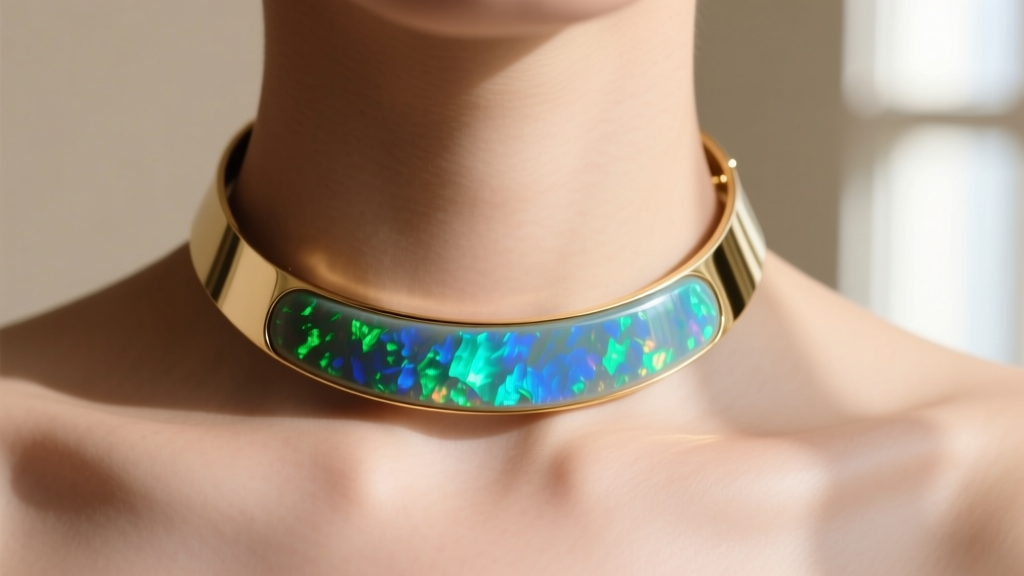
The Allure and Architecture of the Opal Choker
The opal choker necklace represents a unique intersection of high-impact styling and delicate gemology. Sitting precisely at the 14 to 16-inch mark, a choker draws the eye directly to the collarbone and throat, making the iridescent play-of-color in an opal impossible to ignore. However, mastering this piece requires more than simply clasping it around your neck. Because opals are relatively soft (ranking 5.5 to 6.5 on the Mohs hardness scale) and possess unique structural properties, styling and maintaining them demands a strategic approach. This comprehensive guide will walk you through the exact steps to select, style, layer, and preserve your opal choker necklace, ensuring it remains a staple in your jewelry rotation for years to come.
Understanding Your Opal: Ethiopian vs. Australian Origins
Before you begin styling, you must identify the origin of your opal, as this dictates both its visual behavior and its care requirements. The two most common varieties used in modern choker designs are Australian and Ethiopian opals.
- Australian Opals (Non-Porous): Mined primarily in Lightning Ridge and Coober Pedy, these opals have a lower water content (typically 3% to 10%) and a non-porous structure. They are highly stable, resistant to water absorption, and exhibit a consistent, localized play-of-color. According to the Gemological Institute of America (GIA), Australian opals are the traditional standard for fine jewelry due to their durability.
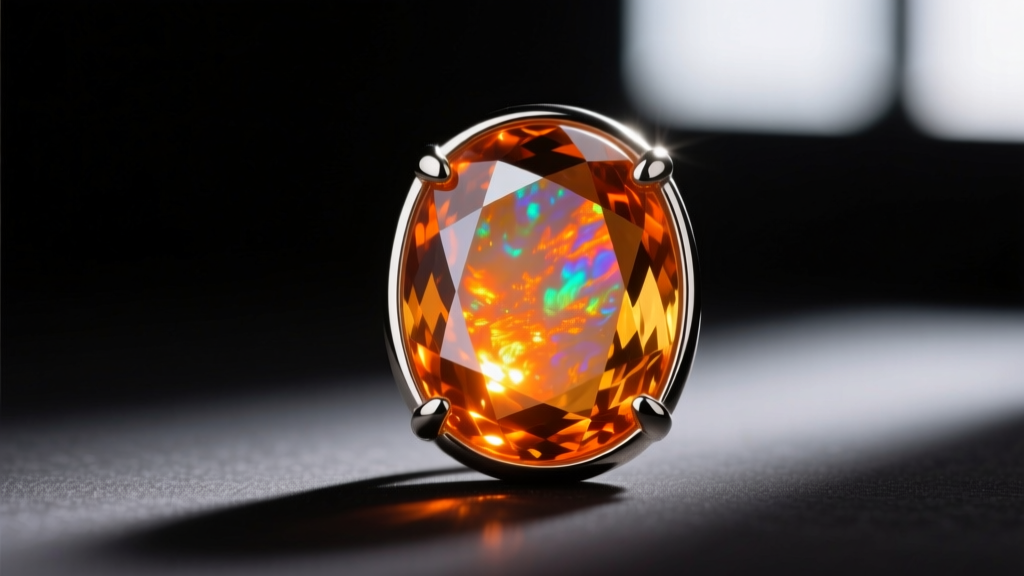
- Ethiopian Opals (Hydrophane): Sourced from the Welo province, these opals are "hydrophane," meaning they are highly porous and can absorb up to 21% of their weight in water. While they often display a more explosive, full-spectrum fire, they will temporarily lose their color and turn translucent if submerged in water. They require specialized hydration management, which we will cover in Step 4.
Step 1: Selecting the Ideal Chain Gauge and Clasp
An opal cabochon, especially one cut to maximize color, carries significant visual and physical weight. A common mistake is pairing a 3-to-5-carat opal pendant with a flimsy 0.8mm chain. To ensure the necklace drapes correctly without warping or breaking, you must match the chain gauge to the stone's weight and the metal's hardness.
| Metal Type | Recommended Gauge (Thickness) | Best Chain Style | Ideal Clasp Mechanism |
|---|---|---|---|
| 18k Yellow Gold | 1.5mm - 1.8mm | Rope or Box Chain | Lobster Claw (Secure) |
| 14k White Gold | 1.2mm - 1.5mm | Cable or Wheat Chain | Lobster Claw (Secure) |
| Sterling Silver | 1.5mm - 2.0mm | Rope or Curb Chain | Lobster or Toggle (if heavy) |
| Titanium (Hypoallergenic) | 1.0mm - 1.2mm | Snake Chain | Spring Ring (Magnetic assist) |
Expert Tip: Avoid spring ring clasps for chokers. The 14-inch length creates constant tension against the back of the neck, and spring rings are notorious for slipping open under lateral pressure. Always opt for a medium-sized lobster claw clasp with a reinforced soldered jump ring.
Step 2: Matching Necklines to Your Choker
The 14-to-16-inch length of a choker interacts intimately with your wardrobe. The goal is to frame the opal without allowing fabric to compete with its play-of-color.
The Sweetheart and V-Neck Pairing
This is the most flattering configuration for an opal choker. A sweetheart or deep V-neckline creates a negative space triangle that points directly to the center of the chest. The choker acts as the horizontal boundary of this triangle, allowing the opal to float against bare skin. This maximizes light entry into the stone, which is critical for Ethiopian opals that rely on ambient light to trigger their internal diffraction grating.
The Off-the-Shoulder Statement
Off-the-shoulder and bateau necklines expose the entire clavicle area. A 15-inch opal choker sits perfectly at the base of the throat in this scenario, creating a striking contrast between the expansive bare shoulders and the concentrated flash of the gemstone. Avoid wearing large drop earrings with this combination; let the choker be the sole focal point.
The Crew Neck Challenge
Wearing a choker over a tight crew neck t-shirt is generally discouraged, as the fabric bunches against the chain and obscures the pendant. If you must wear it with a crew neck, choose a top with a slightly scooped collar and ensure the choker is exactly 16 inches so it rests just below the fabric hem.
Step 3: The Architecture of Layering
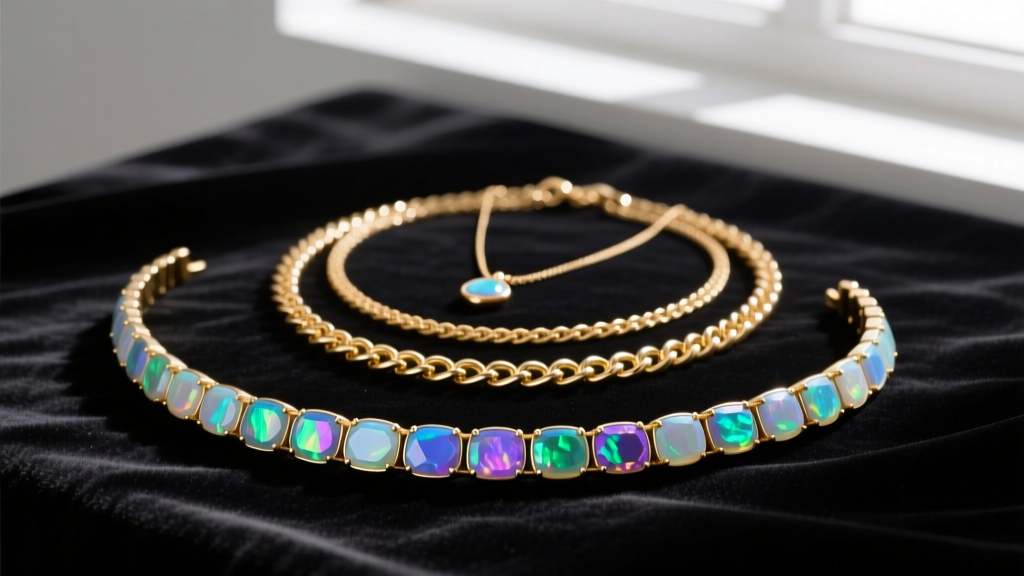
Layering an opal choker necklace requires strict adherence to spatial mathematics. If the chains are too close in length, they will tangle and scratch the delicate opal cabochon. We utilize the "Rule of 4 Inches" to ensure clean, tangle-free layering.
- Layer 1 (The Anchor): Your 14-inch or 15-inch opal choker. This sits high and tight.
- Layer 2 (The Bridge): An 18-inch or 19-inch "princess" length chain. This should be a minimalist design, such as a 1.0mm gold cable chain with no pendant, or a very small, understated diamond solitaire. This bridges the gap between the choker and the lower layers.
- Layer 3 (The Base): A 22-inch or 24-inch "matinee" length chain. This layer can carry a heavier pendant, such as a gold medallion or a larger, opaque gemstone like lapis lazuli or malachite, which provides a color-blocking contrast to the iridescent opal above it.
By maintaining at least a 3-to-4-inch gap between each layer, you prevent the metal chains from acting as abrasive files against the opal's polished surface.
Step 4: Advanced Hydration and Cleaning Protocols
Opal care is where most jewelry owners fail, leading to "crazing" (a network of internal cracks that ruins the stone's structural integrity and optical properties). The GIA's official care guidelines explicitly warn against harsh chemicals and mechanical cleaners, but advanced care goes deeper.
The Ultrasonic Danger
Never, under any circumstances, place an opal choker in an ultrasonic jewelry cleaner. The high-frequency acoustic cavitation creates microscopic shockwaves that will instantly fracture the silica spheres within the opal. Furthermore, the heat generated by the ultrasonic bath will rapidly dehydrate the stone.
The Damp Cotton Storage Method
If your choker features an Ethiopian hydrophane opal, it is constantly exchanging moisture with the environment. In dry, air-conditioned, or heated rooms, the opal will slowly lose its internal water, leading to crazing.
Pro-Tip: When storing your Ethiopian opal choker, place it in a sealed, airtight plastic bag along with a slightly damp (not wet) cotton ball. This creates a micro-climate with 100% humidity, allowing the opal to maintain its optimal water content without being submerged, preserving its fiery play-of-color indefinitely.
Safe Cleaning Technique
To clean the chain and the stone, use a soft, lint-free microfiber cloth slightly dampened with distilled water. Avoid tap water, as the chlorine and dissolved minerals can leave a microscopic film on the opal's surface, dulling its optical fire. Gently wipe the stone, then immediately dry it. Do not use commercial silver polishes or gold dips, as the sulfur and acids in these solutions will permanently etch the opal's surface.
Final Thoughts on Mastering the Opal Choker
An opal choker necklace is not merely an accessory; it is a wearable geological phenomenon that demands respect and understanding. By selecting the correct chain gauge to support the stone, strategically pairing it with complementary necklines, applying the Rule of 4 Inches for layering, and utilizing advanced hydration storage techniques, you elevate your styling from basic to masterful. Treat your opal with the specialized care it requires, and it will reward you with a lifetime of unmatched, iridescent brilliance.


