How to Choose the Perfect Jesus on Cross Necklace Gold Pendant
Discover expert insights on selecting a jesus on cross necklace gold pendant, covering karat weights, casting techniques, and chain pairings.

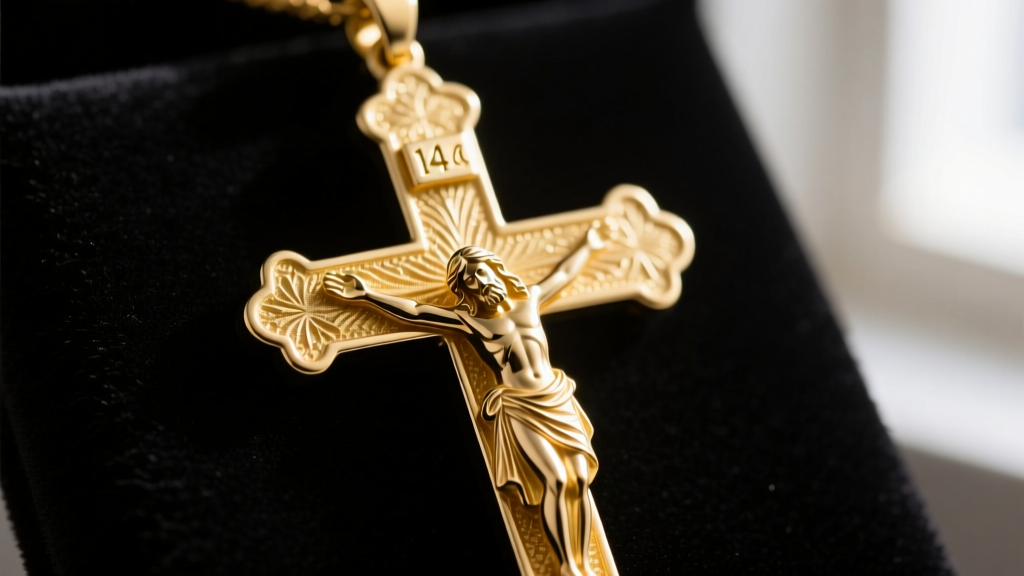
When searching for a meaningful and enduring piece of religious jewelry, the jesus on cross necklace gold pendant remains a timeless choice. However, beneath the spiritual significance lies a complex world of metallurgy, structural engineering, and artisanal craftsmanship. With gold spot prices reaching historic highs in 2026, the market has seen an influx of both masterfully crafted solid pieces and deceptive hollow-body alternatives. As a domain expert in jewelry manufacturing and trend analysis, I will guide you through the technical specifications, casting methodologies, and structural requirements necessary to invest in a crucifix pendant that will last generations.
The Metallurgy of Faith: Karat Weights and Vickers Hardness
The purity of gold is measured in karats, but when it comes to a highly detailed corpus (the figure of Jesus on the cross), structural integrity is just as critical as intrinsic value. According to the Gemological Institute of America (GIA), pure 24k gold is far too malleable for intricate jewelry. To understand why certain karats are preferred for crucifixes, we must look at the Vickers Hardness (HV) scale.
- 10k Gold (41.7% Pure): With a Vickers hardness of approximately 160 HV, 10k gold is highly durable and resistant to scratching. However, its lower gold content results in a paler yellow hue, and it is prone to oxidation and tarnishing over time due to the high alloy content (copper, silver, zinc).
- 14k Gold (58.5% Pure): Sitting at roughly 135 HV, 14k gold is the industry standard for religious pendants. It offers the perfect equilibrium between the rich, warm color of gold and the tensile strength required to prevent the thin extremities of the corpus—such as the fingers and toes—from bending during daily wear.
- 18k Gold (75.0% Pure): At approximately 115 HV, 18k gold provides a luxurious, deep yellow saturation. Because it is softer, an 18k crucifix must be cast with slightly thicker dimensions to compensate for the reduced hardness, which inherently increases the overall weight and price of the piece.
For white gold crucifixes, remember that the alloy is plated with rhodium to achieve a bright white finish. On a high-relief corpus, the rhodium plating will naturally wear away first on the protruding areas like the knees, head, and ribcage, revealing the slightly yellowish-white gold alloy beneath. This is not a defect, but a predictable metallurgical reality that requires periodic re-plating by a professional jeweler.
Casting Techniques: Lost-Wax vs. Die-Struck Precision
The method used to form the jesus on cross necklace gold pendant drastically dictates the level of anatomical and emotional detail captured in the metal. The World Gold Council frequently highlights the evolution of casting technologies, which directly impacts the aesthetic quality of religious iconography.
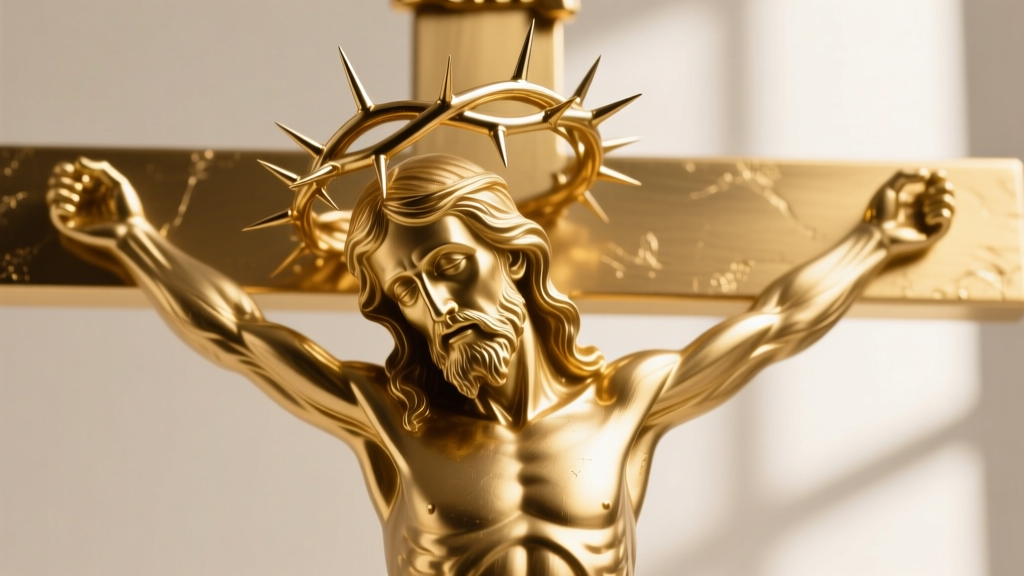
Investment Casting (Lost-Wax Method)
The vast majority of premium, three-dimensional crucifixes are created via lost-wax casting. A master model is carved or 3D-printed in wax, encased in a plaster-like investment material, and burned out in a kiln. Molten gold is then centrifugally or vacuum-cast into the cavity. This method allows for profound depth, capturing the intricate muscle striations, the drape of the loincloth, and the delicate thorns of the crown. However, buyers must inspect the piece for porosity—tiny gas bubbles trapped during cooling that often manifest as microscopic pits on the face or hands of the corpus.
Die-Striking and Stamping
Die-struck crucifixes are formed by stamping sheet gold under immense pressure. While this process compresses the metal grains and creates a very dense, durable pendant, it limits the design to shallow, two-dimensional bas-relief. If you are looking for a flat, lightweight, and highly polished crucifix, die-striking is appropriate. If you desire a sculptural, museum-quality corpus, lost-wax casting is mandatory.
Locating the Sprue Mark
In lost-wax casting, the molten gold enters the mold through a channel called a sprue. After casting, the sprue is cut off and filed down. On a high-quality crucifix, the jeweler will strategically place the sprue at the very top or bottom edge of the cross, or behind the halo, where the filing mark is invisible. If you see a visible, slightly discolored flat spot on the side of the cross or near the corpus, it indicates poor finishing and mass-production shortcuts.
Structural Integrity: Bail Sizing and Chain Weight Ratios
A common failure mode in religious jewelry is the bail (the loop that connects the pendant to the chain) wearing through due to friction. A solid gold crucifix acts as a pendulum, creating continuous lateral friction against the inside of the bail and the chain's jump ring. To prevent catastrophic loss, the chain must be properly scaled to the pendant's mass. Jewelers of America emphasizes the importance of matching chain gauges to pendant weights to ensure longevity.
| Pendant Weight (Solid Gold) | Recommended Chain Width | Ideal Chain Style | Minimum Bail Hole Diameter |
|---|---|---|---|
| 2g - 5g (Light) | 1.5mm - 2.0mm | Cable, Box, or Wheat | 3.0mm |
| 6g - 12g (Medium) | 2.5mm - 3.5mm | Rope or Curb | 4.5mm |
| 13g - 25g+ (Heavy) | 4.0mm - 6.0mm | Miami Curb or Figaro | 6.0mm+ |
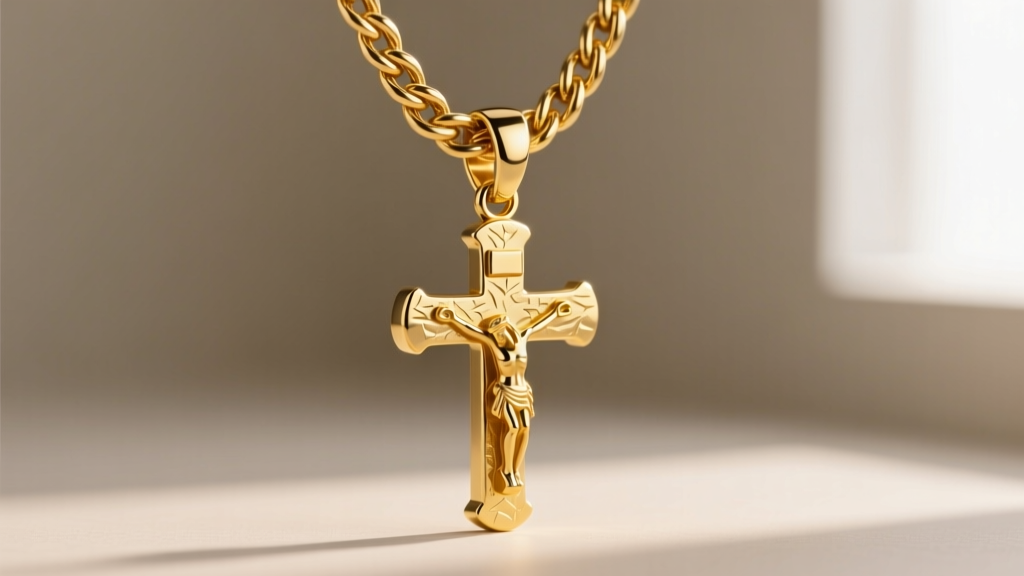
Expert Troubleshooting Tip: Never hang a heavy, solid gold crucifix on a hollow rope chain. Hollow chains have thin exterior walls that will easily crush or snap under the dynamic load of a swinging 15-gram pendant. Always opt for solid-core or semi-solid chains with soldered links to guarantee structural safety.
Maintenance: Preserving High-Relief Details
The intricate crevices of a sculpted corpus trap sebum, dead skin cells, and environmental dust, which can dull the gold's luster over time. Furthermore, improper cleaning can damage the piece.
Warning: Avoid using ultrasonic cleaners on hollow-body or electroformed gold crucifixes. The high-frequency vibrations can cause internal structural collapse, and water can become permanently trapped inside the hollow chambers, leading to irreversible tarnishing and weight discrepancies.
For solid gold crucifixes, the safest and most effective cleaning protocol involves a few drops of mild, phosphate-free dish soap mixed with warm distilled water. Use a soft-bristled baby toothbrush to gently agitate the soap into the deep recesses behind the corpus and the crown of thorns. Rinse thoroughly under a gentle stream of lukewarm water, and immediately pat dry with a microfiber cloth. Do not use abrasive polishing cloths on the face or hands of the figure, as this will gradually erase the fine details of the casting over years of repeated polishing.
Pricing Tiers and Authenticity Markers in 2026
Navigating the pricing of a jesus on cross necklace gold pendant requires an understanding of current precious metal markets and manufacturing premiums. In 2026, with gold prices remaining elevated, the price gap between solid and hollow construction has never been more pronounced.
- Entry-Level ($150 - $350): Typically 10k or 14k gold, die-struck or hollow-electroformed. These pieces are lightweight (1g - 3g) and lack deep three-dimensional relief. They are suitable for children or as subtle, everyday layers.
- Mid-Tier ($400 - $900): Solid 14k gold, lost-wax cast pendants weighing between 4g and 10g. This tier offers the best value, featuring excellent anatomical detail, durable bails, and a satisfying physical weight.
- Heirloom & Luxury ($1,200 - $5,000+): Solid 18k gold or heavy 14k pieces (15g+), often featuring hand-engraved accents, diamond-set halos, or antique oxidation (patina) applied to the recesses to make the corpus pop in stark contrast against the polished cross.
Verifying Hallmarks and Stamps
Authenticity is paramount. According to international jewelry standards, a genuine gold crucifix must bear a karat stamp (e.g., 14K, 585, 18K, 750) and, ideally, a maker's mark. On a crucifix, this stamp is usually located on the flat back of the cross, near the bottom edge, or hidden inside the bail loop. If the stamp is blurry, uneven, or stamped over a highly textured area, it may indicate a counterfeit piece or a poorly executed recasting of a master model.
Ultimately, selecting the right gold crucifix is an exercise in balancing metallurgical science with personal devotion. By prioritizing the correct karat weight for your lifestyle, ensuring the casting method matches your aesthetic expectations, and pairing the pendant with a structurally sound chain, you secure a piece of jewelry that serves as both a profound statement of faith and a masterclass in horological and jewelry engineering.


