Screen-Accurate Labyrinth Goblin King Necklace: A Technical Guide
An expert technical breakdown of the Labyrinth Goblin King necklace, covering screen-accurate metallurgy, casting methods, and chain layering.

The Anatomy of Jareth’s Iconic Jewelry
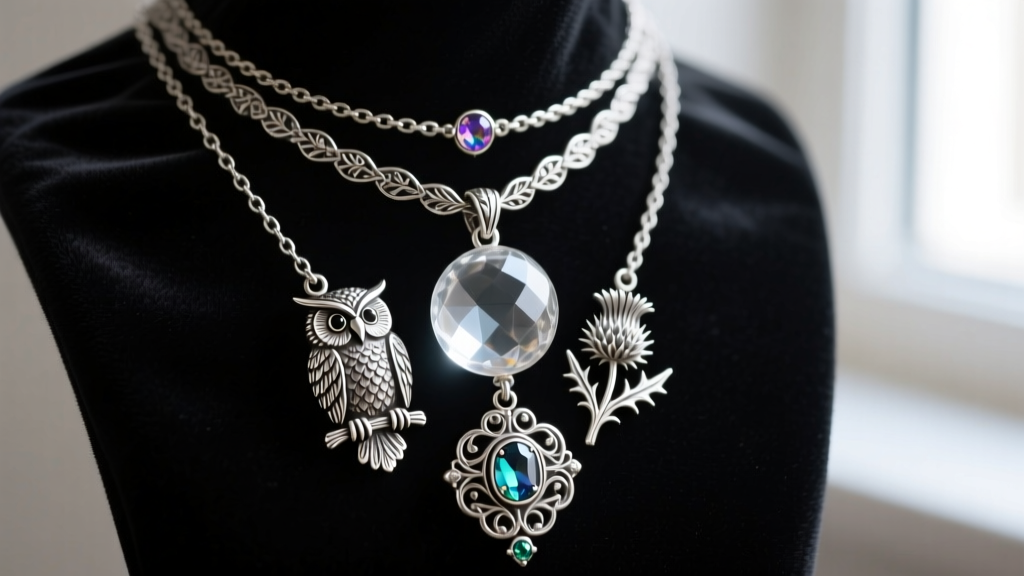
When evaluating the labyrinth goblin king necklace, collectors and prop historians are not just looking at a piece of costume jewelry; they are analyzing a masterclass in character-driven design. Created for Jim Henson’s 1986 cinematic masterpiece, the necklace worn by David Bowie as Jareth was conceptualized by Brian Froud and executed by London-based prop artisans. The piece is a cascading, multi-strand arrangement featuring a specific hierarchy of pendants: a central crystal sphere, an owl motif, a thistle, interlocking rings, and a crescent moon. To achieve a true screen-accurate replica in the modern collector's market, one must look past superficial aesthetics and examine the structural engineering, metallurgical choices, and draping mechanics that define this iconic garment accessory.
Metallurgy & Material Selection: Screen-Used vs. Artisan Replicas
The original 1986 screen-used props were primarily constructed from lightweight white metals, pewter, and aluminum alloys. This was a deliberate choice by the costume department to ensure the heavy-looking necklace would not cause fatigue or restrict Bowie’s dynamic movements during choreography. However, for modern high-end replicas, these base metals are entirely inadequate. They suffer from poor tensile strength, rapid degradation, and a lack of intrinsic value.
Today’s master jewelers crafting the labyrinth goblin king necklace utilize either .925 sterling silver or C26000 jeweler's brass. Sterling silver offers a Vickers hardness of approximately 65-70 HV in its annealed state, providing enough malleability for intricate detailing while maintaining structural integrity when work-hardened. Jeweler's brass, an alloy of 70% copper and 30% zinc, is favored for its warm, golden undertone that closely mimics the oxidized, antique look of the film props when properly patinated. When sourcing a replica, always demand a material assay or hallmark; cheap zinc-alloy die-cast versions found in mall kiosks will invariably snap at the bail under the weight of the crystal pendant.
The Crystal Sphere: Glass vs. Quartz
The centerpiece of the necklace is the spherical crystal. While early prop makers relied on high-index lead glass for its refractive qualities, modern collectors require genuine clear quartz. A 20mm to 25mm clear quartz sphere weighs approximately 11 to 15 grams. Securing this stone requires a custom bezel or a tension-prong setting. Avoid replicas that use cyanoacrylate adhesives to glue the sphere into the bezel; these adhesives yellow under UV exposure and fail due to the differing thermal expansion rates of metal and stone.
Advanced Casting Techniques: Capturing Organic Detail
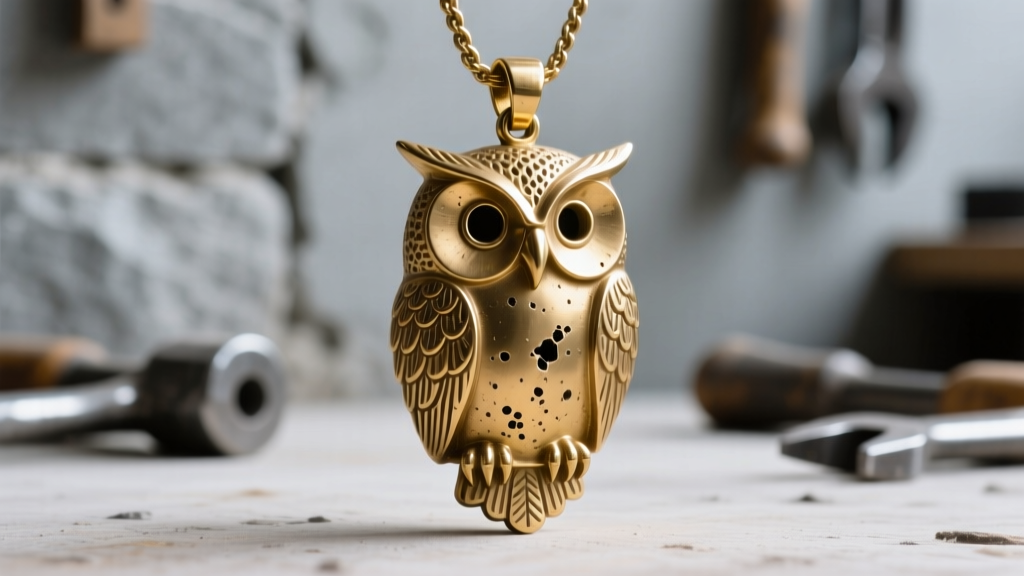
The thistle and owl pendants feature deep undercuts and organic textures that cannot be achieved through traditional metal stamping or die-casting. Authentic replicas rely on the lost-wax investment casting method. In this process, a master model is encased in a vulcanized rubber mold or a high-durometer silicone to capture microscopic surface details.
The wax injection phase is critical. The wax must be injected at precisely 150°F under 40 PSI to prevent shrinkage and warping in the thistle's delicate leaves. Once the wax tree is built and invested in a gypsum-bonded flask, the burnout cycle must reach 1350°F to completely vaporize the wax residue. If the flask is under-burned, carbon inclusions will create pitting on the surface of the silver or brass castings. According to technical guidelines from Rio Grande, a slow cooling process is required for brass alloys to prevent internal stress fractures, particularly in the thin, wire-like stems of the thistle pendant.
Chain Selection and Layering Mechanics
The silhouette of the labyrinth goblin king necklace relies entirely on the drape of the chains. Jareth’s necklace is not a single strand; it is a meticulously layered cascade that sits flat against the chest without tangling. Mass-produced replicas often fail here, using stiff, machine-welded chains that kink and ruin the romantic, gothic drape seen on screen.
To achieve the correct movement, artisans mix chain weaves and wire gauges. The base structural chains must be robust enough to hold the heavy quartz sphere, while the secondary accent chains must be supple enough to flow like fabric. Below is a technical breakdown of the chain configurations required for a screen-accurate build:
| Chain Style | Wire Gauge | Flexibility Profile | Application in Replica |
|---|---|---|---|
| Medium Rolo | 18 AWG | Medium-High | Primary load-bearing strand for the crystal sphere. |
| Flat Cable | 22 AWG | Very High | Secondary draping strands holding the owl and moon. |
| Wheat / Spiga | 20 AWG | Low (Stiff) | Avoid entirely; restricts movement and looks modern. |
| Box Chain | 16 AWG | Medium | Used sparingly for structural back-of-neck support. |
Furthermore, the connection points (jump rings) must be soldered closed. Open jump rings will inevitably pull apart under the pendulum-like swinging motion of the heavy pendants. Master jewelers will use a laser welder or silver solder to permanently fuse the jump rings, ensuring the structural integrity of the layering mechanics.
Patina and Antiquing: Engineering the Goblin Royal Aesthetic
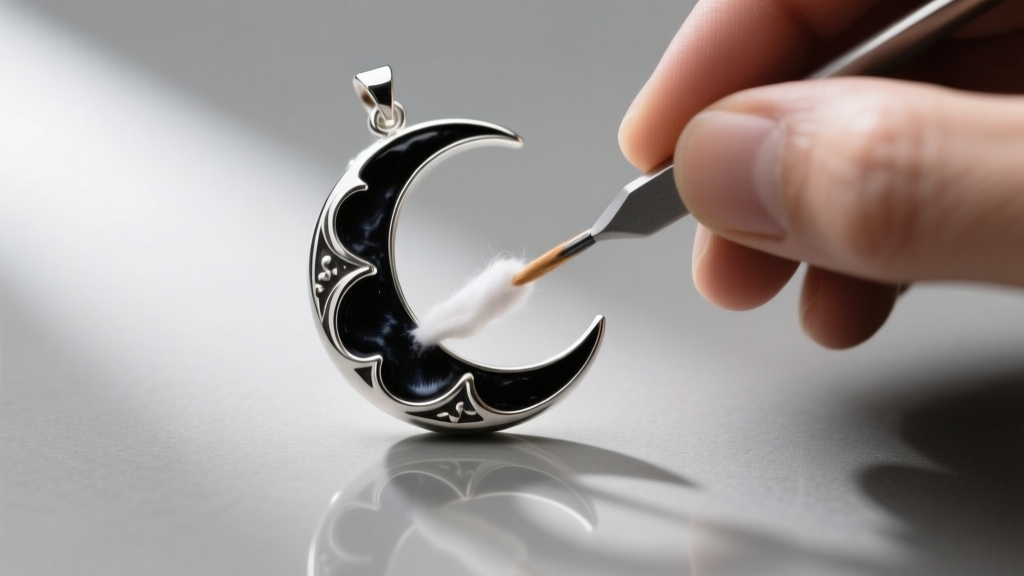
A pristine, high-polish finish completely destroys the illusion of the labyrinth goblin king necklace. Jareth’s jewelry looks as though it has been pulled from a centuries-old subterranean vault. Achieving this requires chemical antiquing, specifically using Liver of Sulfur (potassium sulfide).
The chemical reaction between the sulfur and the copper content in the silver or brass creates a layer of copper sulfide and silver sulfide on the surface, ranging from golden-brown to deep, matte black. The process requires precise temperature control; a solution heated to 140°F will yield a rapid, dark oxidation, while a cold, dilute solution allows for gradual, controlled layering of color. Once the desired depth of black is achieved in the deep recesses of the owl's feathers and the thistle's thorns, the piece is quenched in a baking soda and water bath to neutralize the chemical reaction.
The final step is selective burnishing. Using a radial bristle disc or a brass wire brush mounted on a flex-shaft micromotor running at 3,000 to 5,000 RPM, the jeweler carefully strips the black oxidation from the high-relief areas. This creates a striking contrast between the pitch-black recesses and the warm, satin-finished high points, perfectly mimicking the screen-used props.
Sourcing and Evaluating Artisan Replicas
The market for fantasy prop jewelry is saturated with low-quality, AI-generated 3D prints cast in cheap pot metal. When investing in a high-end labyrinth goblin king necklace, provenance and community verification are paramount. Collector communities such as The Replica Prop Forum maintain extensive, crowdsourced databases of prop makers, detailing which artisans use screen-accurate CAD files derived from original molds versus those who use crude photogrammetry.
Expect to pay between $450 and $950 for a fully screen-accurate, hand-finished sterling silver or jeweler's brass replica featuring genuine quartz and soldered chain links. Any listing priced under $150 is almost certainly a sand-cast or die-struck novelty item lacking the internal structural engineering required to support the weight of the pendants over time. Always request macro-photography of the sprue removal points, the soldered jump rings, and the interior of the bezel setting before commissioning a custom piece.


