Lavender Jade Bead Necklace Value Guide: Is It Worth the Price?
Discover the true value of a lavender jade bead necklace in 2026. Learn to decode jade treatments, bead sizing, and pricing tiers before you buy.

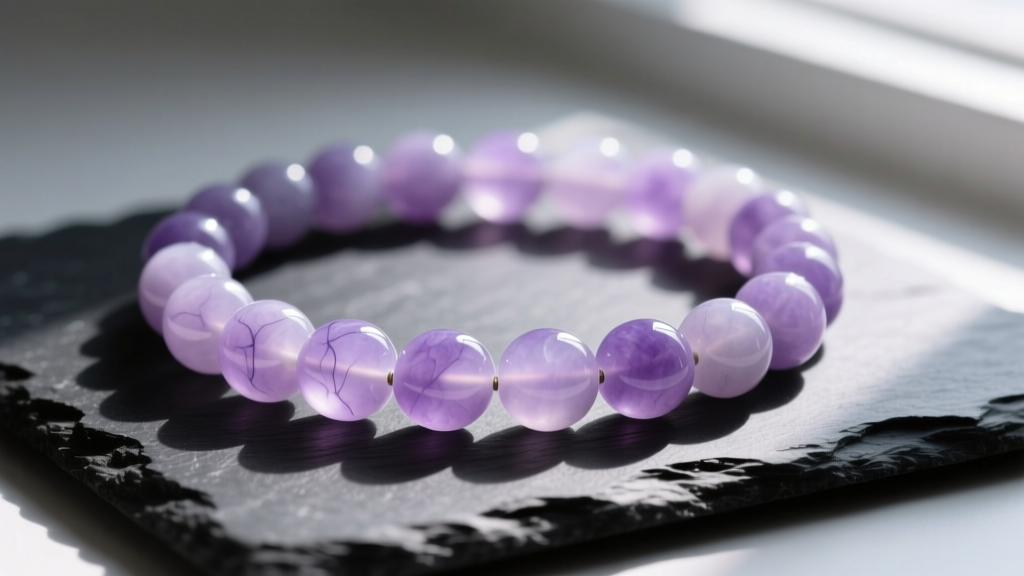
The Allure and Economics of Lavender Jade
The pastel appeal of a lavender jade bead necklace has surged in the fine jewelry market, driven by a growing preference for subtle, ethereal gemstones over traditional deep greens. However, as demand rises, so does the proliferation of misidentified stones and synthetic treatments. In 2026, navigating the budget and luxury tiers of lavender jade requires a firm grasp of gemological realities. Whether you are evaluating a $50 boutique find or a $5,000 auction piece, understanding the intersection of mineralogy, treatment grades, and bead mechanics is essential to assessing true value.
The Mineral Reality: Jadeite vs. Nephrite
The term 'jade' is a commercial umbrella covering two distinct minerals: jadeite (a pyroxene) and nephrite (an amphibole). When it comes to natural lavender coloration, the market is almost exclusively dominated by jadeite. The delicate lilac and pale purple hues in jadeite are caused by trace amounts of manganese, titanium, or iron substituting into the crystal lattice during formation.
Nephrite, conversely, does not naturally occur in true lavender. If you encounter a budget-friendly 'lavender nephrite' bead necklace, you are likely looking at a misnomer. Unscrupulous sellers often use this term to market dyed serpentine (often called 'new jade'), grossular garnet (Transvaal jade), or even dyed chalcedony. According to the Gemological Institute of America (GIA), accurate species identification is the first and most critical step in value assessment. A genuine lavender jadeite bead necklace will always command a premium over nephrite or jade simulants due to its rarity and superior hardness (6.5 to 7 on the Mohs scale compared to nephrite's 6 to 6.5).
The Treatment Trap: Decoding Type A, B, and C
The single greatest factor that destroys the value of a lavender jade bead necklace is undisclosed chemical treatment. The jade market categorizes stones into three primary tiers, and budget buyers are the most frequent victims of Type C misrepresentation.
- Type A (Untreated): The jadeite is entirely natural, subjected only to traditional plum-wax polishing. This is the only grade that retains investment value and structural integrity over decades.
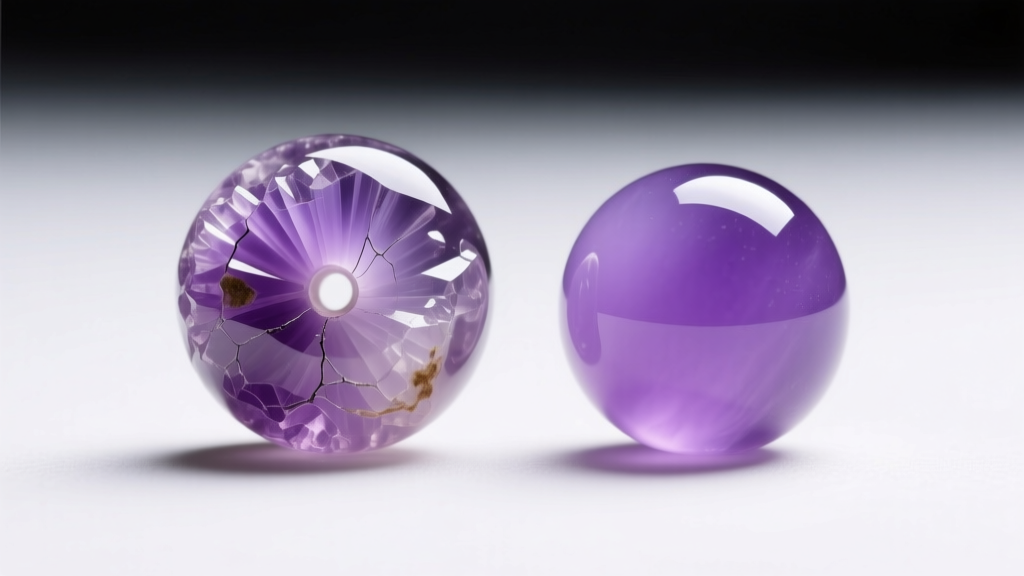
- Type B (Bleached and Polymer-Impregnated): Lower-quality, stained, or opaque lavender jade is bathed in hydrochloric acid to remove brown or grey impurities. This destroys the crystal structure, leaving it porous. It is then vacuum-impregnated with polymer resin to restore translucency. Type B jade becomes brittle over time and yellows as the resin degrades.
- Type C (Dyed): Colorless or pale jadeite is artificially dyed to mimic rare lavender or imperial green hues. The dye concentrates in the microscopic fractures between beads, which can be spotted under 10x magnification.
2026 Market Pricing Matrix for Lavender Jadeite
Valuing a lavender jade bead necklace requires analyzing the 'water head' (translucency) alongside the bead diameter. Lavender jadeite is notoriously more opaque than green jadeite; finding high-translucency lavender is exceptionally rare. Below is a realistic 2026 pricing framework for authentic, Type A lavender jadeite bead necklaces (standard 16-inch princess length).
| Bead Diameter | Opaque / Chalky (Low Water Head) | Semi-Translucent (Medium Water Head) | Icy / Glassy (High Water Head) |
|---|---|---|---|
| 6mm - 8mm | $150 - $400 | $800 - $2,500 | $5,000 - $12,000+ |
| 9mm - 11mm | $500 - $1,200 | $3,500 - $8,000 | $15,000 - $35,000+ |
| 12mm - 15mm | $1,500 - $3,500 | $10,000 - $25,000 | $50,000+ (Auction Grade) |
If a seller offers a 10mm semi-translucent lavender jade bead necklace for $200, it is almost certainly Type C dyed quartz or bleached/resin-filled low-grade jadeite. Reputable dealers like Mason-Kay emphasize that genuine, untreated jadeite of this size and translucency commands strict market premiums.
Hidden Cost Factors: Drilling, Matching, and Stringing
When assessing the budget of a bead necklace, buyers often overlook the lapidary and stringing mechanics, which significantly impact both price and longevity.
Bead Matching and Color Roots
Natural lavender jadeite rarely forms in large, uniform deposits. A high-value necklace requires beads cut from the same boulder to ensure consistent color saturation and 'color roots' (the natural, un-dyed origin points of the color within the stone). A necklace with highly uniform, flawless lavender beads priced under $1,000 is a massive red flag for artificial dyeing.
Drilling Precision
Cheap bead necklaces feature wide, uneven drill holes that cause the beads to sit awkwardly and grind against the stringing material. Premium Type A necklaces feature precision micro-drilling, leaving minimal hole margins that maximize the carat weight and visual surface area of each bead.
Stringing Materials: Silk vs. Steel
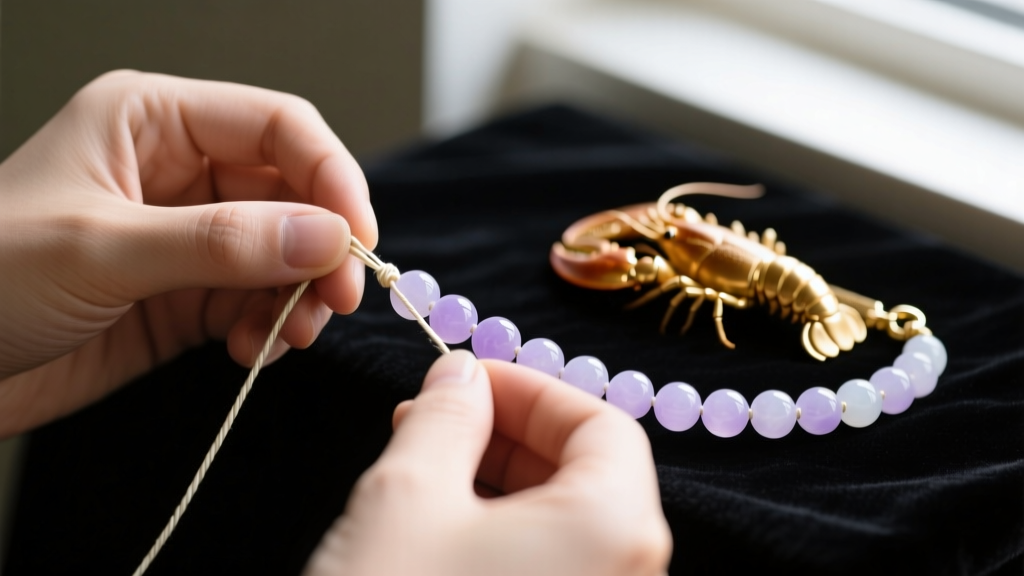
The structural foundation of your necklace dictates its maintenance cycle. Traditional hand-knotted silk thread is the gold standard for high-value jadeite. The knots between each 10mm bead prevent catastrophic loss if the strand snaps and protect the drill holes from abrasion. However, silk degrades with skin oils and moisture, requiring professional restringing every 2 to 3 years (a $50-$100 maintenance cost). Budget necklaces often use nylon-coated beading wire without knots. While durable, steel wire acts like a saw against the jadeite drill holes over time, eventually enlarging them and devaluing the beads.
Authentication Protocols for the Budget Buyer
If you are hunting for a lavender jade bead necklace at estate sales or online auctions, rely on empirical testing rather than seller guarantees.
- The UV Fluorescence Test: Shine a long-wave (365nm) ultraviolet flashlight on the beads. Type A jadeite is generally inert or shows very weak, patchy fluorescence. Type B jadeite, due to its polymer resin fill, will often emit a strong, chalky blue-white glow.
- The Chelsea Filter / Spectroscope: While not definitive on its own, a spectroscope can reveal the absorption spectrum of the dye used in Type C jade. Natural lavender jadeite does not show the strong red-band absorption typical of artificial dyes.
- Specific Gravity (SG): Jadeite has an SG of 3.30 to 3.38. Quartz simulants measure around 2.65, and serpentine sits between 2.44 and 2.62. If the necklace feels unusually light for its volume, it is not jadeite.
- Lab Certification: For any lavender jade bead necklace priced over $500, demand a recent report from a Tier-1 laboratory such as the GIA, NGTC (National Gemstone Testing Center), or AGTA. The report must explicitly state 'Natural Jadeite' with no mention of polymer impregnation or dyeing.
Final Verdict: Where Should Your Budget Go?
For buyers with a strict budget under $500, you are better off purchasing a smaller (6mm), opaque but guaranteed Type A lavender jadeite necklace, or pivoting to a high-quality lavender chalcedony necklace as an honest, untreated alternative. Compromising on treatment grades to secure larger, more translucent beads guarantees that you are purchasing chemically altered, structurally compromised material with zero resale value. True value in the jade market is rooted in natural integrity, not artificial perfection.


