The Navratna Necklace: Technical Gem Specs & Vedic Settings
Explore the technical specifications of a genuine navratna necklace, including exact carat weights, Vedic setting rules, and gemstone authenticity.

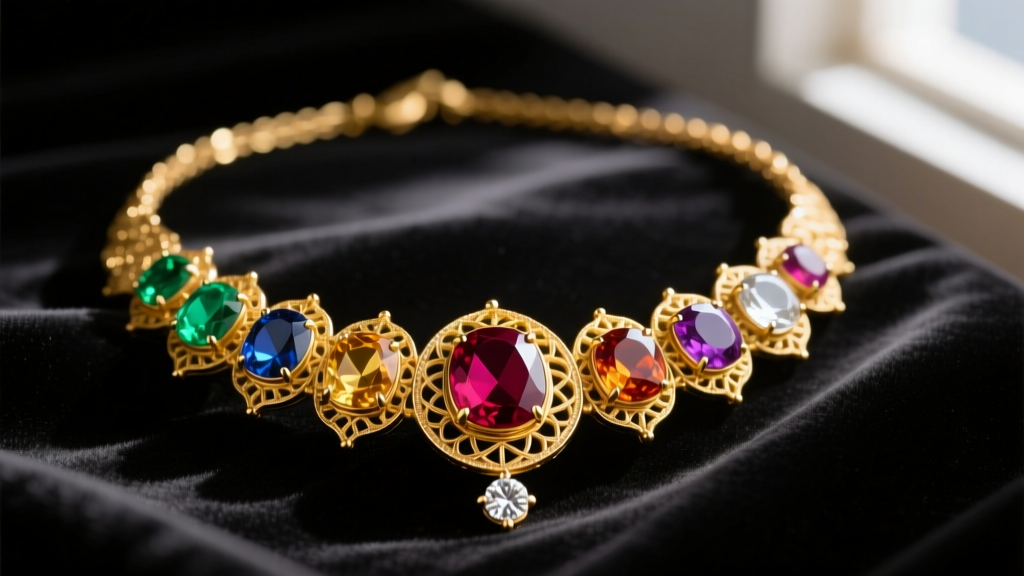
The Metallurgical and Astrological Architecture
The navratna necklace is not merely an ornamental piece of jewelry; it is a highly calibrated astrological instrument rooted in Vedic traditions. Translating to 'nine gems,' the navratna represents the Navagraha (the nine celestial bodies). From a gemological and metallurgical perspective, constructing a genuine navratna necklace requires strict adherence to material purity, precise carat weight ratios, and specialized setting techniques that differ vastly from standard Western jewelry manufacturing.
The foundational metal for a traditional navratna necklace is almost exclusively 22-karat yellow gold. While 18k gold (75% purity) offers superior tensile strength for intricate prong settings, Vedic texts mandate high gold purity to prevent alloy interference with the stones' energetic properties. 22k gold (91.6% purity, typically alloyed with silver and copper) provides the necessary structural integrity for bezel walls while satisfying astrological requirements. Sterling silver is occasionally used as a budget alternative, but it is prone to galvanic corrosion when exposed to the acidic pH of human sweat over decades of continuous wear, which can degrade the open-back settings required for the gems.
The 9 Gemstones: Mineral Specs and Carat Ratios
A critical failure point in mass-produced navratna jewelry is the arbitrary sizing of the gemstones. In a technically accurate navratna necklace, the central stone representing the Sun (Ruby) acts as the baseline for visual and energetic mass. The remaining eight stones must be scaled proportionally based on their specific gravity and optical density, rather than matching exact carat weights. For instance, a 3-carat diamond will appear significantly smaller in physical volume than a 3-carat ruby due to its higher specific gravity (3.52 vs. 4.00). Therefore, master jewelers calibrate by millimeter spread and visual volume.
| Celestial Body | Gemstone | Mineral Family | Mohs Hardness | Volume Ratio (vs Ruby) |
|---|---|---|---|---|
| Sun (Surya) | Ruby | Corundum | 9.0 | 1.0x (Baseline) |
| Moon (Chandra) | Pearl | Organic (Calcium Carbonate) | 2.5 - 4.5 | 1.2x (Visual) |
| Mars (Mangal) | Red Coral | Organic (Calcium Carbonate) | 3.5 - 4.0 | 1.1x (Visual) |
| Mercury (Budh) | Emerald | Beryl | 7.5 - 8.0 | 0.9x (Visual) |
| Jupiter (Guru) | Yellow Sapphire | Corundum | 9.0 | 1.0x (Visual) |
| Venus (Shukra) | Diamond | Carbon | 10.0 | 0.8x (Visual) |
| Saturn (Shani) | Blue Sapphire | Corundum | 9.0 | 1.0x (Visual) |
| Rahu (North Node) | Hessonite | Grossular Garnet | 6.5 - 7.5 | 0.95x (Visual) |
| Ketu (South Node) | Cat's Eye | Chrysoberyl | 8.5 | 0.9x (Visual) |
Setting Techniques: The Skin-Contact Imperative
The most crucial technical requirement of a navratna necklace is that the bottom (pavilion or base) of every single gemstone must maintain direct, unobstructed contact with the wearer's skin. This necessitates an 'open-back' setting. Standard closed-back bezels or foil-backed settings—common in Victorian and modern fashion jewelry—completely negate the astrological function of the piece.
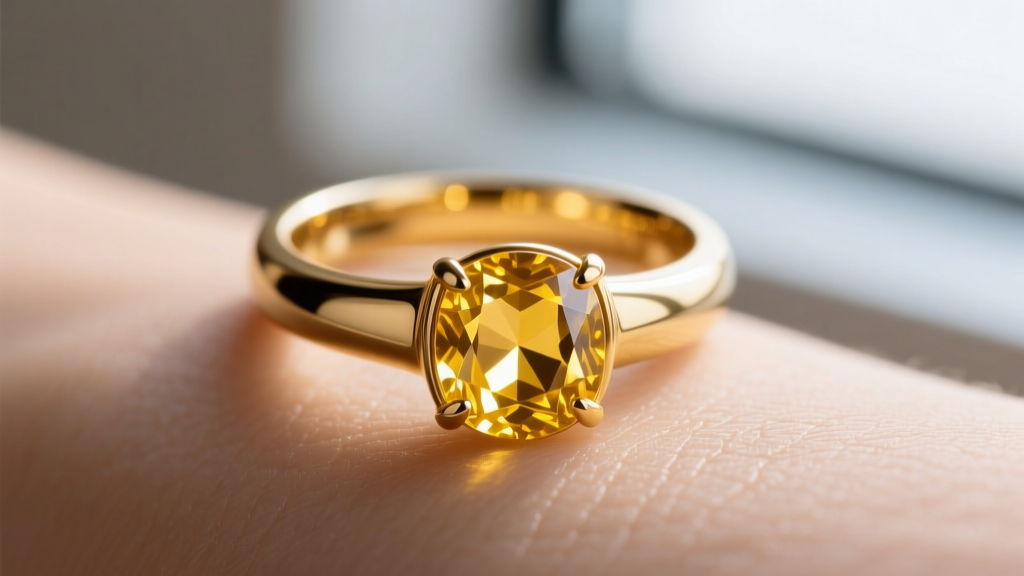
Open-Back Bezel vs. Tension Prongs
To achieve skin contact while securing stones of vastly different hardness levels, jewelers must employ a hybrid setting approach. The corundum family (rubies and sapphires) and diamonds can be secured with heavy 22k gold bezels that leave the culet completely exposed. However, organic stones like pearls and red coral are exceptionally soft (Mohs 2.5 to 4.0). A tight bezel can easily fracture a coral cabochon during the setting process due to the malleability limits of 22k gold. For these organics, specialized tension-prong settings or partial-bezel 'claw' mounts are utilized to grip the girdle without applying compressive force to the dome, while still leaving the base flush against the skin.
Expert Warning: Never allow a jeweler to solder the pendant bail or chain links after the gemstones have been set. The thermal shock from a jeweler's torch will instantly shatter emeralds (which are heavily included and often oil-treated) and crack hessonite garnets. All stones must be set 'cold' using mechanical burnishing tools only after all metallurgical soldering is complete.
Gemstone Treatments and the 2026 Synthetic Threat
Vedic astrology strictly mandates that all nine gemstones in a navratna necklace must be completely natural and untreated. As of 2026, the infiltration of treated and lab-grown stones into the astrological jewelry market has reached critical levels, making independent verification non-negotiable.
Identifying Unacceptable Treatments
- Rubies: Over 80% of commercial rubies are lead-glass filled. Under diffused lighting, these exhibit a tell-tale blue or purple 'flash effect' along the fracture lines. A genuine Vedic ruby must be unheated and untreated, verified by the absence of this flash and the presence of natural rutile silk.
- Yellow Sapphires: Beryllium diffusion is rampant. This treatment introduces beryllium gas into the lattice during heating to create a vibrant yellow hue. Gemologists identify this via immersion in diiodomethane, which reveals color pooling at the facet junctions and girdle. Only naturally colored, unheated yellow sapphires are acceptable.
- Emeralds: While minor cedar oiling is historically accepted in Western gemology, strict Vedic parameters often reject heavily fractured, oil-resin-filled emeralds. The ideal emerald for a navratna necklace is a 'jardin' emerald with natural inclusions but no artificial clarity enhancement.
- Blue Sapphires & Diamonds: With the rise of CVD (Chemical Vapor Deposition) lab-grown diamonds and hydrothermal synthetic sapphires, visual inspection is no longer sufficient. Synthetics lack the chaotic, billion-year-old inclusion patterns required for astrological efficacy.
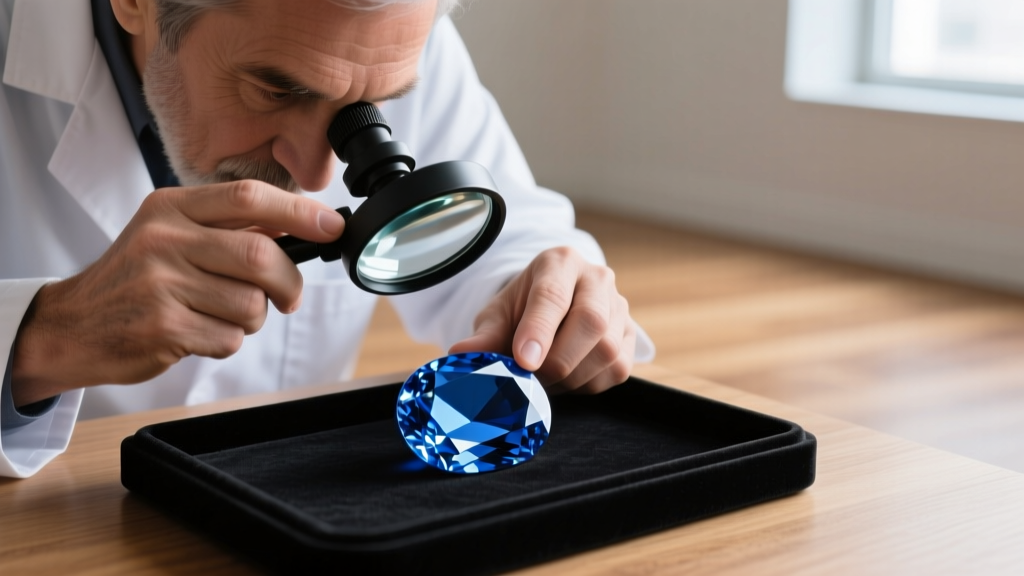
Sourcing and Verification Framework
When commissioning or purchasing a high-value navratna necklace, rely on a strict documentation framework. Do not accept generic 'store certificates' or appraisals from the selling jeweler. According to the Gemological Institute of America (GIA), only advanced spectroscopic analysis can definitively separate natural from synthetic corundum and detect advanced lattice diffusion treatments.
Require individual grading reports for the 'Big Three' stones in the piece (Ruby, Blue Sapphire, Emerald) from tier-one laboratories such as the GIA, SSEF, or Gübelin. For the remaining stones, certificates from the International Gemological Institute (IGI) or the Gem Research Swisslab (GRS) are sufficient to verify natural origin and confirm the absence of synthetic flux inclusions. The total cost for a genuine, untreated 22k gold navratna necklace with certified stones typically ranges from $8,000 to over $45,000, depending heavily on the carat weight and origin (e.g., Burmese ruby, Kashmir sapphire) of the central stones.
Maintenance and Energetic Cleansing Protocols
Maintaining a navratna necklace requires an understanding of the varying chemical stabilities of its components. Never place this piece in an ultrasonic cleaner. The high-frequency cavitation will strip the natural oils from the pearl and coral, causing them to craze and crack, and it can easily fracture the emerald along its natural cleavage planes.
For physical cleaning, use a soft, untreated microfiber cloth and a mild, pH-neutral soap solution applied only to the gold framework. Avoid submerging the organic stones. Astrologically, the piece is traditionally cleansed by submerging it in a mixture of raw cow's milk, honey, and Ganges water (Panchamrit) during specific lunar alignments, though from a purely material standpoint, simply wiping the gold and hard stones with a damp cloth and patting the organics dry will preserve the metallurgical and gemological integrity of the necklace for generations.


