The Ultimate Guide to Choosing a Necklace for Glasses
Discover how to choose the perfect necklace for glasses. Learn ideal lengths, chain gauges, and styling tips to complement your eyewear effortlessly.


The Visual Clash: Why Glasses Change Necklace Rules
Eyewear is no longer just a medical necessity; it is a central pillar of your personal style. When you wear glasses, your face naturally draws the eye, creating a focal point that heavily influences how the rest of your jewelry is perceived. Choosing the right necklace for glasses requires an understanding of visual weight, proportion, and spatial awareness. A necklace that looks stunning on a bare neckline might suddenly look cluttered or compete aggressively with your favorite acetate frames.
The primary challenge glasses wearers face is the "triangle of attention." This visual triangle spans from the bridge of your nose (the top anchor) down to the center of your chest (the bottom anchor). If your necklace pendant rests exactly on the bottom rim of your glasses, it creates visual friction. In this 2026 style guide, we break down the exact measurements, material grades, and structural choices you need to make to harmonize your neckwear with your eyewear.
The Golden Ratio: Matching Chain Gauge to Frame Weight
The most common mistake beginners make is ignoring the physical weight and thickness of their eyeglass frames when selecting a chain gauge. The thickness of your frames should dictate the millimeter width of your necklace chain to maintain proportional balance.
Thick Acetate and Chunky Resin Frames
If you wear bold, oversized acetate frames (typically 4mm to 8mm thick at the temples), a delicate 0.8mm cable chain will look entirely lost. The visual heaviness of the glasses will swallow the necklace. Instead, opt for medium-to-heavy chains ranging from 2.0mm to 3.5mm. Styles like the Figaro, Rope, or Box chain provide enough structural presence to stand up to thick frames without looking like an afterthought.
Minimalist Wire and Titanium Frames
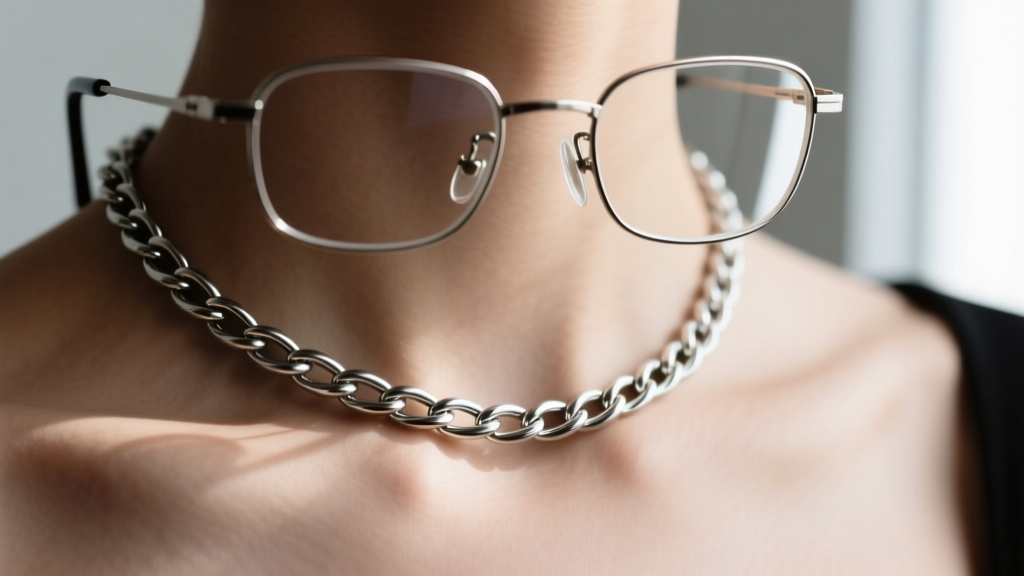
Conversely, if your eyewear consists of ultra-thin titanium wireframes or rimless lenses, a chunky 3mm chain will overwhelm your face and drag your features down. For wireframes, stick to delicate gauges between 0.8mm and 1.5mm. A fine Satellite or Snake chain complements the airy, minimalist aesthetic of thin metal frames, creating a cohesive, lightweight look.
Length Matters: Avoiding the 18-Inch Danger Zone
Standard necklace lengths are designed for bare necklines. When you introduce glasses to the equation, standard lengths can become problematic. The most critical concept to understand is the "18-inch danger zone."
- The 18-Inch Clash: An 18-inch necklace typically rests on the collarbone. For many popular eyeglass styles—especially aviators, oversized round frames, and cat-eye shapes—the bottom rim of the glasses extends down to hover right around the upper collarbone area. An 18-inch chain will often intersect directly with the bottom of your frames, creating a tangled, cluttered aesthetic.
- The 14 to 16-Inch Solution (Choker/Collar): By moving the necklace higher up the neck, you completely separate the jewelry from the eyewear. A 16-inch chain rests securely above the visual line of the glasses, framing the face beautifully without competition.
- The 24 to 28-Inch Solution (Matinee/Opera): If you prefer longer necklaces, dropping the chain to 24 inches or lower ensures the pendant rests well below the bottom rim of even the most oversized spectacles. This elongates the torso and keeps the face as the undisputed focal point.
Pro Styling Tip: Always perform the "sit-and-stand" test. When you sit at a desk and lean forward, long pendants swing outward. Ensure your pendant doesn't swing directly into your line of sight or clack against your lenses when you look down to read.
Functional Fashion: Eyeglass Chains That Double as Necklaces
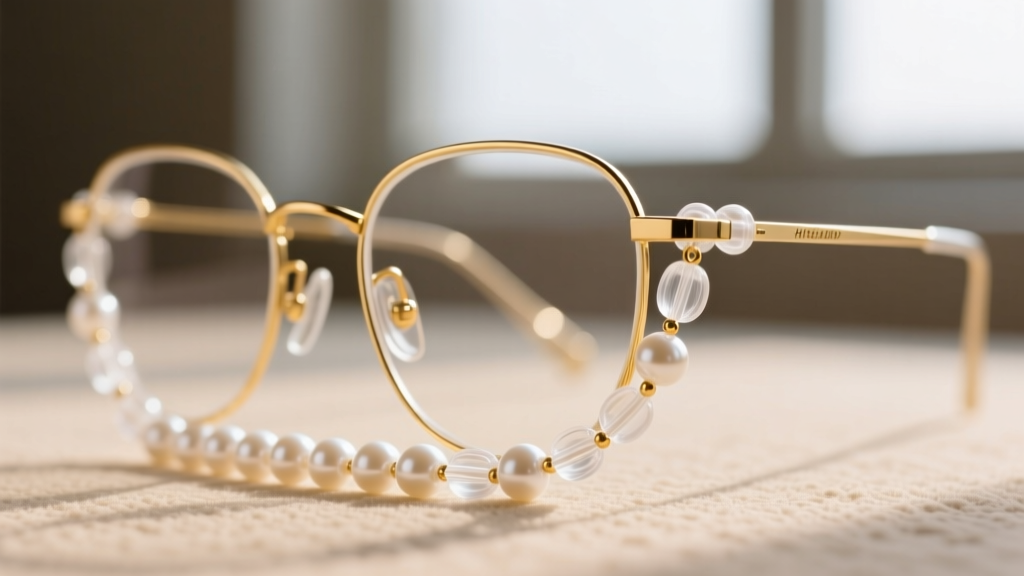
The functional eyeglass chain (or lanyard) has undergone a massive design renaissance. No longer relegated to beaded acrylics from a pharmacy, modern eyeglass chains are crafted from fine metals, semi-precious stones, and leather, designed to be worn as standalone necklaces when your glasses are perched on your head or face.
The Importance of the Temple Grip
When buying a functional necklace for glasses, the attachment mechanism is just as important as the chain itself. Avoid chains that use tight metal O-rings or rigid wire loops. Metal rubbing against acetate can cause micro-abrasions, and metal loops can easily snap the thin arms of wireframes. Instead, look for chains featuring Shore 40A to 50A durometer silicone loops. This specific hardness provides enough elasticity to grip the temple securely without stretching out over time, while being completely gentle on anti-scratch coatings and delicate frame hinges.
Material Guide: Protecting Your Lenses and Coatings
One of the most overlooked aspects of wearing a necklace with glasses is the physical interaction between the jewelry and the lenses. Modern eyeglass lenses are treated with Anti-Reflective (AR) coatings, hydrophobic layers, and UV blockers. According to All About Vision, these coatings are incredibly thin and highly susceptible to scratching from hard materials.
The Mohs Hardness Threat
Polycarbonate and CR-39 plastic lenses typically rank around a 3 to 4 on the Mohs scale of mineral hardness. If you wear a necklace with a dangling pendant featuring a sharp, faceted gemstone—like a quartz point (Mohs 7) or a diamond/moissanite (Mohs 10)—and that pendant swings up and grazes your lenses, it will permanently scratch the AR coating.
To protect your eyewear, choose pendants with smooth, polished surfaces. Bezel-set gemstones, polished pearls, smooth enamel drops, and rounded metallic spheres are excellent choices. Avoid raw, unpolished crystals or pendants with sharp, protruding prongs that can act like a scribe against your expensive lenses.
Quick Reference: Frame Type vs. Necklace Pairing
Use this chart to quickly identify the ideal necklace specifications based on your daily eyewear.
| Frame Style | Ideal Chain Gauge | Best Necklace Length | Pendant Style |
|---|---|---|---|
| Thick Acetate / Chunky | 2.0mm - 3.5mm | 14" - 16" or 24"+ | Bold geometric, smooth enamel |
| Wireframe / Titanium | 0.8mm - 1.5mm | 16" - 18" (if frames are small) | Delicate bezel-set, pearls |
| Oversized / Aviator | 1.5mm - 2.5mm | 14" (Choker) or 28" (Opera) | Flat discs, no swinging prongs |
| Cat-Eye / Horn-rim | 1.2mm - 2.0mm | 16" (Collar) | Asymmetrical drops, smooth metal |
Troubleshooting: Static, Hair, and Tangles
Glasses wearers frequently adjust their frames, pushing them up the bridge of the nose. This repetitive hand movement near the face increases the likelihood of catching a delicate chain on your fingers or tangling it with your hair. If you wear your hair down and frequently adjust your glasses, avoid Snake chains and Box chains with micro-clasps, as the tiny gaps in these chain styles act like combs, catching and pulling individual hair strands. Opt instead for smooth Rope chains or Curb chains, which lay flat and allow hair to slide off without snagging.
Ultimately, styling a necklace when you wear glasses is about creating distinct zones of interest. By respecting the gauge of your frames, avoiding the 18-inch intersection point, and choosing lens-safe materials, you can elevate your daily eyewear from a mere accessory to a cohesive part of your signature jewelry stack. For more insights on gemstone durability and jewelry care, the GIA Gem Encyclopedia remains an invaluable resource for understanding how your jewelry materials interact with the world around them.


