Understanding Necklace Thickness: Gauge & Material Guide
Compare necklace thickness, wire gauges, and metal properties. Learn which chain gauge and material grade offers the best durability for daily wear.

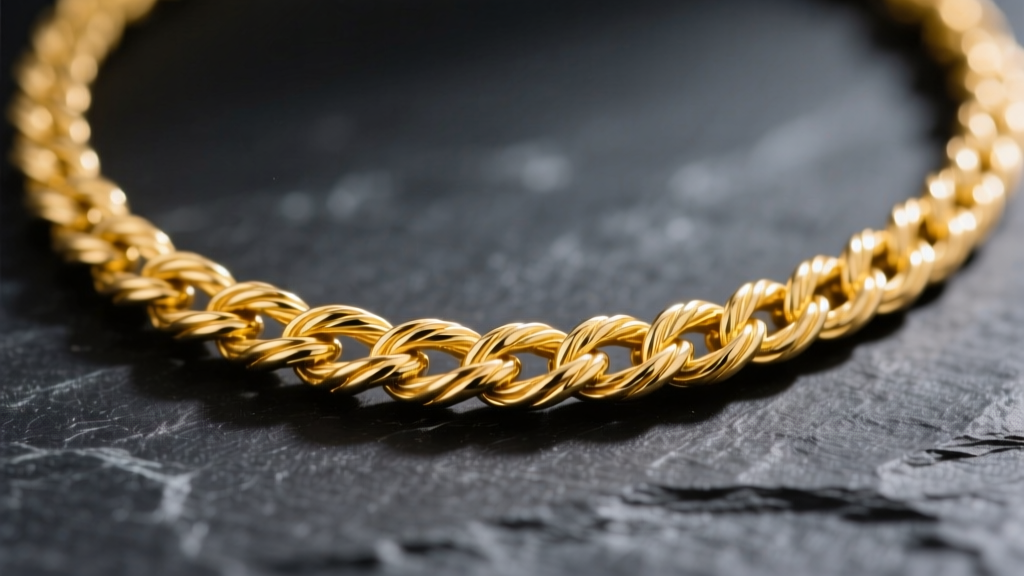
The Metallurgy of Necklace Thickness
When evaluating fine jewelry, consumers often fixate on metal purity or gemstone quality, overlooking a critical structural metric: necklace thickness. In the jewelry industry, the thickness of a chain is not merely an aesthetic choice; it is a direct indicator of tensile strength, link integrity, and long-term durability. As we navigate the 2026 fine jewelry market, advancements in metallurgical hardening and the rise of aerospace-grade titanium alloys have completely redefined the relationship between wire gauge and structural resilience.
Understanding necklace thickness requires a foundational grasp of wire drawing and annealing. When a jeweler creates a chain, metal ingots are pulled through progressively smaller tungsten carbide dies. This cold-working process increases the metal's tensile strength but makes it brittle. To restore malleability, the wire is annealed (heated and cooled). The final necklace thickness—measured in millimeters or standard wire gauges—dictates how much sheer stress the individual links can withstand before permanent deformation occurs.
Material Hardness vs. Chain Gauge: A Comparative Analysis
A common misconception is that a thicker chain in a softer metal will outperform a thinner chain in a harder metal. To make informed purchasing decisions, we must cross-reference the Vickers Hardness (HV) scale with standard gauge measurements. According to metallurgical data from the Gemological Institute of America (GIA), the alloy composition drastically alters how a specific necklace thickness behaves under daily wear.
| Metal Type & Grade | Vickers Hardness (HV) | Minimum Recommended Gauge | Tensile Strength & Wear Profile |
|---|---|---|---|
| 24k Pure Gold | ~25 HV | 12 Gauge (2.05mm) | Extremely low. Prone to stretching and severe scratching. Rarely used for structural chains. |
| 18k Yellow Gold | ~125 HV | 16 Gauge (1.29mm) | Moderate. Offers rich color but requires thicker links to prevent bending under pendant weight. |
| 14k White Gold | ~160 HV | 18 Gauge (1.02mm) | High. The nickel or palladium alloys provide excellent rigidity, allowing for thinner, durable chains. |
| Platinum 950 | ~135 HV | 18 Gauge (1.02mm) | High density and tensile strength. Deforms rather than snaps, making thin gauges surprisingly durable. |
| Grade 5 Titanium | ~340 HV | 20 Gauge (0.81mm) | Exceptional. Aerospace-grade Ti-6Al-4V allows for ultra-thin necklace thickness with immense strength. |
This data reveals a crucial decision framework: if you desire a delicate, sub-1mm chain, you must opt for higher-hardness metals like 14k white gold or platinum. Conversely, if you prefer the rich, buttery hue of 18k or 22k gold, you must compensate for the metal's softness by increasing the necklace thickness.
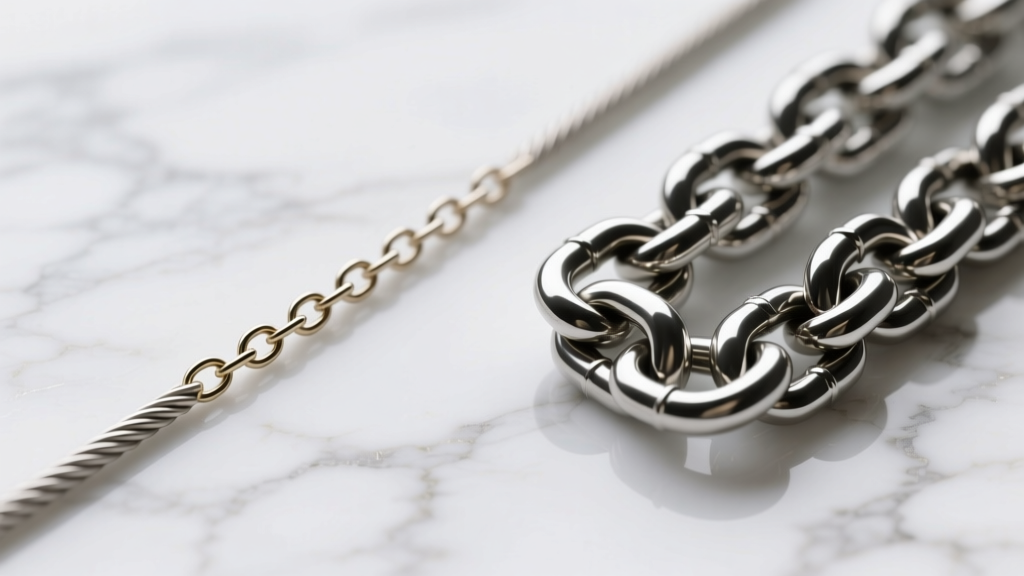
Decoding Standard Necklace Thickness Measurements
Jewelry manufacturers categorize chain thickness into three primary tiers. Understanding these tiers helps you match the chain to your lifestyle, neckline, and pendant requirements.
Sub-1mm: The Delicate Tier (20 to 22 Gauge)
Chains measuring between 0.64mm (22G) and 0.81mm (20G) are designed for minimalism. They sit flush against the collarbone and are ideal for layering. However, structural integrity is a major concern at this necklace thickness. A 20-gauge 18k gold cable chain can support a maximum pendant weight of roughly 2.5 grams before the links begin to ovalize. For daily wear in this tier, platinum or titanium is strongly recommended to prevent micro-fractures.
1.5mm to 3mm: The Everyday Sweet Spot (14 to 10 Gauge)
This is the most versatile range for fine jewelry. A 2mm rope chain or a 2.5mm box chain offers the perfect balance of visual presence and structural resilience. At this necklace thickness, the metal cross-section is large enough to withstand the lateral torque applied when the chain catches on clothing. According to manufacturing guidelines from Rio Grande, chains in the 1.5mm to 3mm range distribute solder-joint stress most effectively, drastically reducing the likelihood of spontaneous link failure.
4mm and Above: Statement and Structural Integrity
Chains exceeding 4mm (such as heavy Cuban links or thick Figaro chains) transition from pendant carriers to standalone statement pieces. At this thickness, the primary concern shifts from tensile snapping to clasp failure. The sheer weight of a 6mm solid gold chain can exert enough downward force to warp standard spring-ring clasps. Always ensure that chains of this thickness are fitted with heavy-duty lobster claws or custom box clasps with dual safety catches.
How Metal Purity Impacts Chain Durability
The purity of the metal directly dictates the necessary necklace thickness for longevity. In 2026, we are seeing a massive shift toward advanced alloying techniques, particularly in 14k and 18k golds. Traditional 14k gold uses copper and silver to add strength, but modern proprietary alloys incorporate trace amounts of zinc or indium to refine the grain structure, increasing hardness without sacrificing the metal's ductility.
"A 1.2mm chain in modern, heat-treated 14k white gold will often outlast a 1.8mm chain in traditional, annealed 22k yellow gold under identical tensile loads." — Master Bench Jeweler Assessment
Platinum presents a unique metallurgical paradox. While its Vickers Hardness is lower than 14k white gold, its tensile strength and density are vastly superior. When a platinum link is subjected to extreme stress, it will stretch or bend rather than snap cleanly. This means a thinner platinum chain can survive impacts that would shatter the solder joints of a thicker gold chain.
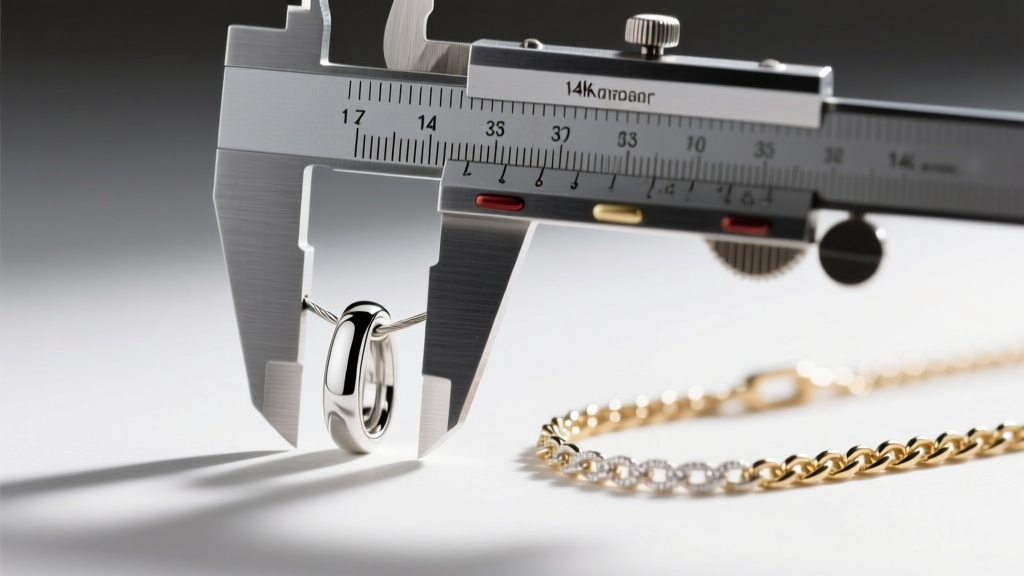
Choosing the Right Necklace Thickness for Pendants
Pairing a pendant with the wrong chain gauge is the leading cause of jewelry repair visits. To ensure structural harmony, follow the 1:3 Weight-to-Thickness Ratio Rule:
- Pendant Weight: Calculate the exact gram weight of your pendant, including the bail.
- Chain Capacity: The pendant should never weigh more than 30% of the chain's total gram weight.
- Bail Clearance: Ensure the inner diameter of the pendant bail is at least 1.5 times the thickness of the chain. Forcing a 3mm chain through a 3.5mm bail causes friction wear that will eventually saw through the link wire.
For heavy gemstone pendants (e.g., a 5-carat sapphire in a solid gold halo setting), avoid hollow-core chains entirely. Hollow chains achieve a thick visual profile with minimal metal, meaning the outer shell will crush under the localized pressure of a heavy pendant bail.
Expert Troubleshooting: Preventing Stretch and Breakage
Even with the correct necklace thickness, specific chain styles possess inherent mechanical vulnerabilities. Understanding these failure modes allows you to troubleshoot before a catastrophic break occurs.
- Curb and Cuban Links: These wide, interlocking links act as miniature levers. When pulled at an angle, the leverage multiplies the tension on the link walls, leading to gradual stretching. If your curb chain looks longer after a year of wear, the links are ovalizing. Have a jeweler tighten them before they snap.
- Box Chains: The structural weakness of a box chain lies in the laser-welded seams of the square links. If bent sharply, the rigid geometric shape cannot absorb the shock, resulting in a clean snap at the solder point.
- Herringbone and Snake Chains: These fluid, flat-laid chains have virtually no lateral structural support. A single sharp kink will break the internal tension wires, permanently ruining the chain's drape. They must be stored flat and never worn to sleep.
By prioritizing the intersection of material hardness, wire gauge, and link geometry, you can select a piece of jewelry that is not only visually stunning but engineered to endure a lifetime of wear. Always verify the exact millimeter thickness and alloy composition with your jeweler before making a significant investment in fine neckwear.


