Noose Necklace Guide: Safe Materials, Gauges & Breakaway Clasps
Explore the technical anatomy of the noose necklace. Learn about 316L steel gauges, breakaway safety clasps, and material grades for alternative jewelry.

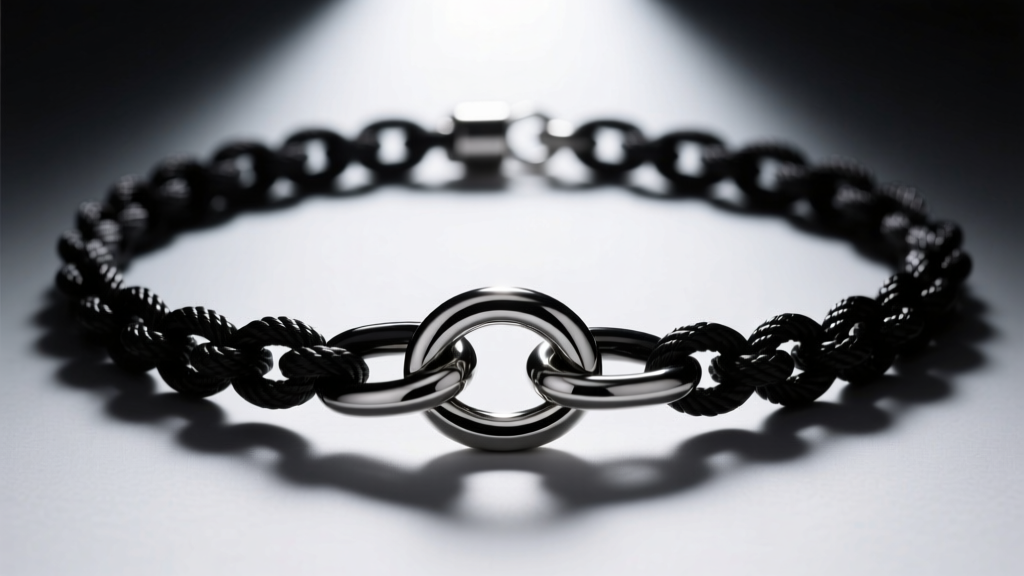
The noose necklace occupies a distinct and provocative space in alternative, goth, metalcore, and punk jewelry. Visually striking, it mimics the silhouette of a hangman’s knot, serving as a bold statement piece. However, from a jewelry design and engineering perspective, the noose necklace presents unique mechanical stresses and severe safety hazards that standard pendants do not. A traditional chain rests passively on the clavicle; a noose design, particularly lariat or slipknot styles, introduces dynamic tension and the risk of entanglement.
As alternative jewelry continues to evolve in 2026, the market has shifted away from dangerous, unregulated novelty pieces toward highly engineered, safety-conscious designs. This expert deep dive examines the metallurgy, hardware physics, and structural anatomy required to design, select, and wear a noose necklace safely without compromising its dark aesthetic.
The Physics of the Slipknot: Fixed vs. Sliding Loops
The most critical design flaw in poorly manufactured noose necklaces is the use of a true sliding slipknot. In a lariat-style necklace where the chain feeds freely through a jump ring or wire-wrapped loop, any sudden downward force on the dangling 'tail' will cause the loop to cinch tightly against the wearer's trachea. If the chain catches on a door handle, branch, or machinery, the resulting tensile force can cause catastrophic injury.
Expert jewelers mitigate this risk through fixed-knot construction. In a high-quality noose necklace, the 'knot' is an illusion. The chain is fed through a primary ring, but a secondary stopper bead, a soldered jump ring, or a tight wire-wrap is placed directly beneath the loop. This prevents the chain from pulling through, effectively transforming the slipknot into a fixed-diameter pendant. When shopping for or designing these pieces, always perform the 'pull test': grip the main loop and the dangling tail and pull in opposite directions. If the loop tightens, the piece is structurally unsafe for daily wear.
Breakaway Safety Mechanisms and Hardware
Even with a fixed knot, a continuous loop of heavy steel chain poses a strangulation risk. The integration of a breakaway safety mechanism at the nape of the neck is non-negotiable for responsible jewelry design. Standard lobster clasps require approximately 12 to 15 pounds of lateral force to disengage—far too much resistance in an emergency.
Magnetic Neodymium Clasps
The industry standard for safe alternative necklaces is the magnetic breakaway clasp. These utilize Neodymium (NdFeB) magnets, typically in N42 to N52 grades. An N42 cylindrical magnet measuring 6mm x 10mm provides roughly 8 pounds of pull force. This is sufficient to support the static weight of a 3mm stainless steel rope chain (which averages 45 to 60 grams) but will instantly decouple when subjected to the sudden shear force of an entanglement. Note: Keep magnetic clasps away from high heat, as neodymium cores begin to depolarize and lose holding strength at temperatures exceeding 80°C (176°F).
Low-Tension Spring Rings
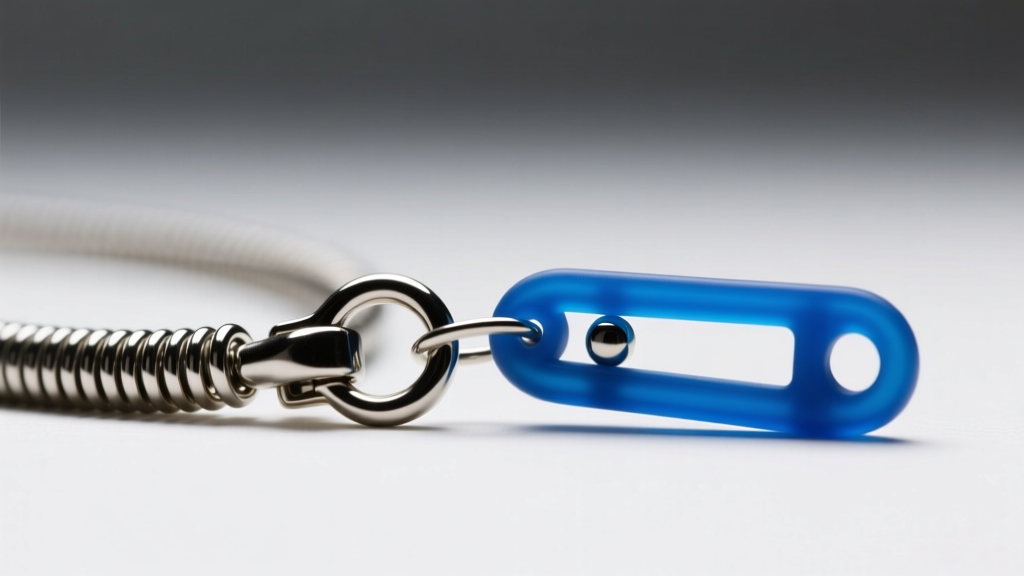
For those who prefer mechanical hardware, low-tension spring rings are engineered with a weaker internal coil. Unlike standard spring rings that lock securely, these are calibrated to pop open under 4 to 6 pounds of outward radial pressure. They are often paired with a 3mm silicone safety pin integrated into the chain link, ensuring the necklace separates before transferring dangerous kinetic energy to the cervical spine.
Material Metallurgy and Chain Gauges
The alternative jewelry market is unfortunately flooded with cheap 'Tibetan silver' or Zamak (pot metal) alloys. Zamak has a low tensile yield strength and is highly brittle; a 2mm Zamak chain can snap unpredictably under stress, leaving sharp, jagged edges against the skin. For a piece that carries the heavy visual and physical weight of a noose design, high-grade metallurgy is essential.
| Material Grade | Alloy Composition | Tensile Yield | Corrosion Resistance | Safety Verdict |
|---|---|---|---|---|
| 316L Stainless Steel | Fe, Cr, Ni, 2-3% Mo | ~485 MPa | Exceptional (Marine Grade) | Excellent for heavy chains |
| ASTM F138 Titanium | Ti, Al, V | ~830 MPa | Biocompatible / Hypoallergenic | Best for sensitive skin |
| Zamak / Pot Metal | Zn, Al, Cu, Mg | ~220 MPa | Poor (Oxidizes rapidly) | Avoid (Brittle failure risk) |
| 304 Stainless Steel | Fe, Cr, Ni | ~505 MPa | Good (Fails in high chloride) | Acceptable, but 316L is superior |
According to the British Stainless Steel Association, the addition of molybdenum in 316L steel drastically increases its resistance to pitting corrosion from human sweat and environmental chlorides. For chain gauges, a 2.0mm to 3.5mm rope chain provides the ideal balance. Anything thinner than 1.5mm lacks the structural rigidity to hold the 'knot' shape, while chains exceeding 4.0mm become excessively heavy, increasing the baseline load on the breakaway clasp. For a comprehensive breakdown of jewelry alloy properties, the Rio Grande Metals Guide remains an indispensable resource for bench jewelers.
Wire Wrapping Techniques for the Noose Knot
When the noose knot is crafted via wire wrapping rather than cast or soldered, the choice of wire temper is critical. Artisans typically use 18-gauge or 20-gauge wire. If 'dead-soft' wire is used, the friction of the chain sliding against the knot over time will cause the wire to slowly unspool and deform. Expert fabricators use 'half-hard' wire (which has a higher Vickers hardness due to cold working) to ensure the wraps remain rigid. The wraps must be sealed with a microscopic drop of cyanoacrylate or a jeweler's epoxy at the termination point to prevent the wire tail from scratching the wearer's neck.

Sizing, Drape, and Neckline Compatibility
The visual impact of a noose necklace relies heavily on the drop length of the 'tail' and the circumference of the main loop.
- The Choker Fit (14-15 inches): Sits tightly at the base of the throat. Best paired with deep V-necks or scoop necks to allow the tail (usually 2 to 3 inches long) to rest against the bare sternum. This creates a high-contrast, aggressive silhouette.
- The Princess Length (17-18 inches): Sits on the collarbone. This is the safest and most versatile length, as it keeps the hardware away from the delicate trachea area. It pairs exceptionally well with crew necks, turtlenecks, and button-down shirts, allowing the knot to rest over the fabric.
- The Matinee Length (20-24 inches): Rarely used for noose designs, as the long drop increases the pendulum effect, making the heavy metal knot prone to swinging and catching on objects.
Maintenance and Hardware Fatigue Inspection
Because the noose design concentrates kinetic stress on specific jump rings—particularly the ring that forms the 'eye' of the knot—routine maintenance is mandatory. Every three months, inspect the primary jump ring for lateral distortion. If the gap of the jump ring has twisted open even a fraction of a millimeter, the chain can slip out, causing the piece to break or the fixed knot to fail. Use two pairs of flat-nose pliers to gently twist the ring back into perfect alignment, ensuring the cut ends meet flush. Never pull jump rings apart laterally, as this weakens the metal's crystalline structure and accelerates fatigue failure.
By prioritizing fixed-loop construction, precision-calibrated magnetic breakaways, and marine-grade 316L steel, the noose necklace transcends its shock-value origins to become a masterclass in safe, avant-garde jewelry engineering.


