Opalite Stone Necklace: Technical Guide & Buyer Tips
Discover the technical truth behind the opalite stone necklace. Learn about man-made glass vs. natural opal, Mohs hardness, and setting styles.

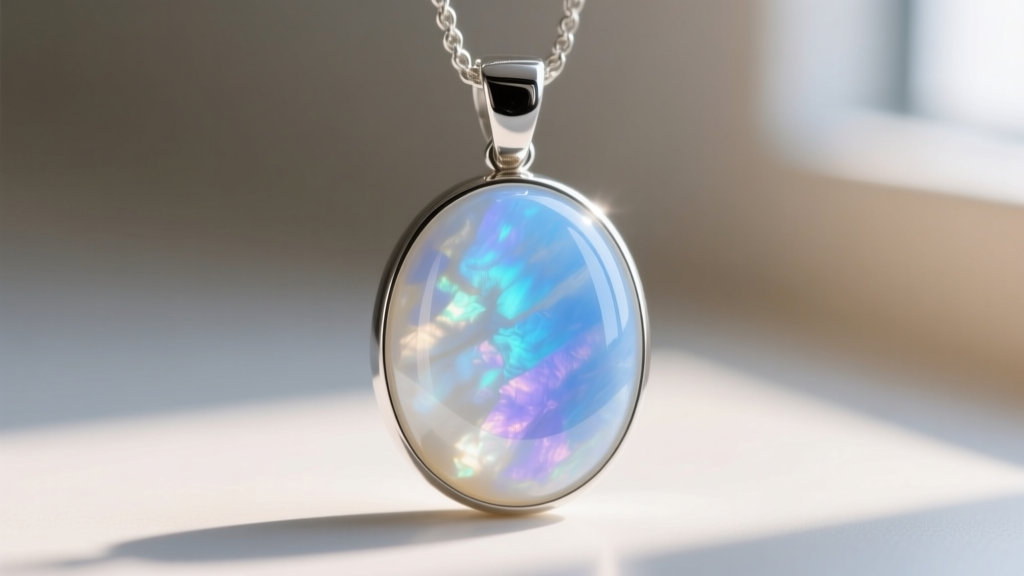
The Material Reality: Man-Made Glass vs. Natural Opal
In the commercial jewelry market, the term 'opalite' is one of the most widely misunderstood material descriptors. When shopping for an opalite stone necklace, buyers must first understand that approximately 95% of the stones sold under this name are not natural gemstones at all. Instead, they are a type of opalescent man-made glass, often created by introducing fluorite, dolomite, or bone ash into a silica melt to produce a milky, iridescent effect. This phenomenon is known in physics as the Tyndall effect, where light scatters through suspended particles in the glass matrix, creating a soft blue or pink glow depending on the background lighting.
True natural opalite does exist, but it is exceptionally rare. In gemological terms, natural opalite is a variety of common opal (non-precious opal) that lacks the play-of-color seen in precious opals but exhibits a uniform, milky translucency. Because natural common opal is brittle and difficult to cut into large, flawless cabochons, it is rarely used in mass-market necklaces. Therefore, a technical buyer must approach the opalite stone necklace market with the understanding that they are likely evaluating high-quality artisan glass rather than a hydrated silica mineral. According to the Gemological Institute of America (GIA), distinguishing between natural opal and opalescent glass requires an understanding of their vastly different internal structures and optical properties.
Gemological Data: Commercial Opalite vs. Natural Opal
To make informed purchasing decisions, it is crucial to compare the physical and optical properties of commercial glass opalite against its natural counterparts. The data below outlines the exact gemological metrics used by appraisers and jewelers.
| Property | Commercial Opalite (Glass) | Natural Common Opal | Precious Opal |
|---|---|---|---|
| Chemical Composition | SiO2 + Fluorite/Dolomite | SiO2·nH2O (Hydrated Silica) | SiO2·nH2O (Hydrated Silica) |
| Mohs Hardness | 5.5 - 6.0 | 5.5 - 6.5 | 5.5 - 6.5 |
| Refractive Index (RI) | 1.50 - 1.52 | 1.43 - 1.46 | 1.43 - 1.46 |
| Specific Gravity (SG) | 2.45 - 2.60 | 1.98 - 2.25 | 1.98 - 2.25 |
| Optical Phenomenon | Tyndall Effect (Scattering) | None / Chatoyancy | Diffraction (Play-of-Color) |
| Internal Inclusions | Spherical gas bubbles, swirls | Silica spheres, water pockets | Silica spheres, water pockets |
As noted in the Mindat Mineral Database, the specific gravity is the most reliable non-destructive metric for differentiation. Glass opalite is significantly heavier than natural opal due to the lack of water content and the presence of heavier flux compounds used in the glassmaking process.
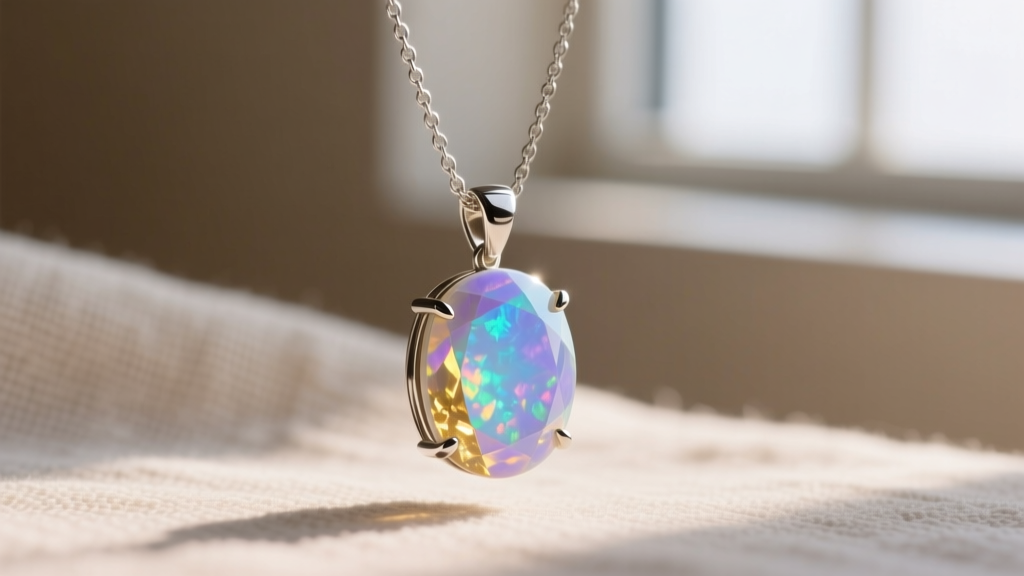
Setting Mechanics and Chain Metallurgy
Because a commercial opalite stone necklace relies on glass, the setting mechanics must account for the material's specific failure modes. Glass lacks the crystalline cleavage planes of natural minerals, meaning it does not chip predictably; instead, it fractures conchoidally (like a shell) and is highly prone to girdle chipping if subjected to localized pressure.
Why Bezel Settings Outperform Prongs
For any opalite cabochon, a full or semi-bezel setting is technically superior to a prong setting. Prong settings require the jeweler to apply concentrated mechanical force to the stone's girdle to secure the metal claws. With glass opalite, this localized pressure frequently results in micro-fractures that propagate over time, eventually causing the stone to crack or pop out of the setting. A bezel setting, by contrast, distributes pressure evenly around the entire circumference of the stone, protecting the vulnerable edges while providing a modern, flush aesthetic.
Optimal Chain Gauges and Alloys
The pendant's weight and the glass's fragility dictate the optimal chain metallurgy. Flimsy chains will tangle and cause the pendant to swing erratically, increasing the risk of impact damage against hard surfaces.
- Chain Gauge: Opt for a minimum thickness of 1.0mm to 1.5mm. A 1.2mm cable or rope chain provides the necessary tensile strength to support a 15-20 carat glass opalite cabochon without kinking.
- Alloy Selection: Standard sterling silver (925) is prone to sulfide tarnishing, which can transfer to the porous backing of some lower-grade opalite glass. Argentium Silver (935 or 960) is highly recommended due to its germanium content, which provides exceptional tarnish resistance and a brighter, whiter luster that complements the blue Tyndall effect of the stone.
- Gold Alternatives: If preferring gold, 14k gold-filled chains (featuring a thick outer layer of 14k gold mechanically bonded to a brass core) offer superior durability and longevity compared to thin gold vermeil or gold-plated brass, which will inevitably wear through and expose the base metal to skin acids.
Authenticity Testing and Market Pricing
When evaluating an opalite stone necklace, especially in the secondary or artisan market, verifying the material is essential to avoid overpaying for mass-produced glass disguised as rare natural opal.
Non-Destructive Verification Methods
1. Thermal Conductivity Test: Natural opal is a poor conductor of heat and feels distinctly cool to the touch, taking longer to warm up against the skin. Glass opalite, being denser and lacking water content, absorbs ambient and body heat much faster. If the stone feels warm almost immediately upon handling, it is likely glass.
2. Magnification (10x Loupe): Examine the stone's interior near the drill hole or girdle. Natural opal will show a random, granular texture or, in the case of synthetic Gilson opal, a 'lizard skin' columnar structure. Glass opalite will almost always reveal perfectly spherical gas bubbles or sweeping, curved striae (flow lines) caused by the molten glass cooling process.
Pricing Tiers in 2026
Understanding the fair market value prevents buyers from falling prey to inflated 'mystical' marketing. The pricing for an opalite stone necklace generally falls into three distinct categories:
- Mass-Market Commercial ($15 - $45): Features machine-pressed glass opalite set in base metals or thin silver plate. Often imported in high volumes with standardized, thin cable chains (under 0.8mm).
- Artisan & Gold-Filled ($60 - $150): Features hand-cut or high-quality cast glass opalite, set in Argentium silver, solid 10k/14k gold, or heavy gold-filled bezels. Chains are robust (1.2mm+), and the craftsmanship ensures secure, tension-free settings.
- Natural Common Opalite ($250 - $600+): Genuine, mined common opal with a milky translucency, set by specialized lapidaries. These pieces come with gemological certificates verifying the hydrated silica composition and specific gravity.
Long-Term Care and Abrasion Prevention
Despite its glass composition, an opalite stone necklace requires specific care protocols to maintain its optical clarity and structural integrity. The most critical threat to glass opalite is thermal shock.
Because the material is an amorphous solid with internal stress points from the manufacturing cooling process, sudden temperature changes can cause catastrophic shattering. Never wear an opalite necklace in a sauna, hot tub, or while taking a hot shower immediately after being out in the freezing cold. Furthermore, ultrasonic cleaners are strictly prohibited. The high-frequency cavitation bubbles generated by ultrasonic machines will aggressively exploit any micro-fissures in the glass, leading to internal clouding or complete fracture.
Expert Maintenance Tip: To clean your opalite stone necklace, use only a solution of lukewarm distilled water and a single drop of pH-neutral dish soap. Gently agitate with a soft-bristled baby toothbrush, rinse with room-temperature water, and dry immediately with a microfiber cloth to prevent water spots from dulling the glass's high-polish luster.
By understanding the precise material science, setting requirements, and market realities of glass opalite, collectors and everyday wearers can confidently select an opalite stone necklace that offers lasting beauty, structural durability, and fair market value.


