Pearl and Onyx Necklace Value Guide 2026: Pricing & Quality
Discover the true value of a pearl and onyx necklace in 2026. We break down pricing tiers, material grades, and how to avoid overpaying for treated gems.

The Economics of Monochromatic Elegance
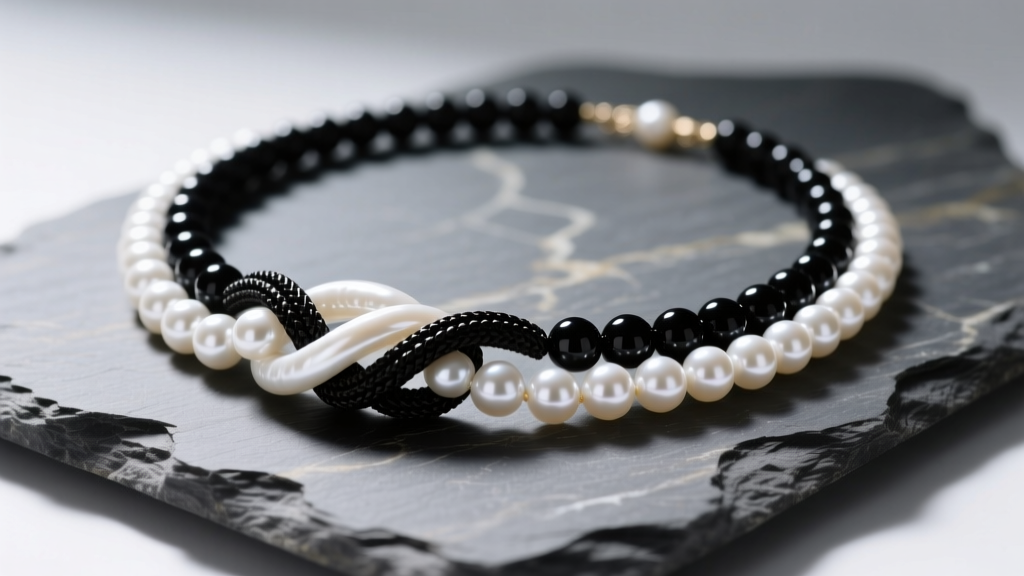
The pairing of luminous white pearls with deep, light-absorbing black onyx represents one of the most striking contrasts in fine jewelry. As we navigate the luxury and mid-tier jewelry markets in 2026, the pearl and onyx necklace has seen a massive resurgence, driven by a renewed appreciation for Art Deco revival and high-contrast minimalist styling. However, this surge in popularity has flooded the market with pieces that range from exquisite heirloom investments to overpriced costume jewelry. For the discerning buyer, understanding the true value of these materials is no longer optional; it is a financial necessity.
Assessing the budget and value of this specific gemstone pairing requires looking past the aesthetic appeal and diving deep into gemological realities, stringing techniques, and hardware purity. This comprehensive guide will deconstruct the pricing matrices of pearl and onyx necklaces, equipping you with the exact metrics needed to evaluate whether a piece is a genuine investment or a markup trap.
Deconstructing the Materials: What You Are Actually Paying For
To accurately assess the value of a pearl and onyx necklace, we must first separate marketing terminology from gemological fact. The price variance between two visually identical necklaces can easily exceed 2,000%, and the culprits are hidden in the material grades.
The Onyx Reality Check: Natural vs. Treated
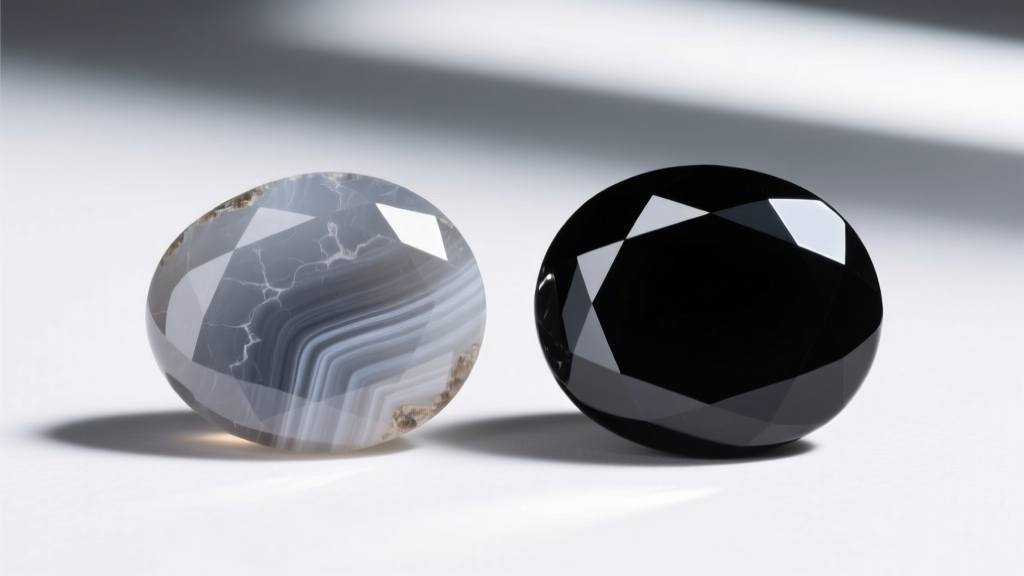
Here is the most critical value assessment factor that most retailers omit: true, naturally occurring black onyx is exceptionally rare. According to the Gemological Institute of America (GIA), the vast majority of commercial 'black onyx' is actually gray or white chalcedony (agate) that has been treated with carbon and sugar solutions, then heated to achieve a uniform black color.
Under the Federal Trade Commission (FTC) Jewelry Guides, it is legally permissible to sell this treated agate simply as 'onyx' or 'black onyx' without mandatory disclosure of the dye treatment, provided it mimics the natural stone. Therefore, when evaluating a mid-tier necklace priced between $200 and $600, you are almost certainly paying for expertly dyed agate. This is not inherently a bad thing—treated onyx is highly stable, durable (Mohs hardness of 6.5-7), and takes a brilliant polish—but you should never pay natural black onyx premiums (which can push a strand into the thousands) for treated material. If a seller claims their sub-$1,000 onyx beads are 'untreated natural black onyx,' consider it an immediate red flag.
Pearl Grading Metrics That Impact Price
The pearl component of your necklace dictates the bulk of the financial value. The GIA Pearl Quality Factors emphasize luster, surface cleanliness, and nacre thickness as the primary value drivers. In 2026, the market is dominated by three types of pearls used in these contrasting strands:
- AAA Round Freshwater: The sweet spot for value. Modern nucleation techniques in China have produced freshwater pearls with near-perfect roundness and mirror-like luster that rival saltwater varieties at a fraction of the cost. Expect to pay $150 to $400 for a high-quality freshwater and onyx strand.
- Akoya Saltwater: The traditional standard for perfectly round, high-luster pearls. An Akoya pearl and onyx necklace will command a premium, typically starting at $600 and reaching $2,500+. Look for 'Hanadama' certification, which guarantees a minimum nacre thickness of 0.4mm (though premium strands often exceed 0.8mm) and exceptional luster.
- Tahitian Pearls: Naturally dark and peacock-toned, Tahitian pearls are sometimes paired with matte-finished onyx for a moody, avant-garde look. These are luxury investment pieces, with strands rarely dipping below $1,500.
The 2026 Pearl and Onyx Necklace Pricing Matrix
Use this structured matrix to benchmark the necklace you are considering against current market realities. If the price does not align with the material specifications, the piece is either overpriced or the materials are misrepresented.
| Value Tier | Price Range (2026) | Pearl Grade & Type | Onyx Quality | Hardware & Stringing |
|---|---|---|---|---|
| Entry-Level / Fashion | $45 - $150 | Commercial Freshwater (oval/potato), thin nacre, visible blemishes | Dyed agate, uneven drilling, matte or cloudy polish | Gold-plated brass, unknotted nylon or steel wire |
| Mid-Range / Fine | $250 - $750 | AAA Round Freshwater or AA+ Akoya, high luster, clean surface | Precision-cut treated onyx, excellent polish, uniform facets | 14k Gold Vermeil or Gold-Filled, French wire or silk-knotted |
| Luxury / Investment | $1,200 - $5,000+ | Hanadama Akoya or Gem-Grade Tahitian, thick nacre, mirror luster | Master-carved onyx cameos or rare untreated natural black onyx | Solid 14k/18k Gold, diamond-set clasps, hand-knotted silk |
Hardware and Stringing: The Hidden Value Indicators
Amateur buyers focus solely on the gems; experts inspect the string and the clasp. The structural integrity of a pearl and onyx necklace heavily influences its long-term value and wearability. Because onyx is significantly harder and heavier than pearl, improper stringing can lead to catastrophic failure.
'When pairing heavy, hard gemstones like onyx with softer, delicate pearls, the stringing material acts as the only barrier preventing the onyx from grinding against the pearl nacre. Silk knotting is not just a luxury; it is a structural necessity for mixed-strand necklaces.' — Master Bench Jeweler, 2025 Guild Symposium
Stringing Techniques and Failure Modes
In the budget tier ($45-$150), manufacturers often use unknotted nylon or steel wire to save on labor costs. Steel wire is a critical failure mode for pearls. Over time, the rigid wire kinks, and the heavy onyx beads will act like sandpaper against the softer pearl nacre at the drill holes, eventually causing the pearls to crack or flake. A genuine fine jewelry piece will utilize French wire (gimp) near the clasp to prevent silk fraying, and will feature individual silk knots between every bead. Hand-knotting adds $75 to $200 in labor costs to the final retail price, but it ensures that if the strand breaks, you lose only one bead rather than the entire necklace.
Clasp Mechanisms and Metal Purity
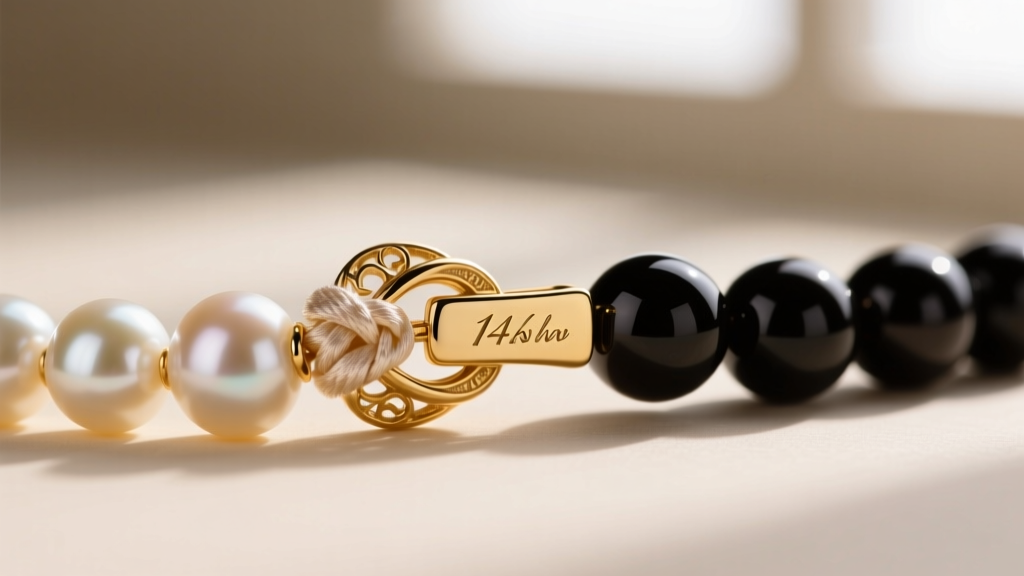
The clasp is the second major value indicator. A heavy strand of Akoya pearls and onyx beads requires a secure locking mechanism. Lobster clasps or custom box clasps with figure-eight safety catches are standard in the mid-to-high tiers. Furthermore, verify the metal purity. 'Gold vermeil' must legally consist of a sterling silver base plated with at least 2.5 microns of 10k or 14k gold. Many budget brands use 'gold-plated brass,' which will oxidize, turn the skin green, and degrade the resale value of the necklace to zero within a few years of regular wear.
Red Flags: How to Spot Overpriced Costume Pieces
When conducting your budget and value assessment, walk away from the transaction if you encounter any of the following deceptive practices:
- The 'Genuine Pearl' Evasion: If the product description simply says 'genuine pearl' without specifying Freshwater, Akoya, or Tahitian, you are likely looking at low-grade, irregular freshwater beads that cost the manufacturer pennies.
- Uncalibrated Bead Sizing: In a valuable necklace, the pearls and onyx beads should be calibrated to within 0.2mm of each other. If the 6mm onyx beads are paired with 5mm to 7mm pearls, it indicates mass-produced, unsorted inventory.
- Plastic Spacers: Some brands use black polymer clay or painted resin beads to mimic onyx. Real onyx feels cold to the touch and has substantial weight; resin will feel light and warm up quickly against the skin.
- Missing Knots at the Clasp: If the last three beads before the clasp are not knotted and secured with French wire, the silk will rapidly fray against the metal clasp loop, leading to a broken strand.
Final Verdict: Maximizing Your Investment
The pearl and onyx necklace remains a masterclass in contrast and timeless style, but its financial value is entirely dependent on material transparency and construction quality. For the smartest allocation of a mid-range budget ($300-$600), prioritize a strand featuring AAA-round freshwater pearls, precision-cut treated onyx, and solid 14k gold hardware with individual silk knotting. This specific combination offers 90% of the visual perfection of a luxury Hanadama strand while entirely avoiding the steep depreciation and markup associated with luxury brand names. By demanding gemological specificity and structural integrity, you ensure your investment remains as enduring as the stones themselves.


