Budgeting for a Pink Butterfly Necklace: 2026 Value Guide
Discover the true value of a pink butterfly necklace in 2026. We analyze material grades, gemstone tiers, and pricing to help you budget wisely.

The 2026 Market Landscape for Lepidopteran Jewelry
The butterfly motif remains a dominant force in jewelry design, symbolizing transformation and delicate beauty. However, when consumers search for a specific aesthetic—such as a pink butterfly necklace—they are immediately confronted with a massive price disparity. In 2026, you can find this exact pendant style retailing for anywhere between $12 at a fast-fashion kiosk and $4,500 at a high-end bespoke jeweler. As a buyer, how do you determine if a piece is a genuine investment or an overpriced trinket? This budget and value assessment breaks down the exact material grades, gemological properties, and hardware mechanics that dictate the true worth of pink butterfly necklaces.
Decoding the 'Pink' Element: Enamel vs. Gemstones
The most significant price driver in these necklaces is how the pink coloration is achieved. Manufacturers generally rely on three distinct methods, each with vastly different production costs, durability profiles, and resale values.
1. Cold Enamel and Epoxy Resin (The $15–$60 Tier)
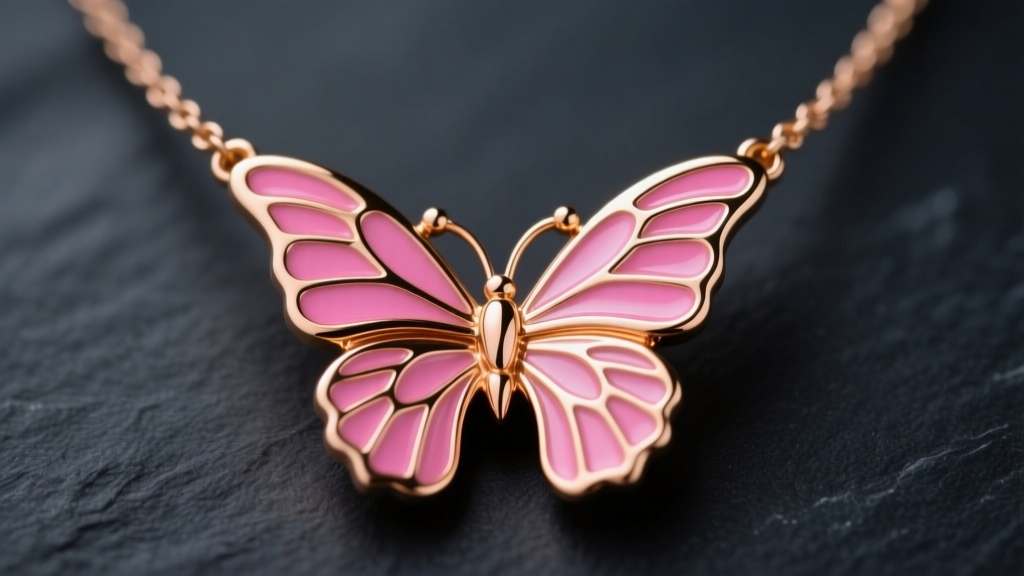
Budget-friendly butterfly pendants typically utilize cold enamel, which is essentially an epoxy resin mixed with pink pigment and painted into metal recesses. While this allows for vibrant, opaque pastel pinks, it is highly susceptible to UV degradation and chemical damage. Perfume, lotion, and even natural skin acidity can cause cold enamel to yellow, cloud, or chip within 12 to 18 months of daily wear. From a value perspective, you are paying strictly for the brand name and design, not material longevity.
2. Vitreous Enamel (The $150–$400 Tier)
Mid-tier and luxury designers use vitreous (kiln-fired) enamel. This involves fusing powdered glass to a metal substrate at temperatures exceeding 1,400°F. The resulting pink is translucent, deeply luminous, and virtually impervious to water, cosmetics, and UV fading. A pink butterfly necklace featuring genuine vitreous enamel over sterling silver or 14k gold holds its structural integrity for decades, justifying its higher price point.
3. Pink Gemstones: Sapphire, Tourmaline, and Quartz (The $200–$5,000+ Tier)
When the butterfly's wings are set with pink gemstones, the value assessment shifts to gemological metrics. According to the Gemological Institute of America (GIA), the specific mineral species dictates both the price per carat and the wearability.
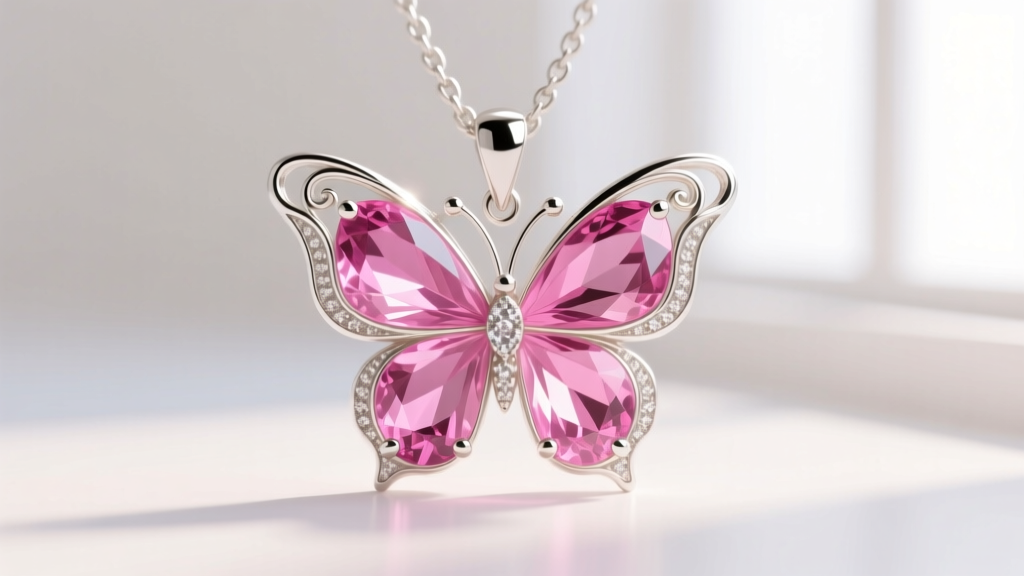
- Pink Sapphire (Corundum): Ranking 9 on the Mohs hardness scale, pink sapphires derive their color from trace amounts of chromium. They are exceptionally durable for daily wear. A well-cut, 1.5-carat pink sapphire butterfly pendant in 18k gold will typically retail between $1,200 and $3,500, depending on saturation and clarity.
- Pink Tourmaline: Ranking 7 to 7.5 on the Mohs scale, tourmaline offers vivid, neon-pink hues (especially the Paraíba variety, though standard pink is more common). It is more heavily included than sapphire and requires careful prong maintenance. Expect to pay $300 to $800 for a quality tourmaline piece.
- Rose Quartz: A Mohs 7 stone that is usually translucent to opaque. While beautiful in cabochon cuts, it is abundant and inexpensive ($2 to $15 per carat). A rose quartz butterfly necklace should never exceed $150 unless the metalwork is solid high-karat gold.
Metal Alloys and Plating Thickness: Where Brands Cut Corners
The metal foundation of your necklace dictates its hypoallergenic properties and its resistance to tarnish. When evaluating a gold-toned pink butterfly necklace, you must look past the marketing terminology and examine the micron thickness of the plating.
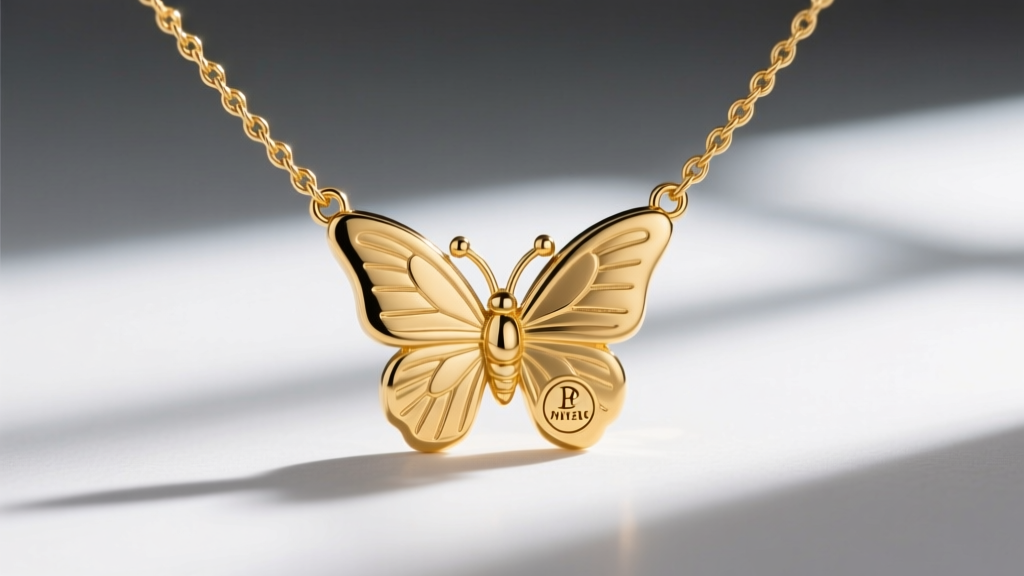
The Federal Trade Commission (FTC) Jewelry Guides strictly regulate how metals can be labeled. 'Gold Plated' generally means a base metal (like brass or copper) is coated with a microscopic layer of gold, often just 0.5 microns thick. This layer will wear away to the base metal within months of friction against the collarbone. Conversely, 'Gold Vermeil' (pronounced ver-may) requires a sterling silver base and a minimum of 2.5 microns of 10k, 14k, or 18k gold. Vermeil offers significantly better value, as the sterling silver base prevents the green skin discoloration associated with brass, and the thicker gold layer can last 2 to 5 years before requiring a professional re-plating (which typically costs $45 to $85).
Chain Gauge and Hardware Mechanics
A common failure point in budget jewelry is the chain and clasp assembly. A heavy gemstone or enamel butterfly pendant requires a chain with adequate tensile strength. Many fast-fashion brands pair heavy pendants with 22-gauge (0.6mm) chains to save on metal costs. A 22-gauge chain will easily snap under two pounds of tension—such as when the pendant catches on a sweater.
For optimal value and security, look for an 18-gauge (1.0mm) or 16-gauge (1.2mm) cable or rolo chain. Furthermore, inspect the clasp. Stamped lobster clasps are hollow, lightweight, and prone to the internal spring failing. Cast lobster clasps, which are solid and slightly heavier, provide a secure closure that will outlast the pendant itself. Always check the jump ring connecting the pendant to the chain; it should be soldered closed or feature a heavy-gauge split ring to prevent the butterfly from sliding off and getting lost.
Value Assessment Matrix: How to Spot a Fair Price
Use the following matrix to evaluate if a pink butterfly necklace is priced fairly based on its material composition and construction quality.
| Material Tier | Estimated Price Range | Expected Lifespan (Daily Wear) | Maintenance & Hidden Costs |
|---|---|---|---|
| Cold Enamel & Brass Plating | $15 - $45 | 6 - 18 Months | Cannot be repaired; high tarnish risk. |
| Vitreous Enamel & Gold Vermeil | $120 - $350 | 3 - 7 Years | Re-plating costs ~$60 every few years. |
| Rose Quartz & Solid 14k Gold | $250 - $600 | Lifetime | Occasional ultrasonic cleaning; prong tightening. |
| Pink Sapphire & Solid 18k Gold | $1,500 - $4,500+ | Generational | Appraisal and insurance premiums; high resale value. |
Final Verdict: Maximizing Your Investment
When budgeting for a pink butterfly necklace, the highest value proposition in 2026 lies in the mid-tier market. Pieces featuring vitreous enamel over heavy gold vermeil, or rose quartz set in solid 10k or 14k gold, offer the best intersection of durability, aesthetic beauty, and financial prudence. Avoid the ultra-cheap epoxy resin pieces if you intend to wear the necklace more than once a week, as the cost-per-wear quickly outweighs the initial savings. By scrutinizing the plating micron thickness, demanding an 18-gauge chain, and verifying the gemstone species, you can confidently acquire a piece that honors the delicate butterfly motif without compromising on structural integrity or long-term value.


