The Expert Guide to Grading a Pink Coral Bead Necklace
Discover the technical grading metrics, species origins, and stringing requirements for authenticating a premium pink coral bead necklace.

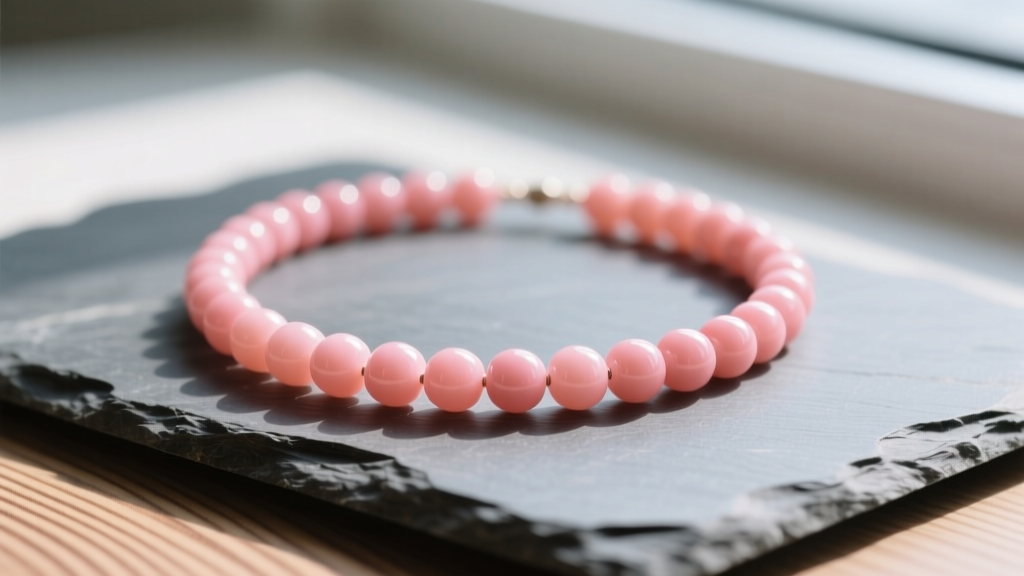
Gemological Profile: Species and Color Origins
Unlike crystalline minerals formed in the earth's crust, a premium pink coral bead necklace is an organic gemstone, requiring a distinctly different analytical framework for grading and valuation. The term 'precious coral' refers specifically to the Corallidae family, which boasts a Mohs hardness of 3.5 to 4.0 and a specific gravity of 2.6 to 2.7. To evaluate a necklace accurately, a gemologist must first identify the biological species, as this dictates the bead's structural integrity, color saturation, and ultimate market value.
Corallium Secundum (Midway Coral)
Harvested at extreme depths of 300 to 400 meters primarily around the Midway Atoll, Corallium secundum is the undisputed king of pink coral bead production. Its primary advantage lies in its uniform color distribution and lack of a white longitudinal core. This allows lapidaries to cut large, perfectly spherical beads (8mm to 14mm) with consistent 'angel skin' or salmon-pink saturation throughout the entire volume of the gem.
Pleurocorallium Elatius (Momo Coral)
Sourced off the coasts of Japan and Taiwan, Momo coral is highly prized but presents structural challenges for bead cutting. It features a distinct white or pale core running through the center of the branch. When cut into beads larger than 6mm, this white core often becomes visible on the surface or near the drill hole, creating a bi-color effect that, while natural, lowers the gemological grade for a matched strand.
Corallium Rubrum (Mediterranean Coral)
Found in shallower waters, Mediterranean coral offers an intense, deep cherry-pink to red saturation. However, the branches are notoriously thin. It is exceptionally rare to find a Mediterranean pink coral bead necklace with stones exceeding 5mm in diameter. Most strands of this species are graduated or feature smaller, uniform rondelle cuts.
The 4Cs of Pink Coral Bead Grading
Evaluating a pink coral bead necklace requires moving beyond standard diamond grading and adapting the metrics to organic structures. The Gemological Institute of America (GIA) emphasizes surface integrity and color uniformity as the primary drivers of value in organic gems. Below is the technical grading matrix used by high-end lapidaries.
| Metric | Premium (AAA) | Commercial (AA) | Sub-Standard (A) |
|---|---|---|---|
| Color Saturation | Uniform salmon/peach, no white core visible | Slight color banding, minor core visibility | Patchy color, heavy white core exposure |
| Sphericity Tolerance | < 0.05mm deviation from perfect sphere | 0.05mm - 0.15mm deviation | > 0.15mm deviation, visible flat spots |
| Surface Pitting | Zero pits or calcareous inclusions under 10x | Minor surface pitting, invisible to naked eye | Visible pitting, requiring polymer fillers |
| Drill Hole Precision | Laser-drilled, 0.8mm-1.0mm, zero blowout | Mechanical drill, minor edge chipping | Wide holes (>1.2mm), severe edge blowout |
Structural Integrity: Drilling and Stringing Mechanics
The structural assembly of a pink coral bead necklace is just as critical as the gems themselves. Calcium carbonate is highly susceptible to acid degradation and friction wear. If coral beads are strung without knots, the bead-on-bead friction will rapidly wear away the mirror-like polish, creating flat spots and generating corrosive dust that accelerates degradation.
Thread Sizing and Knotting
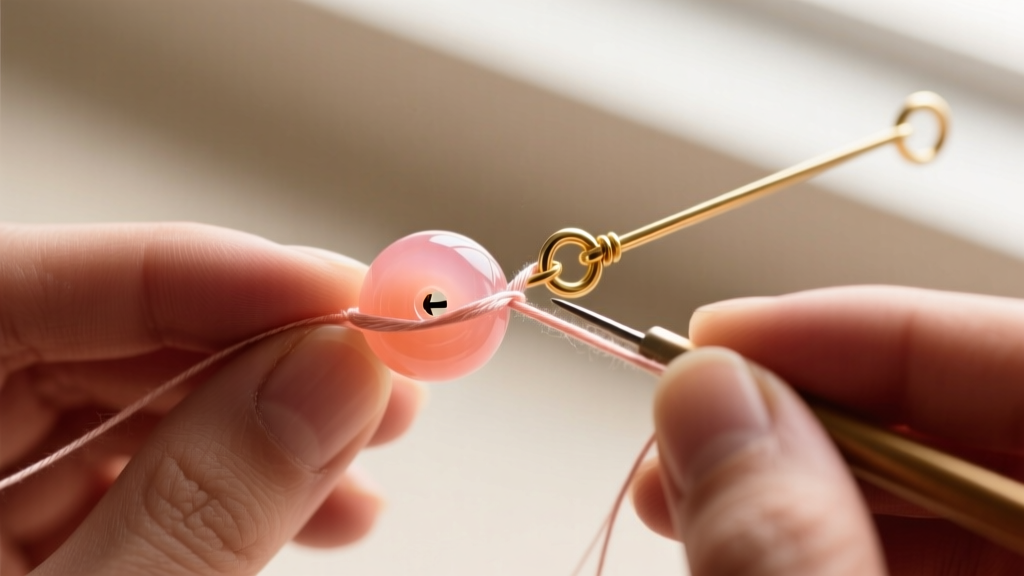
Expert stringers exclusively use 100% natural silk thread (such as Griffin) for precious coral. Synthetic nylons are too abrasive and can cut into the relatively soft drill holes over time. The thread gauge must be precisely matched to the bead diameter:
- 4mm - 5mm Beads: Size #2 silk (0.45mm diameter) with a 0.6mm drill hole.
- 6mm - 8mm Beads: Size #D silk (0.60mm diameter) with a 0.8mm drill hole.
- 9mm - 12mm Beads: Size #F silk (0.90mm diameter) with a 1.0mm to 1.2mm drill hole.
Clasp Guarding (French Wire)
The transition point between the silk thread and the metal clasp is the most common failure point in any beaded necklace. A master jeweler will always employ French wire (also known as gimp or bullion)—a microscopic coiled tube of gold or silver—threaded over the silk at the clasp connection. This prevents the metal jump ring from acting as a saw blade against the organic silk fibers during wear.
Authentication vs. Imitation: Spotting Fakes
As the market value of untreated pink coral has surged, so has the sophistication of imitations. Relying solely on visual color assessment is insufficient. A technical authentication protocol requires 10x to 30x magnification and, in some cases, non-destructive chemical testing.
Dyed Howlite and Magnesite
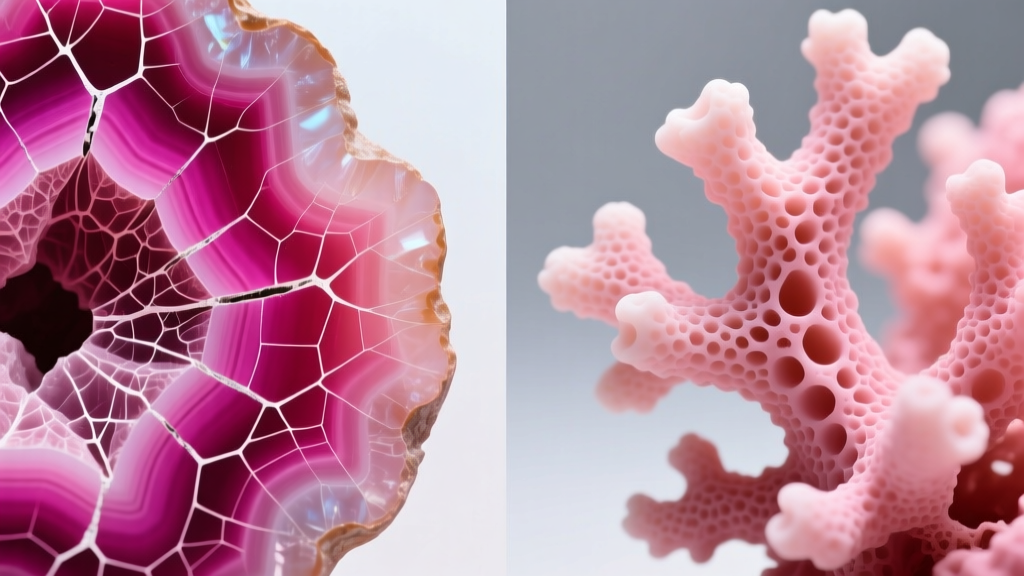
Howlite is a porous, white borate mineral that readily accepts dyes. Under magnification, dyed howlite reveals a distinct 'webbed' pattern where the dye concentrates in the natural fractures of the stone. Genuine pink coral, conversely, will display continuous longitudinal and radial striations—a wood-grain-like structure that is the biological hallmark of its polyp origins.
Glass and Polymer Imitations
Glass beads will exhibit conchoidal fractures near the drill hole and may contain spherical gas bubbles, which never occur in organic coral. Reconstituted coral (calcium carbonate powder mixed with polymer resins) lacks the continuous striation pattern and will often exhibit a granular, speckled texture under a gemological microscope.
"When authenticating a pink coral bead necklace, the acetone swab test is a critical first line of defense. A cotton swab dipped in pure acetone rubbed gently near the drill hole will immediately lift surface dyes from treated howlite or shell, while leaving the stable, natural pigments of genuine Corallium species entirely unaffected."
Market Valuation and Sourcing Ethics
The acquisition of a pink coral bead necklace is inextricably linked to marine conservation. Precious corals are slow-growing, deep-sea organisms that may take decades to add a single millimeter of girth to their calcium carbonate skeletons. Due to historical overharvesting, the international trade of precious coral is strictly monitored.
According to NOAA Fisheries Coral Conservation guidelines and CITES regulations, several Corallium species are listed in Appendix III, requiring strict export permits and certificates of origin. When purchasing a high-value pink coral bead necklace, buyers must demand verifiable documentation proving the material was harvested legally and sustainably prior to trade restrictions, or sourced from heavily regulated, sustainable quotas. Ethical provenance is no longer just a moral preference; it is a fundamental component of the necklace's gemological appraisal and resale valuation.


