RE 8 Necklace with 2 Holes: Engineering & Sizing Guide
Explore the engineering, metallurgy, and failure prevention of the RE 8 necklace with 2 holes. Expert technical specs and tension data inside.


In the realm of heavy luxury chains and high-tensile modular jewelry, standard clasp mechanisms are often the weakest point of failure. As chain weights exceed 50 grams, the sheer kinetic force exerted on a single jump ring or spring clasp can lead to catastrophic deformation. Enter the RE 8 (Reinforced Figure-8) dual-hole system. For collectors and jewelers evaluating high-security options, the re 8 necklace with 2 holes represents a pinnacle of mechanical jewelry design, combining redundant safety loops with advanced load distribution. This expert deep dive explores the metallurgy, physics, and precise technical specifications that make this dual-anchor system the industry standard for heavy chains in 2026.
The Mechanics of the RE 8 Dual-Hole System
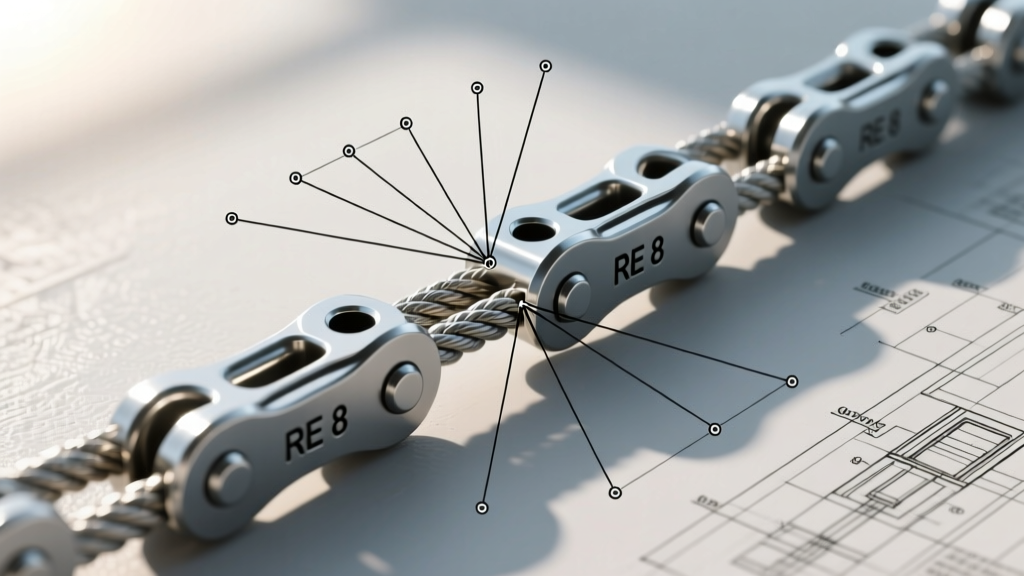
The 'RE 8' designation refers to a Reinforced Figure-8 safety and connector architecture. Unlike standard single-loop safety chains that merely drape over a primary clasp, the RE 8 system utilizes a dual-hole (2 holes) anchor plate. This plate is permanently integrated into the terminal links of the chain or the bail of a heavy pendant. The figure-8 wire threads through both holes, creating two distinct, parallel load-bearing pathways.
If the primary locking mechanism (such as a heavy-duty lobster clasp or box clasp) experiences a spring failure or accidental depression, the RE 8 figure-8 wire catches on the dual-hole plate. Because the wire passes through two separate apertures, the kinetic energy of a dropping chain is instantly distributed across two anchor points rather than one, effectively halving the shear stress applied to the safety wire itself.
Metallurgical Requirements and Vickers Hardness
The structural integrity of an RE 8 necklace with 2 holes relies heavily on the specific alloy composition and work-hardening of the precious metals used. According to metallurgical data from the Gemological Institute of America (GIA), the Vickers hardness (HV) of the alloy dictates its resistance to the slow, abrasive wearing down of the dual-hole apertures.
- 14k Yellow Gold (58.5% Au): Typically exhibits a Vickers hardness of 120-140 HV in its annealed state, which can be work-hardened to approximately 180 HV. The higher copper and zinc content provides superior tensile strength, making it the ideal choice for the RE 8 dual-hole anchor plates and the figure-8 safety wire.
- 18k Yellow Gold (75% Au): Softer and more malleable, with an annealed hardness of roughly 90-110 HV. When crafting an 18k RE 8 system, jewelers must increase the wire gauge by at least 20% to compensate for the lower yield strength and prevent the dual-hole loops from stretching under sudden dynamic loads.
- Platinum (95% Pt): With a hardness of 110-130 HV but exceptional density and tensile strength, platinum RE 8 systems are virtually impervious to shear snapping, though they require specialized laser welding due to the metal's high melting point (1,768°C).
Load Distribution: Single vs. Dual-Hole Connectors
To understand why the 2-hole configuration is critical, we must examine the physics of a sudden chain drop. If a 100-gram gold Cuban link chain is subjected to a sudden jerk (a dynamic load factor of 5G), the terminal link experiences approximately 5 Newtons (roughly 500 grams) of peak shear force.

Shear Stress Calculations
In a traditional single-hole safety chain, a 1.2mm wire must absorb the entire 500g shear load. This approaches the yield strength of softer 18k gold alloys, leading to micro-fractures over time. In the RE 8 necklace with 2 holes, the 500g load is divided between the two anchor holes. Each hole absorbs only 250g of shear force. This keeps the stress well below the elastic limit of the metal, ensuring that the safety mechanism remains permanently deform-free, even after years of dynamic loading.
'The transition from torch soldering to pulse-arc and laser welding has revolutionized dual-hole safety mechanisms. We can now fuse the RE 8 anchor plates directly to the terminal links without annealing the surrounding work-hardened chain links, preserving the tensile strength of the entire assembly.' — Master Jeweler & CAD Specialist, 2026 Bench Manual.
Common Failure Modes in Heavy Chains
Even with advanced dual-hole systems, improper sizing or maintenance can lead to failure. The Jewelers of America notes that most heavy chain losses are not due to the chain snapping, but rather terminal component failure. Watch for these specific failure modes:
- Aperture Elongation: The two holes in the RE 8 plate slowly stretch into ovals due to chronic friction against the figure-8 wire. This is common in under-gauged 18k gold pieces.
- Work-Hardening Fatigue: If the figure-8 safety wire is repeatedly bent open and closed without proper annealing by a jeweler, it will become brittle and snap at the fulcrum point.
- Solder Joint Degradation: Traditional lead or low-temperature solders used on the dual-hole anchor plates can fracture under thermal expansion and contraction cycles.
Technical Specifications and Sizing Chart
When commissioning or retrofitting an RE 8 necklace with 2 holes, matching the wire gauge to the chain weight is non-negotiable. The following chart outlines the minimum required specifications for 14k gold systems based on static chain weight.
| Chain Weight (Static) | RE 8 Wire Gauge (Min) | Dual-Hole Plate Thickness | Recommended Clasp Type |
|---|---|---|---|
| 20g - 40g | 14-Gauge (1.6mm) | 1.2mm | Standard Lobster (15mm) |
| 41g - 75g | 12-Gauge (2.0mm) | 1.8mm | Heavy Lobster (20mm) |
| 76g - 120g | 10-Gauge (2.5mm) | 2.5mm | Box Clasp with Dual Safety |
| 121g - 200g+ | 8-Gauge (3.2mm) | 3.5mm+ | Tongue & Groove / Magnetic |
Professional Maintenance and Laser Welding Protocols
Maintaining an RE 8 dual-hole system requires specialized bench techniques. Standard ultrasonic cleaning is generally safe, but high-frequency steam cleaning can sometimes force microscopic debris into the tight tolerances of the dual-hole apertures, causing the figure-8 wire to bind.
Retrofitting and Repair
If an RE 8 anchor plate becomes damaged, it must be replaced using laser welding. Traditional torch soldering requires heating the surrounding links to over 700°C (for hard solder), which will anneal (soften) the work-hardened Cuban or rope links adjacent to the clasp. This localized softening creates a new weak point in the chain. Pulse-arc and laser welding, however, operate with a highly focused thermal footprint. A jeweler can fuse a new 14k dual-hole plate to the terminal link in milliseconds, keeping the ambient temperature of the surrounding chain below 100°C, thereby preserving the structural integrity and Vickers hardness of the entire piece.
Ultimately, investing in a properly gauged RE 8 necklace with 2 holes is an exercise in applied physics and materials science. By understanding the load distribution, alloy hardness, and precise sizing requirements, collectors can ensure their heavy luxury chains remain secure, structurally sound, and mechanically flawless for generations.


