Troubleshooting Your Necklace with Four Leaf Clover Pendants
Is your necklace with four leaf clover pendants damaged? Learn expert troubleshooting for enamel chips, loose inlays, and chain tangling.

The Unique Vulnerabilities of Clover Geometry
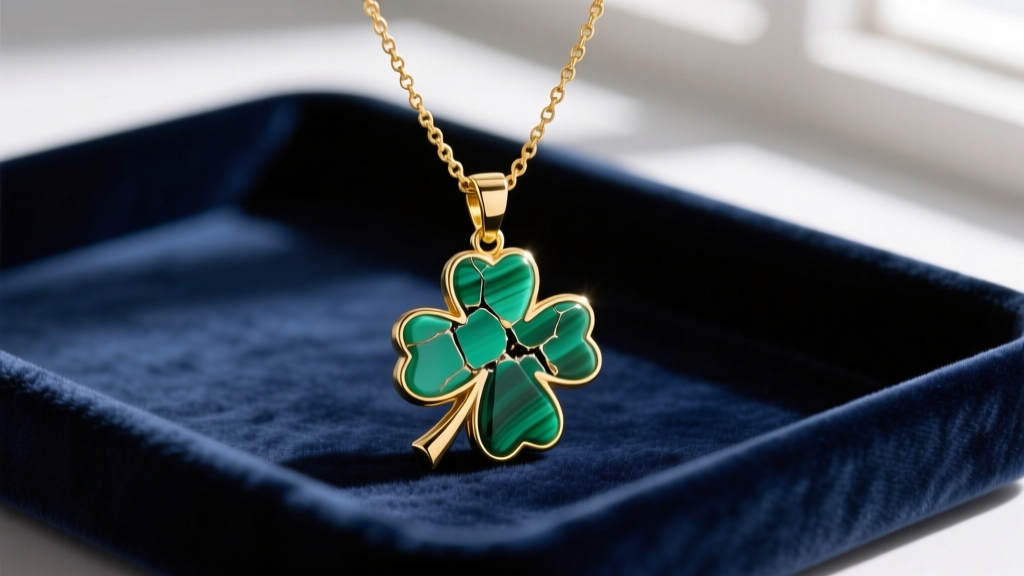
The necklace with four leaf clover motifs has remained a staple in jewelry boxes for decades, popularized by iconic luxury houses and vintage estate pieces alike. Symbolizing luck and prosperity, the quatrefoil design is visually striking but structurally complex. Unlike simple geometric pendants (such as circles or teardrops), a four-leaf clover features four protruding lobes and a wide, continuous bezel edge. This specific geometry creates distinct mechanical vulnerabilities. The protruding edges are highly susceptible to impact damage against hard surfaces, while the wide surface area of the inlay materials—often mother-of-pearl, malachite, onyx, or guilloché enamel—makes them prone to thermal shock, delamination, and chemical etching.
In 2026, as vintage clover pendants age and modern gold-vermeil replicas see heavy daily wear, jewelry repair benches are seeing a surge in specific failure modes related to these pieces. Whether you are dealing with a chipped malachite lobe, a tangled chain sawing through a delicate bail, or lifting enamel, troubleshooting a clover pendant requires an understanding of both lapidary science and chain mechanics. Below, we break down the most common issues and provide actionable, expert-level solutions to restore your lucky charm.
Troubleshooting Inlay Damage: Malachite, MOP, and Enamel
The most frequent point of failure on any necklace with four leaf clover pendants is the inlay material. Because the clover shape requires precise, symmetrical cutting, the stones or enamel used are often pushed to their structural limits. To troubleshoot effectively, you must first identify the material and its position on the Mohs hardness scale, as this dictates the repair protocol.
Material Hardness and Failure Modes
| Inlay Material | Mohs Hardness | Common Failure Mode | DIY vs. Professional Fix |
|---|---|---|---|
| Malachite | 3.5 - 4.0 | Edge chipping, acid etching from sweat | Professional lapidary polish or custom recut |
| Mother-of-Pearl (MOP) | 2.5 - 4.5 | Delamination, cracking from thermal shock | Professional replacement (DIY glue fails) |
| Black Onyx | 7.0 | Bezel separation, rare surface scratching | Professional bezel tightening |
| Cold Enamel (Resin) | N/A (Polymer) | Yellowing, deep gouges, edge lifting | DIY UV resin fill or professional repour |
Fixing Chipped Malachite and Onyx
Malachite is notoriously soft and porous. If your clover pendant features malachite and has suffered an edge chip on one of the four lobes, do not attempt to fill it with standard superglue (cyanoacrylate). Superglue will wick into the porous stone, leaving a permanent, cloudy white stain. According to the Gemological Institute of America (GIA), malachite is highly sensitive to heat and acids. A professional lapidary must carefully sand and re-polish the entire bezel edge to maintain the symmetrical quatrefoil shape. Expect to pay between $80 and $150 for a custom lapidary recut and bezel re-seating.
Addressing Mother-of-Pearl Delamination
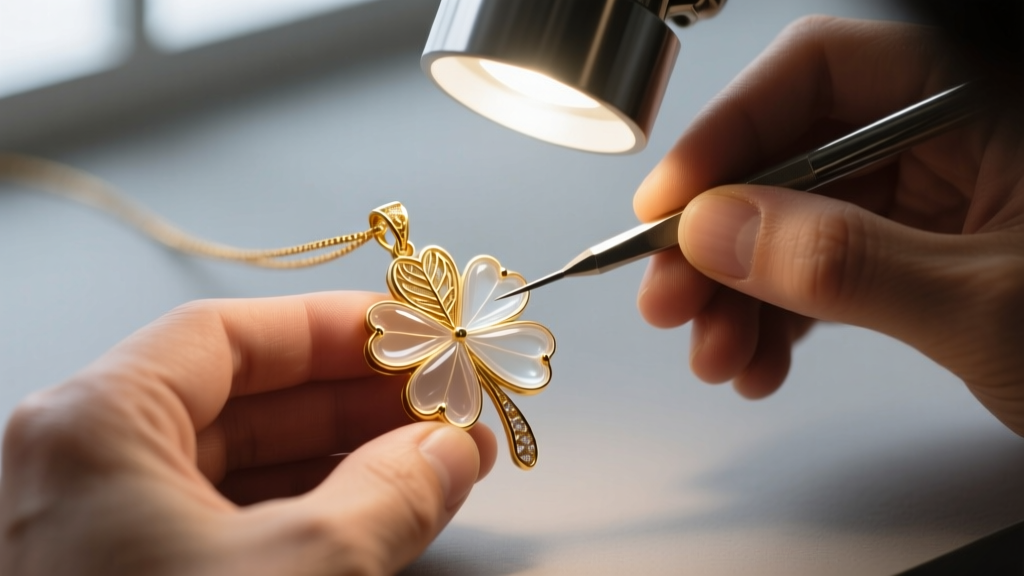
Mother-of-pearl is an organic material composed of nacre layers. When exposed to ultrasonic cleaners or harsh chemicals, these layers can separate (delaminate), creating a cloudy, cracked appearance. If the MOP inlay has lifted from the gold bezel, you can temporarily secure it using a micro-drop of G-S Hypo Cement. However, for a permanent fix, the stone must be removed, the bezel cleaned of old adhesive with acetone, and re-seated using a two-part jeweler's epoxy. For high-end pieces, always refer to specialized care guidelines, such as those outlined by Van Cleef & Arpels, which strongly advise against ultrasonic cleaning for organic inlays.
Fixing Bail Friction and Chain Tangling
The bail—the loop that connects the pendant to the chain—is a critical stress point. On many clover pendants, the bail is integrated into the top lobe or attached via a small, unsoldered jump ring. A pervasive issue with the necklace with four leaf clover designs is "pendant slide friction." Because the clover is relatively heavy and wide, it tends to slide back and forth across the collarbone, causing the chain to saw through the inside of the bail.
Upgrading the Chain Gauge
If you notice a deep groove forming inside the pendant's bail, your chain is likely too thin. Chains under 0.8mm (such as delicate cable or thin rope chains) act like a wire saw against soft gold or gold plating. To troubleshoot this:
- Upgrade to a Box or Wheat Chain: Switch to a 1.0mm to 1.2mm box chain. The flat, interlocking links distribute friction more evenly and resist kinking.
- Add a Protective Jump Ring: If the bail is already deeply grooved, a jeweler can insert a hardened steel or platinum jump ring inside the gold bail. This sacrificial ring takes the friction, saving the pendant from snapping.
- Soldered vs. Unsoldered: Ensure the jump ring connecting the pendant to the chain is laser-soldered shut. An unsoldered ring will eventually pull apart under the pendulum-like weight of the four-leaf clover.
Addressing Gold Plating and Vermeil Wear
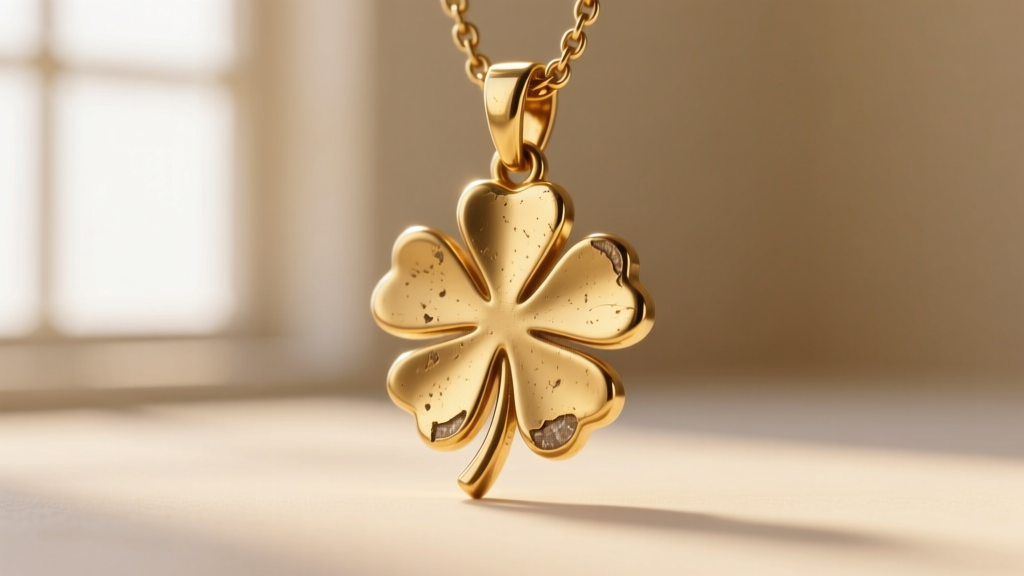
Many accessible clover necklaces on the market are crafted from gold vermeil (thick gold plating over sterling silver) or standard gold-plated brass. The four outer edges of the clover are high-contact zones that rub against clothing and skin, leading to rapid plating loss. When the brass or silver base metal is exposed, it can oxidize, turning the surrounding skin green or black.
The Replating Process
You cannot simply "buff out" worn plating; the metal must be chemically or electrolytically replaced. If you take a vermeil clover pendant to a jeweler for replating, they must first mask the inlay. Malachite and MOP are highly sensitive to the cyanide-based solutions used in gold electroplating. A skilled jeweler will paint the stones with a peelable masking lacquer, polish the exposed metal to remove scratches, and apply a fresh 2.5-micron layer of 18k gold. This service typically costs between $60 and $120 in 2026, depending on the complexity of the masking required.
When to Seek Professional Jewelry Repair
While minor maintenance can be done at home, certain structural failures require a professional bench jeweler. Attempting DIY fixes on these specific issues often results in irreversible damage to the pendant's symmetry or the destruction of the inlay.
Professional Repair Cost Guide (2026 Estimates)
- Laser Welding a Cracked Bail ($75 - $120): Traditional torch soldering will shatter malachite or MOP due to thermal shock. Laser welding concentrates heat in a microscopic area, allowing the jeweler to fuse a broken gold bail without heating the adjacent stone.
- Cold Enamel Restoration ($90 - $150): If your vintage clover features guilloché enamel (translucent enamel over engraved metal) that has chipped, a specialist must color-match UV-cured optical resins and cure them under specific wavelengths to mimic the original depth and refraction.
- Bezel Re-burnishing ($45 - $80): If an onyx or MOP stone is rattling inside its setting, the jeweler will use a burnishing tool to carefully push the gold bezel back over the edge of the stone. This requires a steady hand, as slipping can scratch the soft inlay.
Expert Troubleshooting Tip: Never use commercial silver dips or ammonia-based jewelry cleaners on any necklace with four leaf clover pendants featuring organic stones. Ammonia will instantly strip the iridescent nacre layer off mother-of-pearl and cause malachite to turn a dull, lifeless brown. Stick to a damp, lint-free microfiber cloth for routine cleaning.
Final Thoughts on Clover Pendant Longevity
A necklace with four leaf clover motifs is an investment in both craftsmanship and sentiment. By understanding the specific material vulnerabilities of your inlay, upgrading your chain gauge to prevent bail friction, and avoiding ultrasonic cleaners, you can preserve the structural integrity of the piece for decades. When in doubt, consult a certified bench jeweler who understands the thermal and chemical sensitivities of lapidary inlays, ensuring your lucky charm remains intact for years to come.


